



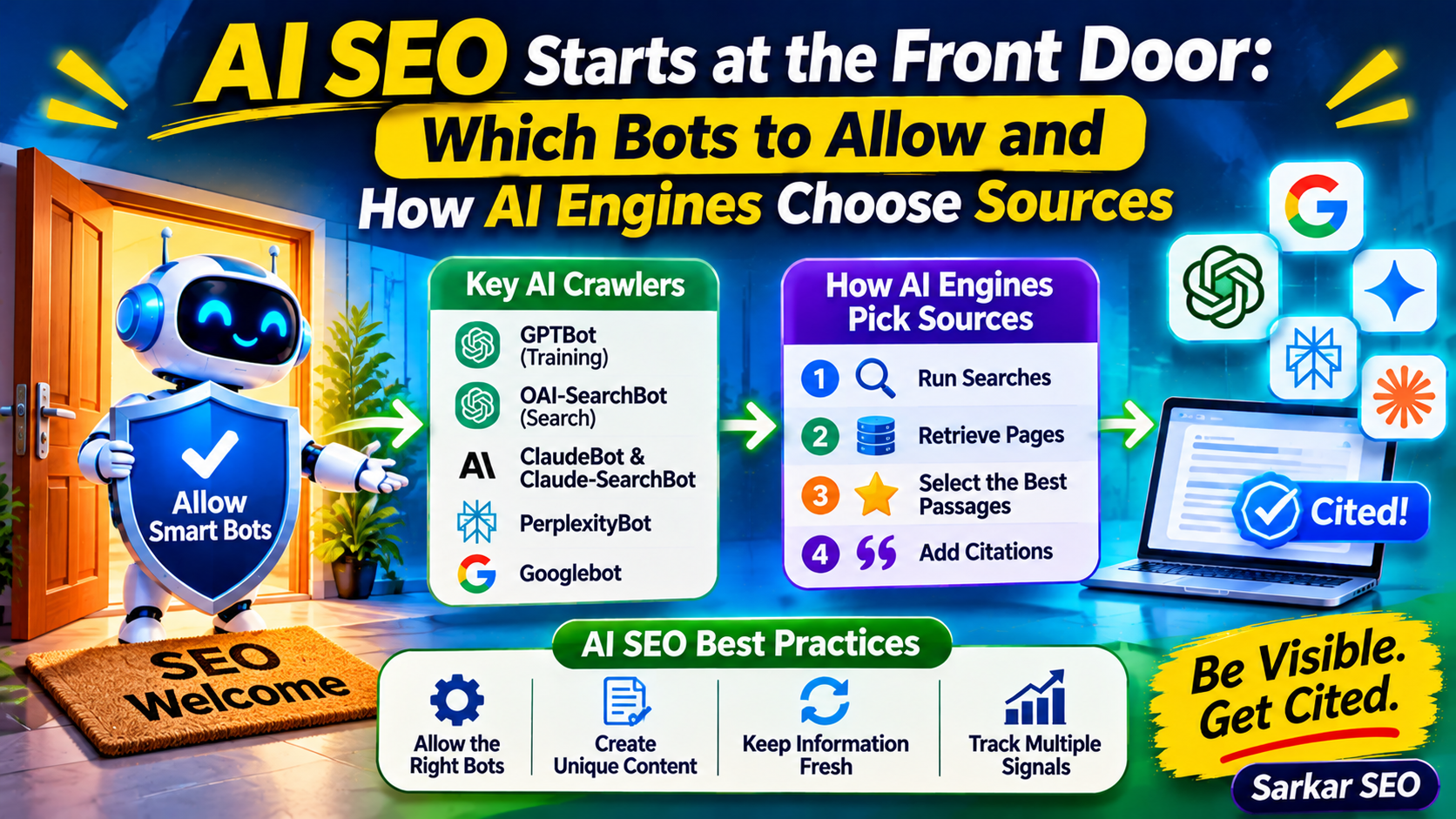
Most AI SEO advice begins with content. This guide begins one step earlier, with a question many sites never ask: can the right AI systems reach your pages at all? It then explains how those systems choose the few sources they name in an answer. If your visibility has stalled despite good writing, the cause may be a robots.txt file or firewall rule nobody has reviewed in years.
“AI Crawler” Is Several Different Jobs
Treating every bot the same leads to bad decisions. One guide sorts them into four jobs: training, search, agent fetches and archiving, each with its own user agent.
The big providers now split these jobs. OpenAI uses GPTBot for training and OAI-SearchBot for ChatGPT search. Blocking GPTBot does not hide your site from ChatGPT search, while blocking OAI-SearchBot does remove you from search answers. Anthropic follows the same pattern, and documents ClaudeBot and Claude-SearchBot as separate controls. Perplexity’s indexing crawler, PerplexityBot, respects robots.txt and, per Perplexity’s own guide, is not used for training. ai crawlers robots txt claudebot gptbot perplexitybot +3
User-triggered fetchers are the awkward case. OpenAI’s documentation no longer reliably ties ChatGPT-User to robots.txt, so disallowing it doesn’t guarantee it stays out. One analysis concludes that robots.txt is the wrong tool for ChatGPT-User and Perplexity-User.
The sensible reading: allow the bots that feed answers, and treat training bots as a business decision. Letting a model learn from your content is a question of principle and licensing, not ranking.
Google Is the Exception
Google works differently, and misunderstanding it is costly. Google has no retrieval crawler for AI Overviews or AI Mode; those features are grounded in the ordinary Search index fetched by Googlebot. The Google-Extended token doesn’t affect inclusion in Search, so blocking it won’t remove you from AI Overviews. Blocking Googlebot, meanwhile, removes you from Google entirely. ai crawler directives and llms txt +2
If you want to limit how your content appears, Google’s levers are nosnippet, data-nosnippet, max-snippet and noindex. There is no separate AI switch.
The Hidden Blocker: Your Firewall
A permissive robots.txt means little if the request never reaches it. Sites that explicitly allow GPTBot still get it blocked at the firewall, because default WAF rules on Cloudflare, Akamai, and AWS often rate-limit unfamiliar bot traffic before robots.txt is consulted. Another source notes that many sites inherit default rules that block AI crawlers without the team realizing.
Verify this with evidence rather than assumption. Check your server logs for the bots you want, then confirm your security layer lets them through. Allow time for changes too: one source says rule changes can take about 24 hours to apply for OAI-SearchBot.
At Sarkar SEO, we treat bot access as step one of any AI visibility review, because no rewrite can help a page the crawler never sees.
How AI Engines Choose What to Cite
Once access works, selection begins. The common pattern has four steps: turn the question into searches, retrieve candidate pages, select the passages that answer it most directly, and attach citations to the sentences they support. Notably, citation is the last step of a search process, not a judgement about which brand is best.
Retrieval alone doesn’t earn a mention. In one AirOps study, 15,000 prompts led ChatGPT to retrieve 548,534 pages, and only 15% were cited in the final response. Your page can be found and still lose the selection round to one with a cleaner, more specific passage.
Displayed citations also show only part of the picture. Academic audits caution that pages apparently visited differ from pages ultimately cited, so a citation list is not a full retrieval trace.
Each Engine Draws From a Different Pool
Don’t assume one strategy covers everything. A 2026 citation index reported that only 11% of domains were cited by both ChatGPT and Perplexity. An academic audit likewise found low source-set overlap across Google Search, AI Overviews, and Gemini. The engines even behave differently: Perplexity cites more sources per query but uses each shallowly, while ChatGPT cites fewer but absorbs them more deeply. ChatGPT Search vs Google AI Overviews vs Perplexity: the 2026 Guide +2
Be careful with platform-share statistics, because they conflict. One July 2026 tracker put Reddit at 16.7% of ChatGPT citation share, yet another report described Reddit’s share of ChatGPT citations falling from 3.8% to 0.5% in weeks after ChatGPT changed how it fans out queries. Methods differ and the engines change constantly, so treat any percentage as a dated snapshot, not a rule.
One vendor preprint found that about 78% of citations went to corporate websites, including a brand’s own pages and pages from other companies in the same space. It is a single, vendor-authored source, but it supports a useful idea: build presence both on your site and wherever your category is discussed credibly.
A Practical Access Policy
Use this as a starting template, then adjust for your business:
- Allow: Googlebot, plus Bingbot, since Microsoft Copilot builds on Bingbot’s index.
- Allow for answers: OAI-SearchBot, Claude-SearchBot, and PerplexityBot.
- Decide deliberately: GPTBot, ClaudeBot, and Google-Extended.
- Protect: cart, checkout, account, and API paths for all bots.
Remember that robots.txt is a request, not a lock. If a page must not be opened, use site-level access control rather than relying only on a robots.txt rule. Review the policy quarterly, since crawler names and scopes keep changing.
