



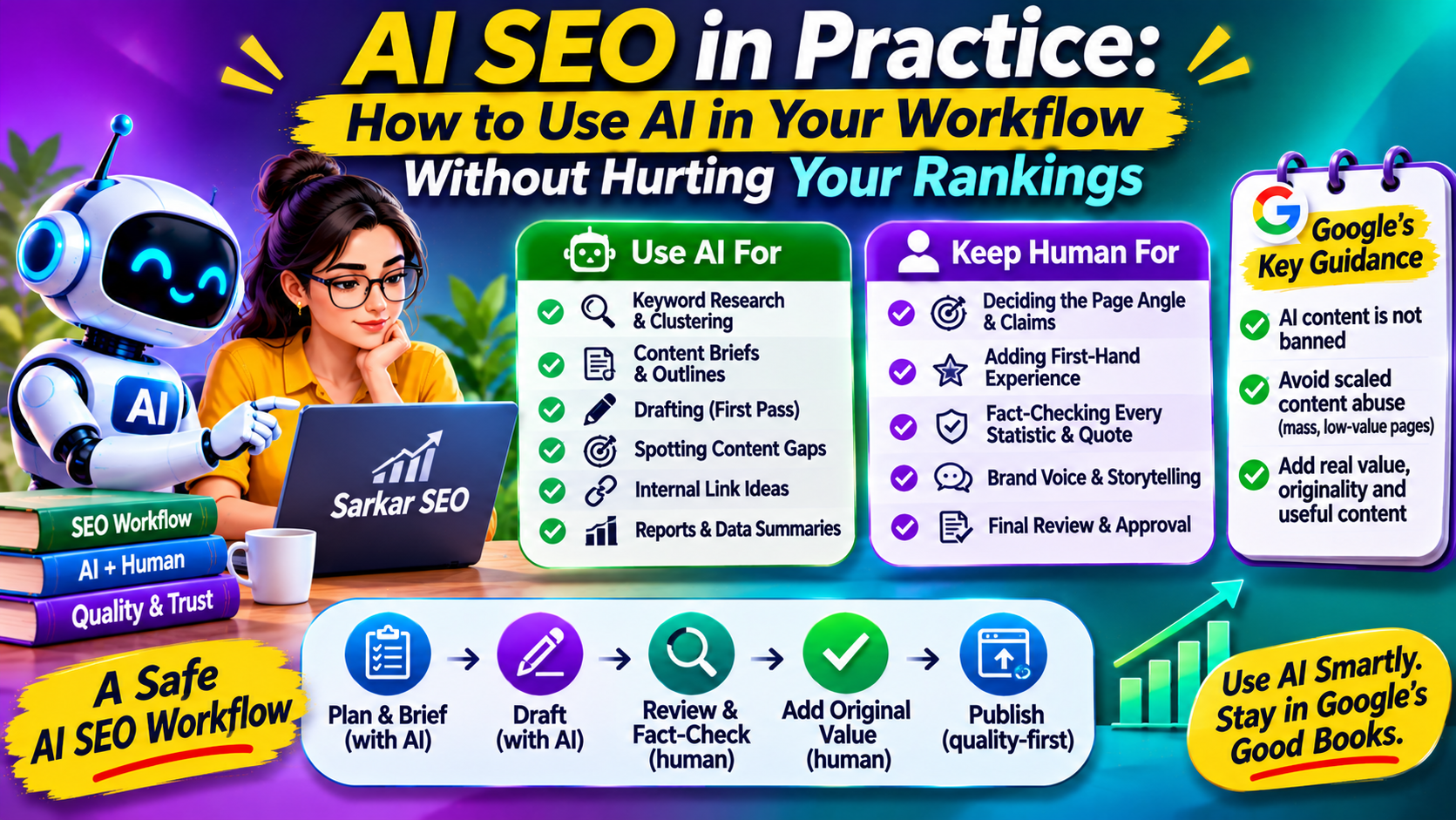
“AI SEO” carries two meanings. One is optimizing so AI answer engines can find and cite you. The other is using AI tools to do the SEO work itself: research, briefs, drafts, audits. This article covers the second, because it is where many teams quietly take their biggest risks. The question isn’t whether to use AI SEO. It’s where to stop.
How Teams Already Use It
AI is routine in SEO work now. In a Keyword.com survey of about 97 respondents, 87% reported using AI regularly or more extensively, and only one reported fully automated work. The most common uses were content briefs and outlines (77%), keyword research and clustering (68%), drafting (66%), and reporting (60%). The sample is small, so treat it as a signal rather than a census.
The same survey found that most usage still depends on one person supplying the prompt, context, and checks each time, and only 26% had documented workflows. That gap, between using AI and governing it, is where quality problems start.
What Google Actually Penalizes
Google doesn’t ban AI-generated content. The relevant policy is scaled content abuse: producing many pages primarily to manipulate rankings rather than help users. It applies whether the pages come from AI, human writers, scraping, or a mix. Google’s spam documentation specifically warns that using generative AI to create many pages without adding value may violate it.
Three developments make this more pressing:
- Google’s spam policies now explicitly cover AI Overviews and AI Mode as well as classic results.
- The September 2026 spam update began on September 24 and lists scaled content abuse among the policies in scope.
- Google’s May 2026 optimization guide reportedly says that building pages for every query variation primarily to manipulate rankings or AI answers violates the policy. I saw this through a secondary summary, so check Google’s own text before relying on the exact wording.
Quality raters matter too. Reporting on Google’s rater guidelines says pages with AI content showing little effort, originality, or added value can receive the lowest rating.
Not every automation is a problem. Google’s guidance has long treated things like transcripts as appropriate uses of automation, and AI translation reviewed by someone who knows the target language is another accepted pattern.
What the Ranking Studies Show
The research is mixed, and honest reading matters here.
An Ahrefs study of about one million top-10 pages (June 2026) found that 5.3% of top-three pages were 100% AI-generated, while pages with under 50% AI content made up 82.2% of top-three rankings. A Semrush study of 42,000 blog posts found human-written pages held position one 80% of the time versus 9% for purely AI pages, though AI content appeared more often lower on page one.
Both studies rely on AI detectors and are observational, so they cannot prove the production method caused the ranking. There is also no public evidence that Google runs an AI detector as a ranking factor, and public detectors can flag human writing by mistake.
The takeaway is practical rather than ideological: AI-assisted pages can rank, fully AI pages can occasionally reach the top, but heavily AI pages are a minority at the very top. Ahrefs also reported that low- and moderate-AI pages earned two to three times the organic impressions of heavily AI pages. Raw, unedited output is the risk, not the tool.
A Workable Split: What AI Does and What Humans Own
One practitioner playbook summarizes it well: let AI save hours, but keep humans on positioning, voice, fact-checking, and credibility. A split that follows this logic:
Good fits for AI: clustering keywords, drafting brief structures, spotting content gaps, suggesting internal links, summarizing crawl data, and preparing reports.
Keep with people: deciding what a page should claim, supplying firsthand experience, verifying every statistic and quote, setting the brand voice, and approving what gets published.
At Sarkar SEO, we recommend that no AI-assisted page goes live until a named person has checked its facts and confirmed it says something the top results don’t already say.
The Fan-Out Trap
AI systems break a question into sub-questions, which tempts teams to publish one thin page per variation. Resist that. A large guide isn’t a violation simply because it’s large; the problem is volume created to manipulate rankings. Safer habits include one clear question per article, sourced facts, independent review, and growing content in planned waves, and fewer, stronger pages usually beat dozens of near-duplicates.
A Pre-Publish Checklist
Before anything AI-assisted goes live, ask:
- Is there original value? Does the page include experience, data, or analysis a competitor lacks?
- Are the facts verified? Check each claim against a primary or reputable source. Google’s guidance calls for manual review of AI-generated content for accuracy, and that includes metadata and structured data, not just body copy.
- Is the purpose clear? Would the page exist if search engines didn’t?
- Does a person stand behind it? Name an author or reviewer who can be held accountable.
- Is it distinct? If ten pages differ only by a swapped keyword, merge them.
Build a Workflow, Not a Habit
Because many teams rely on one person’s prompts, make the process repeatable. Document which tasks AI handles, who reviews each output, and what gets rejected. Keep a log of corrections so recurring errors, such as invented statistics or outdated claims, become visible and get fixed in the process. Sarkar SEO treats this documentation as part of the deliverable, since a process others can audit is easier to trust than a clever prompt.
