



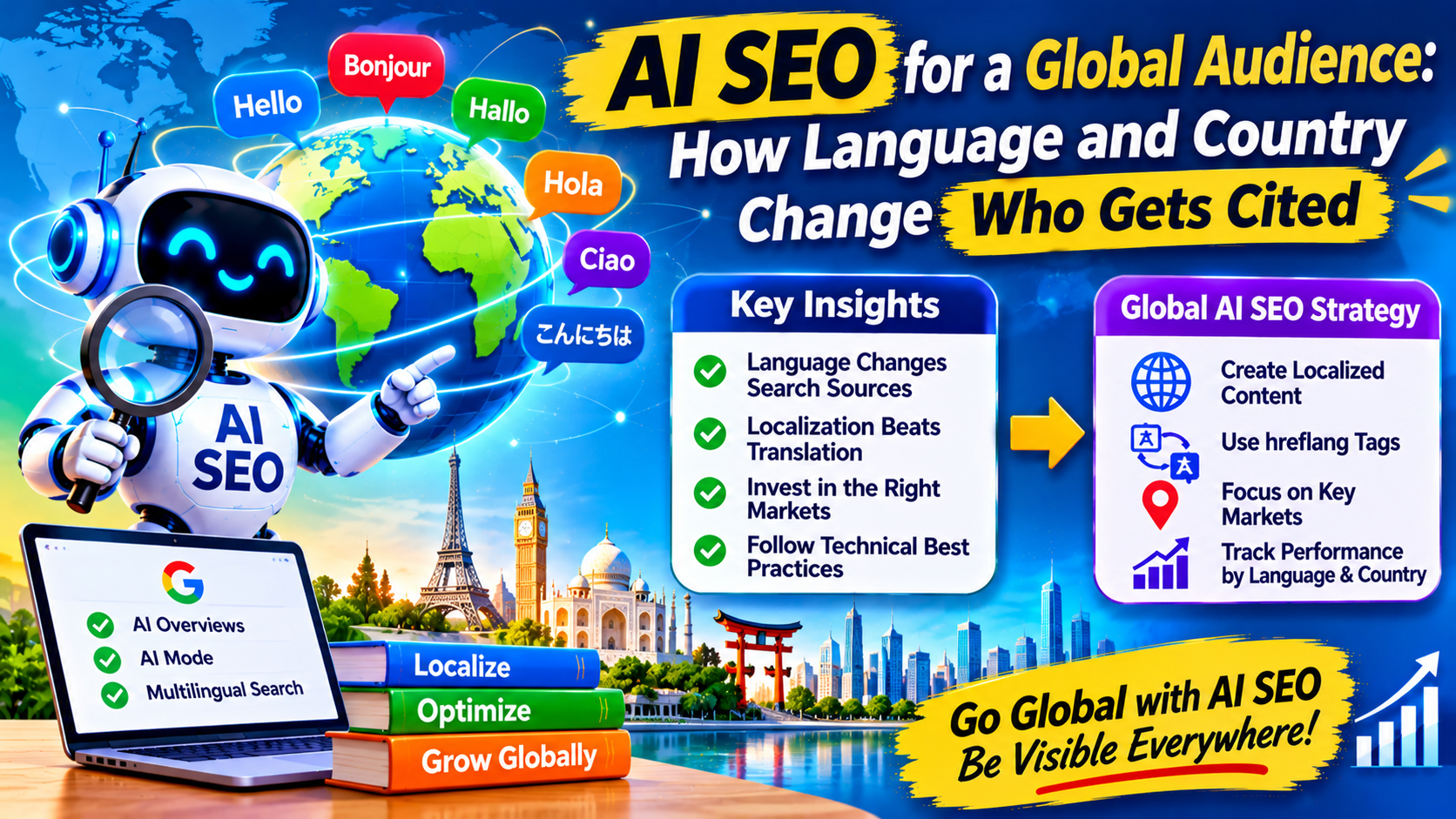
Most AI SEO advice quietly assumes an English-speaking searcher in the United States. If your audience spans several countries, that assumption can cost you visibility. AI answers vary by language, the sources they cite shift, and a page that wins in one market may be invisible in another. This guide covers what changes when you optimize for the whole world.
The Rollout Is Global, but the Experience Isn’t Uniform
Google’s AI features have spread widely. AI Overviews expanded to more than 100 countries in late 2024, and AI Mode reached over 200 countries and territories in October 2025, adding more than 35 languages. Earlier in 2025, AI Mode had been limited to English in many markets, and non-English support arrived in stages, starting with Hindi, Indonesian, Japanese, Korean, and Brazilian Portuguese.
Availability keeps changing, so check Google’s own availability pages before building a market plan. The lesson is that “AI search” is not one product with one set of results. The experience depends on the user’s language and location.
Language Changes the Sources
The strongest evidence comes from large citation studies, with the caveat that they come from vendors and researchers using particular prompts.
Profound analyzed 3.25 billion citations across seven AI models and 14 countries. It found that when the same prompt was asked in English and in Spanish, the overlap of cited websites was low: roughly 0.15 to 0.17 on Gemini and 0.33 to 0.35 on ChatGPT, on a scale where 1.0 means identical. Another analysis of the same data concluded that language drives more divergence than geography, since English versus Spanish gaps were bigger than US versus Spain gaps in the same language.
Platform habits shift too. ChatGPT’s social citation rate dropped from about 10% to 3 to 5% in every non-English market Profound studied, and the explanation offered was that ChatGPT’s social citations are dominated by Reddit, an English-first platform. Spanish prompts surfaced social content about 1.4 times as often as English in Google AI Overviews but about half as often in ChatGPT.
The practical point: your English visibility report says little about your German, Arabic, or Portuguese visibility.
Thin Local-Language Content Is a Gap You Can Fill
One academic audit of AI answers to mental health questions in seven languages found that non-English queries surfaced fewer sources, a mean of 9.2 versus 12.3 for English. The drop wasn’t uniform. ChatGPT averaged 17.5 sources in English but 4.3 in Twi, while Perplexity stayed within a narrow range across all seven languages. This was one topic area, so don’t generalize the exact figures. Still, it shows that some engines struggle in some languages.
A separate study of AI chatbots answering news questions found English-language sources dominating even for non-English queries. For Russian queries, two English-language sources together outweighed the most prominent Russian outlet. When a language has little strong local content, engines may fall back on English sources.
For a business, that reads as an opening: if few good pages answer a question in a given language, a well-made local page has less competition for the citation.
Translation Is Not Localization
Many teams translate their site, add hreflang tags, and wait. That approach is necessary but incomplete.
Hreflang tells Google which pages are alternate versions of each other; it does not label a page’s language, and it doesn’t consolidate ranking signals across versions. Google also treats localized versions as duplicates only if the main content remains untranslated. Search Engine Land’s analysis, as summarized by one source, argues that hreflang and canonical signals do not ensure your content matches local user expectations or search behavior.
Localization means adapting examples, terminology, currency, regulations, and the questions people actually ask in that market. A word-for-word translation can read as low effort, and Google’s guidance expects translated pages to be useful and distinct.
Notably, there is no published guidance from Google on how AI Overviews or AI Mode choose between language versions of a page. The sensible fallback is Google’s standard international guidance, plus the basic requirement that a page be indexed and eligible to appear in Search with a snippet to be a supporting link.
Sarkar SEO’s view is that a smaller set of properly localized pages beats a large set of machine-translated copies.
Where to Invest First
You can’t localize everything at once, and you shouldn’t. Prioritize like this:
- Choose markets with evidence. Look at where you already receive impressions, leads, or customer inquiries.
- Translate pages that matter to that market, not the whole site by default.
- Start with commercial pages such as services, pricing, and comparison content, then add supporting guides.
- Have a native speaker edit every AI-assisted translation for meaning, tone, and local terminology.
- Rewrite examples for the market rather than swapping words.
Technical Basics for Multilingual Pages
- Give every language its own crawlable URL. Subdirectories on one domain are a common balance of simplicity, consolidation, and cost.
- Avoid ?lang= parameters and browser-only translation widgets, because crawlers may not treat them as independent pages.
- Keep hreflang annotations consistent across all alternates, with canonical tags that don’t contradict them.
- Use localized URL slugs, titles, and meta descriptions.
- Ensure each language version is indexed. A version that Search handles poorly starts at a disadvantage in AI features too.
Sarkar SEO often sees international projects stall at this stage, when a translated page exists but isn’t crawlable or indexable as its own page.
Look Beyond Your Own Site
Because engines lean on whatever strong local content exists, your presence on regional directories, local publications, and in-language communities matters. Build relationships where your target audience actually asks questions, not only where English-language marketers do.
