



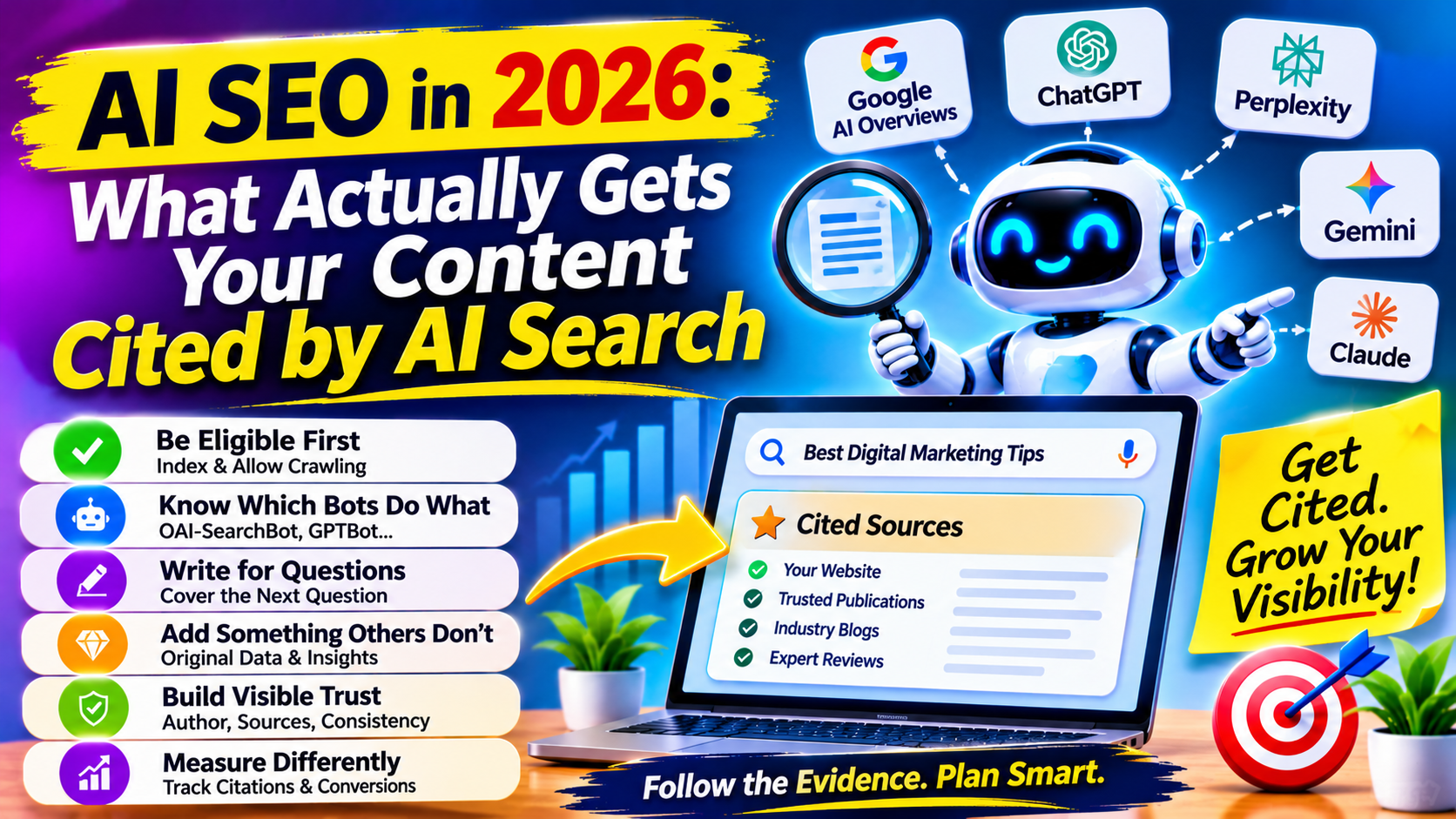
Search no longer ends with ten blue links. Google answers questions with AI Overviews and AI Mode, ChatGPT searches the live web, and Perplexity, Gemini and Claude cite sources inside their replies. AI SEO is the practice of making your content easy for these systems to find, understand and trust enough to cite. Much of the advice about it is hype, so this guide sticks to what the evidence supports.
What AI SEO Really Means
AI SEO does not replace search engine optimization. It extends SEO to answer engines. Classic SEO aims to rank a page. AI SEO also aims to get individual passages retrieved and cited. Success shows up as citations, brand mentions and qualified clicks, not only ranking position.
Google is direct about this. Its Search Central documentation says SEO best practices remain relevant for AI Overviews and AI Mode, with no additional requirements and no special optimizations needed. In May 2026 Google also published a dedicated guide to generative AI features. Coverage of that guide notes that it requires no special schema markup. There is no secret AI switch, only fundamentals done well.
Step One: Be Eligible First
Google says a page must be indexed and eligible to appear with a snippet before it can be shown as a supporting link in AI features. Check the basics before writing anything new:
- Crawling is allowed in robots.txt and by any CDN or firewall.
- Important pages are indexed, with no accidental noindex tags.
- Internal links make each page easy to discover.
- The page loads quickly and reads well on mobile.
The CDN point is the one people miss. A security rule can block legitimate crawlers while the robots.txt file looks perfectly fine.
Step Two: Know Which Bots Do What
Other platforms add their own crawlers. According to industry guides that summarize vendor documentation, OpenAI separates OAI-SearchBot, which surfaces sites in ChatGPT search, from GPTBot, which collects training data. Blocking GPTBot does not remove you from ChatGPT search, but blocking OAI-SearchBot does. Anthropic documents Claude-SearchBot and ClaudeBot as separate controls, and Perplexity uses PerplexityBot.
A sensible default is to allow the search crawlers and treat training crawlers as a business decision. Then check your server logs to confirm the bots actually reach your pages. Bot names change, so verify them against each vendor’s current documentation.
Step Three: Write for Questions, Not Just Keywords
Google says AI Overviews and AI Mode may use query fan-out, which means splitting one question into several related subqueries. A page that answers only the headline query can lose to one that also covers the follow-ups. Four habits help:
- Lead with the answer. Put a direct, plain sentence under each question-style heading, then add detail.
- Make passages self-contained. Each section should still make sense if an AI system lifts it out alone.
- Cover the next question. Think about cost, risks, alternatives and steps a curious reader would ask next.
- Be specific. Name tools, dates, conditions and numbers instead of vague claims.
This is not writing for machines. It is clear writing, which machines and people both reward.
Step Four: Add Something Others Don’t
AI summaries compress consensus. If your page repeats what ten others already say, there is little reason to cite it. Original data, a documented process, a real example or a well-argued opinion gives a system something it cannot get elsewhere.
The honest version matters here. Share only experience you actually have, and label estimates as estimates. A useful pre-publishing question, and one Sarkar SEO recommends for every content plan, is simple: what does this page add that the current top results lack?
Step Five: Build Visible Trust
Answer engines favor sources that look accountable. Use a named author with relevant credentials, show publish and update dates, and cite your sources in the text. Keep your brand name, about page and descriptions consistent across the web.
Structured data is a smaller lever than many claim. Google says it is not required for AI features. It still helps describe your content for standard search features. If you use Article, Organization or Product markup, make sure it matches what visitors actually see on the page.
Step Six: Measure Differently
Google says sites appearing in AI features are counted within overall Search Console traffic, so there is no separate AI report. You have to read patterns instead. Track these:
- Impressions and clicks for question-style queries
- Growth in branded searches
- Referral visits from AI platforms in your analytics
- A monthly manual check
For the manual check, run your 20 most important questions across Google, ChatGPT, Perplexity, Gemini and Claude, and record whether you are cited. Google also says clicks from pages with AI Overviews tend to be higher quality. That is Google’s own claim, so test it against your analytics.
Mistakes to Avoid
- Chasing llms.txt as a fix. Google does not treat it as a requirement for its AI features.
- Publishing unedited AI drafts at scale. Thin, repetitive pages give answer engines nothing worth citing.
- Blocking every AI bot out of fear. You may protect training data, but you also disappear from AI search answers.
- Expecting guarantees. No one controls which sources an AI system chooses, and anyone promising a guaranteed placement is selling certainty that does not exist.
