



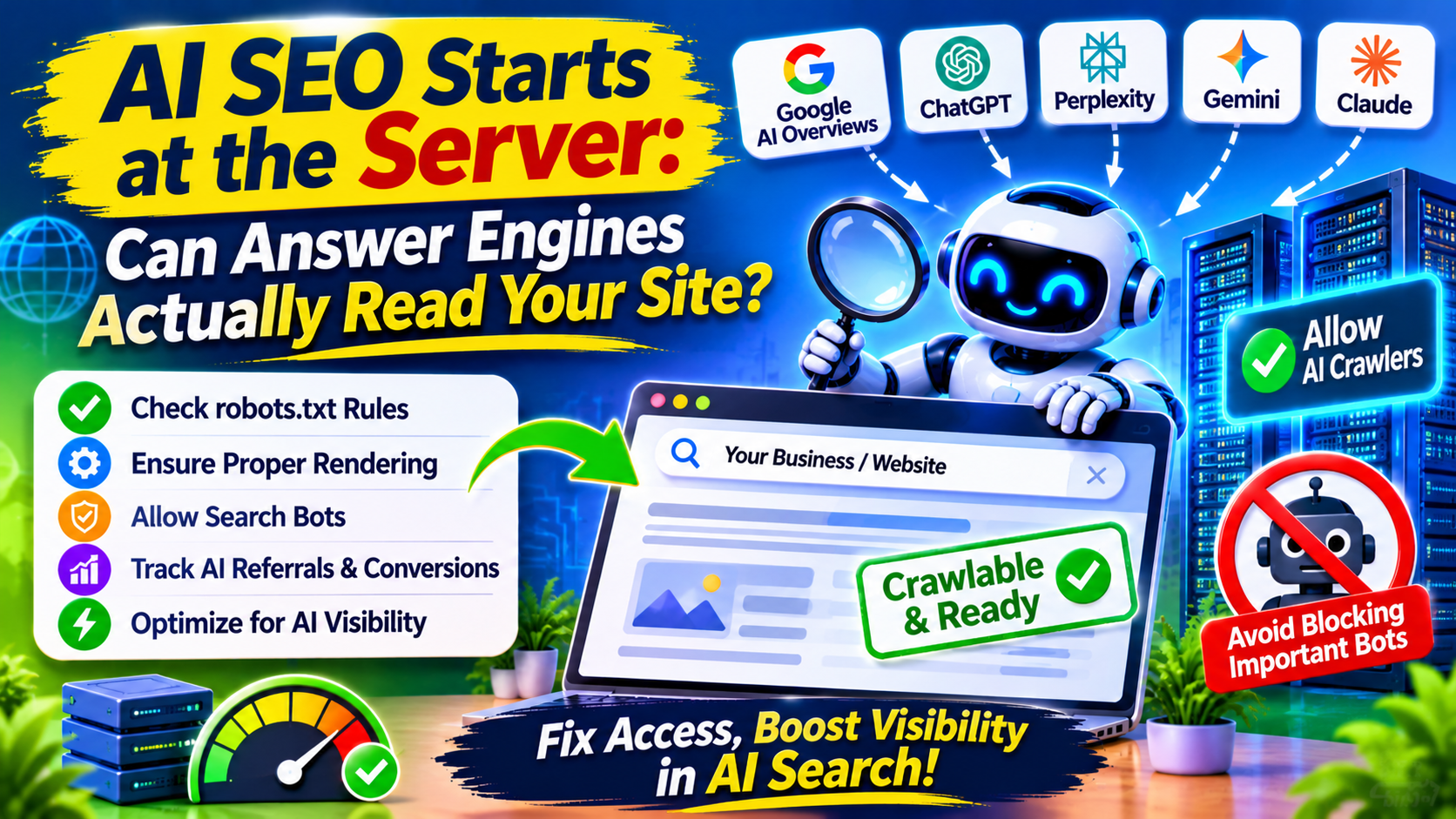
Most AI SEO advice starts with content: write better answers, add more structure, build authority. That matters, but it skips a step. If an AI crawler cannot reach your pages, or is served an empty shell, even the best article never enters the answer. This guide covers the unglamorous layer underneath AI SEO: access, rendering and realistic expectations.
Not All AI Bots Do the Same Job
“AI crawler” is a blanket term for very different visitors. A useful way to sort them is by purpose rather than by brand: search bots build the index behind AI answers, while training bots collect data for future models.
OpenAI illustrates the split. GPTBot is the training control, and OAI-SearchBot is the control for ChatGPT search. Anthropic documents a similar separation, so blocking ClaudeBot does not stop you from allowing Claude-SearchBot if you want search visibility. Perplexity’s guidance, per the same source, says its crawler is not used for training. ai crawlers robots txt claudebot gptbot perplexitybot +2
The consequence is easy to miss. Blocking the training bot costs little visibility, but blocking OAI-SearchBot removes you from ChatGPT Search answers. Two similar-looking lines in a robots file produce opposite business outcomes.
The Accidental Blackout Problem
Many sites are invisible to AI by accident, not by decision. A crawl study by Zyte found that 27.2% of sites block all automated traffic through a wildcard rule, catching AI crawlers without naming them, while only 1.8% explicitly welcome AI with allow rules.
The usual causes are mundane:
- Copy-pasted templates. Block lists circulated in 2024 often set Disallow for every AI user agent, including the search crawlers responsible for citing you.
- Stale rules. Companies add and rename crawlers. OAI-SearchBot, for example, was separated from GPTBot later, so a rule written before the split may not mean what its author intended.
- Security layers. Some WAF and bot-management rules treat unfamiliar user agents as scrapers by default.
A caution on the other side: robots.txt is a request, not protection. It does not hide content, and a URL that must stay private needs login controls or removal from public access.
A Sensible Default Policy
For most business sites, a clear policy has three parts. Allow the retrieval crawlers that feed answers. Decide on training crawlers as a matter of principle, since that is a licensing and brand decision rather than a ranking one. And keep transactional paths such as carts, accounts and internal APIs closed to everyone.
Publishers are already making these distinctions deliberately. Zyte observed that a newspaper may block GPTBot and CCBot while explicitly allowing OAI-SearchBot and PerplexityBot, a precise commercial decision about which AI agents return value. Whichever way you lean, review the file regularly, because bot names and roles change.
Rendering: The Check Almost Everyone Skips
Permission is only half of access. If your key content loads through JavaScript, a crawler may receive a page with nothing useful in it. One practical test is to fetch the raw HTML of an important page and see whether the real content is present. As one technical guide puts it, if the crawler is served nothing usable, fixing rendering is worth more than any content change downstream of it.
Pair that with log analysis. Rather than editing rules because someone posted a new bot list online, first inspect how AI crawlers are already using your site. Server logs show which bots arrive, what they request and whether your firewall is turning them away. rightblogger
What the Traffic Actually Looks Like
Once access is sorted, expectations need calibrating. AI referral volume is growing quickly but from a small base, and published estimates disagree.
SE Ranking reports that AI platforms now account for 0.32% of all website traffic, up from 0.24% in 2025 and 0.02% in 2024. Ahrefs’ tracking of tens of thousands of sites put March 2026 chatbot referrals at just 0.28% of total web traffic. Other benchmarks land closer to 1%. The honest summary is that the real figure depends on how it is measured and on your industry, and most sites sit somewhere between a fraction of a percent and a few percent.
Platform mix is shifting too. ChatGPT leads with roughly 75% of AI referral traffic, followed by Gemini, Perplexity, Copilot and Claude, but its share is slipping while Claude grew 320% year over year from a tiny base. Optimizing for one assistant alone is a risky bet.
Small Volume, Different Quality
The reason AI visitors attract so much attention is conversion. Ahrefs reported from its own analytics that AI search visitors were just 0.5% of visitors but drove 12.1% of signups.
Treat that as one company’s result, not a rule. A review of the wider evidence found that AI traffic converts between 1.2x and 9x better than Google organic, depending on the study, the industry and how conversion is defined. Another analysis raises a fair caveat: no published study controls for selection, so more AI referral volume may move you down the quality curve instead of multiplying the good behavior.
The practical lesson is to measure your own numbers. Segment AI referrals in analytics, compare conversion against your organic baseline, and judge the channel by pipeline, not sessions. At Sarkar SEO, we begin AI visibility projects with this baseline, because without it no later improvement can be proven.
A 30-Minute AI Access Audit
- Open your robots.txt and list every rule that touches an AI or wildcard user agent.
- Confirm that search and retrieval crawlers are allowed on public content.
- Decide, and write down, your stance on training crawlers.
- Fetch the raw HTML of five priority pages and confirm the main text is present.
- Check firewall and CDN settings for rules that challenge unknown bots.
- Review server logs for AI user agents and any blocked requests.
- Tag AI referrals in analytics so conversions can be compared with organic.
The Takeaway
AI SEO is often sold as a content problem, yet it begins as an infrastructure one. Reachable pages, readable HTML and a deliberate crawler policy are the entry ticket. Strong content decides whether you get cited once you are in the room.
Fix the access layer first, measure the channel honestly, and then invest in depth. If you want that foundation audited, Sarkar SEO can review your crawler policy and rendering as part of a wider AI search plan.
