



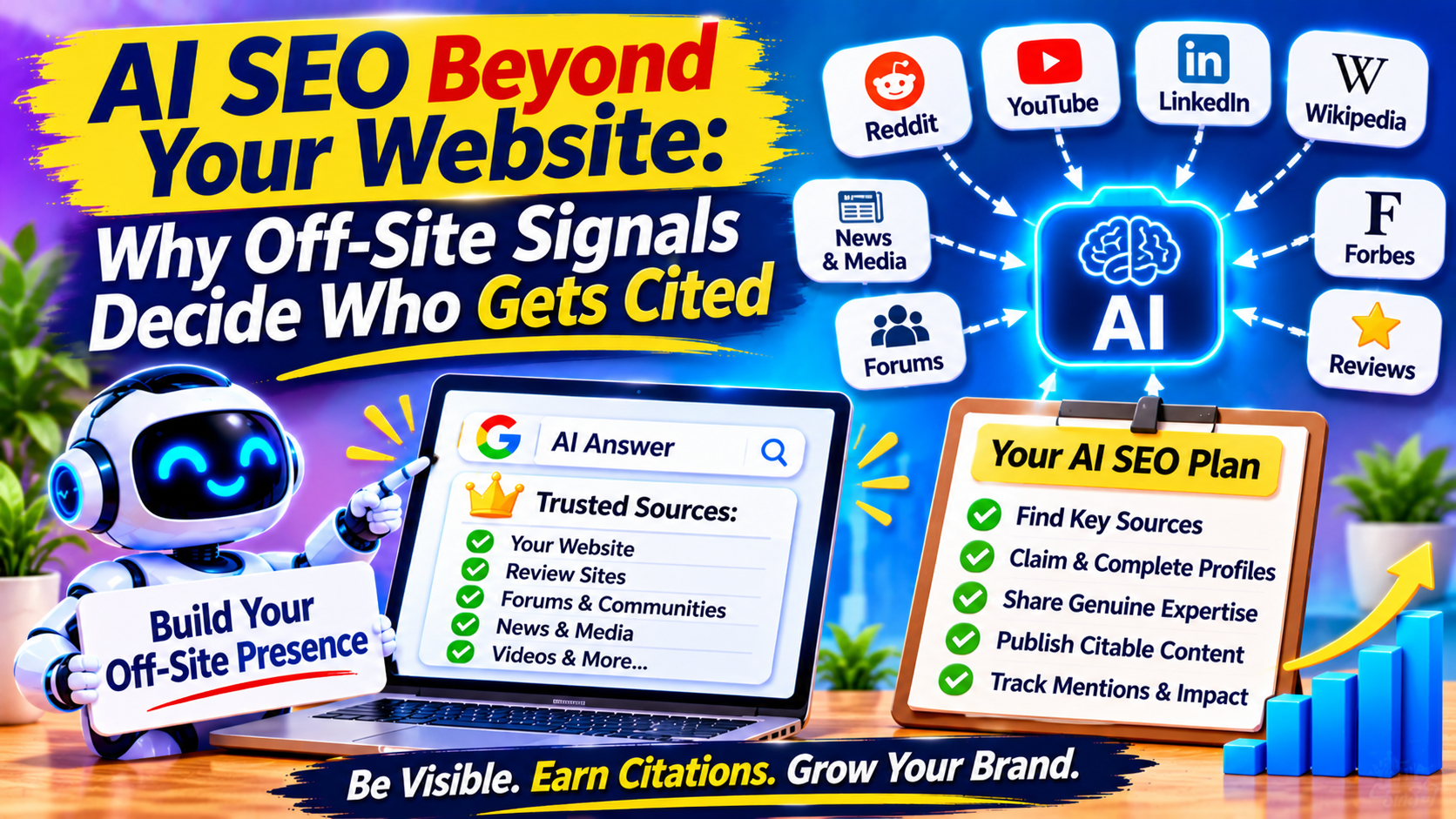
Classic SEO trained us to look inward: fix the page, improve the content, earn a few links. AI SEO adds an uncomfortable twist. When an answer engine builds a response, it often leans on what other people say about you, not just what you say about yourself. Your reputation across the web becomes part of your ranking.
Where AI Answers Actually Come From
Several large citation studies point the same way: the sources AI engines quote are frequently not brand websites. Peec AI analyzed 30 million cited sources across ChatGPT, Google AI Mode, Gemini, Perplexity and AI Overviews. Its list of most-cited domains was led by Reddit, then YouTube, LinkedIn and Wikipedia, followed by Forbes, G2 and Yelp.
An earlier analysis by xfunnel.ai grouped citations into owned, competitor, earned and user-generated content. It found that AI search engines cite third-party content the most. Its advice: invest in a mix of owned content, third-party coverage and presence on relevant community platforms. searchenginejournal
That fits a broader reading from PR analysts, who argue that earned media, third-party validation, Wikipedia governance and community engagement are the levers that move AI citations.
Each Engine Has Its Own Taste
Treating “AI” as one audience is a mistake. Peec’s per-platform breakdown shows clear differences:
- ChatGPT: Wikipedia, Reddit, Forbes, Techradar and LinkedIn lead.
- Google AI Overviews: YouTube, Reddit, Facebook, LinkedIn and Medium lead.
- Perplexity: Reddit, YouTube, LinkedIn, Wikipedia and G2 lead.
Review sites matter in particular niches. In the xfunnel study, ChatGPT often referenced LinkedIn, G2 and Gartner Peer Reviews, which suggests B2B buyers’ questions are being answered partly from vendor-comparison sources, not vendor homepages.
Video deserves its own note. AirOps found that YouTube held 4.6% of all AI citations by June 2026, and about 99% of YouTube citations point to one specific video. That second figure matters: the engine is quoting a particular video that answers a particular question, not your channel in general.
The Data Does Not Agree, and That Is Useful
A fair reading must include the counterexample. Profound’s analysis of 11.8 billion data points concluded that brand websites are the dominant source of AI citations, ahead of press, Reddit or YouTube. Other studies say the opposite.
These findings are not necessarily contradictory. Results differ by industry, by prompt type, by which engines are sampled and by whether the query names a brand. A person asking about your product by name will probably see your own site cited. A person asking an open question like “what is the best option for X?” will see a wider field of third-party voices. The takeaway is not to abandon your website. It is to cover both kinds of query.
Be Careful With Correlation
Many headline numbers here are associations. SE Ranking’s study of 129,000 domains reported that domains with millions of Reddit brand mentions averaged 7 ChatGPT citations versus 1.8 for domains with minimal Reddit presence. Ahrefs’ study of 75,000 brands found that YouTube mentions correlated at 0.737 with appearances in ChatGPT, AI Mode and AI Overviews. contentlycontently
Strong brands naturally attract mentions and citations, so it is hard to separate cause from effect. A healthier interpretation: off-site presence is a useful signal that your brand is real, discussed and trusted, not a button that guarantees citations. Anyone promising a fixed multiplier is overselling.
A Practical Off-Site AI SEO Plan
- Find where your category is already being discussed. Search the questions your customers ask and note which forums, review sites, videos and publications appear in AI answers. Do this for several engines, because the overlap is partial. This map is the starting point of every Sarkar SEO visibility audit, since it replaces guesses with observed gaps.
- Claim and complete the profiles that matter. For many categories that means the review platforms and professional networks AI engines already cite. Keep your name, description, services and location consistent everywhere, so engines resolve all mentions to one entity.
- Take part in communities honestly. Reddit’s prominence tempts marketers into spam, which tends to backfire in communities that punish self-promotion. Peec’s own guidance is to monitor what is said about your brand and, if you take part, be authentic and add real value. Answering real questions as a named expert beats dropping links.
- Make video that answers one question well. Given how AI engines point to individual videos, build a short, clearly titled video around each high-value question, with an accurate transcript.
- Publish something worth citing. Original data, a survey, a benchmark or a detailed method gives journalists, bloggers and forum users a reason to reference you. An industry index summarized by Search Engine Journal’s coverage suggests that Perplexity favors primary research sources and niche authority sites, rewarding depth and specificity over brand recognition. Treat that as a hint to test, not a law.
- Earn independent coverage. Press mentions, podcast guest spots, expert quotes and third-party reviews create the independent validation these engines appear to favor. Search Engine Journal noted that this rewards the discipline that has spent years building trust signals that are authoritative, third-party and outside the brand’s own website.
How to Track Progress Without Fooling Yourself
Pick 20 to 30 questions that matter to your business and test them monthly across the main engines. Record whether you are mentioned, which sources are cited, and which competitors appear beside you. Because AI answers vary from run to run, repeat each prompt a few times and look at trends, not single results.
Pair this with business metrics: branded search growth, direct inquiries and conversions. At Sarkar SEO, we recommend reading citations and revenue together, because visibility that never turns into enquiries is a vanity metric.
Common Mistakes
- Fake reviews and astroturfing. They violate platform rules, can damage trust and are exactly what quality systems try to discount.
- Ignoring your own site. Third-party signals complement a clear, authoritative website; they do not replace it.
- Optimizing for one engine. The source preferences above differ too much to bet on a single platform.
- Expecting speed. Reputation compounds slowly. Plan in quarters, not weeks.
