



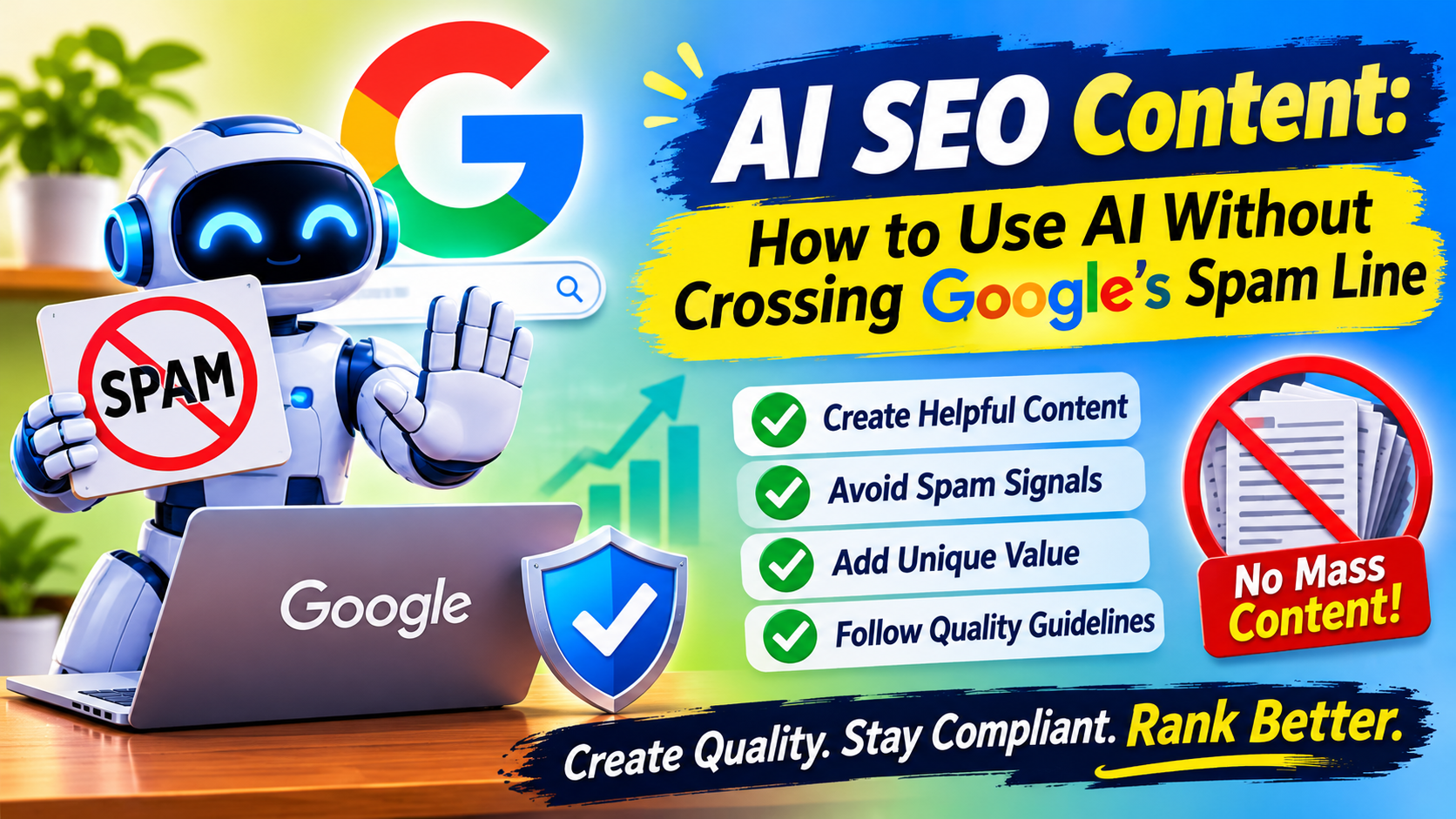
Every SEO team now faces the same practical question: how much of the work can AI do before it hurts rankings? Treating “AI SEO” only as optimizing for AI answers misses half the picture. The other half is using AI inside your own content process, and that is where many sites quietly put themselves at risk.
Google Does Not Penalize AI. It Penalizes Intent.
The most common myth is that Google punishes anything a machine writes. The policy says otherwise. Google’s spam rules define scaled content abuse as generating many pages for the primary purpose of manipulating search rankings and not helping users. The method is irrelevant: human-written spam and AI-generated spam face identical consequences.
The policy itself is not new. Google renamed it from “spammy auto-generated content” to “scaled content abuse” in March 2024. That wording shift matters, because it moved the test from how content is made to why it exists.
Enforcement has continued. One analysis of a 2026 spam update noted that it hit scaled content abuse, site reputation abuse and manipulative links, and did not target AI content as such, only abuse. A later update beginning in September also lists scaled content abuse among the policies in scope. Expect this area to keep being policed.
What Ranking Data Says About AI Content
Studies of top-ranking pages show AI content is common, but fully automated pages rarely win.
- Ahrefs’ June 2026 study of one million pages, as reported by secondary coverage, found that 5.3% of pages in positions 1 to 3 were 100% AI-generated, while 82.2% of top-3 results had under 50% AI content. aigrowthagent
- A separate Graphite study across 31,493 keywords classified 86% of sampled ranking articles as human-written, and found that articles classified as AI-generated tended to rank lower.
- Other analyses report that around 19% of top pages are primarily AI-generated, while 86.5% contain some AI content.
Those numbers look inconsistent, and the reason is worth knowing: they use different AI detectors, thresholds and keyword samples. AI-detection tools are imperfect, so treat any single percentage as a rough guide. The consistent pattern across them is simpler. Some AI assistance is normal at the top of search, but pure, unedited output is the minority.
Ahrefs’ Ryan Law offered a plain interpretation, saying Google appears to rely on the same old hallmarks of content quality that it always has.
Where the Line Actually Sits
Because “scaled content abuse” has no published numeric threshold, the practical test is about purpose and added value. One summary of the policy stresses that there is no universal safe publishing quota. Instead, ask these questions about any AI-assisted page:
- Does this page exist because a reader needs it, or because a keyword list said so?
- Does it contain anything that a competitor’s page lacks, such as data, experience, a decision framework or a real example?
- Would a subject-matter expert sign their name to it?
Google’s quality raters are told to look for the same weaknesses. Reporting on the September 2025 rater guidelines says pages showing little effort, originality or added value can receive the lowest quality rating.
Two patterns sit clearly on the wrong side. The first is generating a separate page for each phrasing of a question. One guide notes that Google’s AI-features documentation says creating a separate page for each possible query phrasing, mainly to influence rankings or AI responses, falls within the scaled content abuse policy. The second is mass-rewriting top-ranking pages. As one practitioner guide frames it, that yields little originality or added value, and the fix is to add expert analysis and unique examples. aigrowthagentrankai
A Safer Workflow: Machines Draft, People Decide
At Sarkar SEO, the working rule is that AI accelerates the steps around judgment but does not replace it. Here is a practical division of labor.
Good uses of AI
- Clustering keywords and grouping them by intent
- Summarizing sources you have already collected
- Producing a first outline from a brief you wrote
- Spotting gaps against competing pages
- Editing for clarity, grammar and consistency
- Checking drafts against a style guide
Jobs that need a person
- Choosing which topics deserve a page at all
- Supplying first-hand experience, client results, screenshots and original data
- Taking a position, including where you disagree with the consensus
- Verifying every statistic against its original source
- Final accountability for accuracy
That last point deserves emphasis. AI tools can state invented figures with confidence, so every number and quotation needs a human check before publication.
Quality Control Before You Hit Publish
Run each AI-assisted article through a short gate:
- Source check: every claim with a number links back to something you actually opened.
- Originality check: at least one section could not have been written without your own knowledge or data.
- Redundancy check: the page does not duplicate another page on your site under a slightly different keyword.
- Voice check: it reads like your brand, not like generic internet text.
- Usefulness check: a reader could act on it today.
If a page fails two or more of these, rework it or leave it unpublished. Fewer, stronger pages almost always beat a large archive of thin ones.
Why This Also Helps AI Answer Visibility
Content that survives this gate is also the content answer engines are most likely to use. Generic text is interchangeable, so there is no reason for an assistant to cite your version over another. Original data, clear definitions and well-sourced claims give models something specific to quote. In that sense, protecting your site from spam risk and winning citations are the same discipline.
Mistakes to Avoid
- Publishing in bulk because it is cheap. Low production cost is exactly what makes volume tempting and, as the policy makes clear, risky.
- Trusting detectors as a safety net. Passing an AI-detection tool does not prove quality, and failing one does not prove spam.
- Leaving no human fingerprints. Pages with no named expertise, no examples and no point of view blend into the noise.
Treating one update as the end of the story. Policies and enforcement keep evolving, so build a process that stays compliant by design.
