



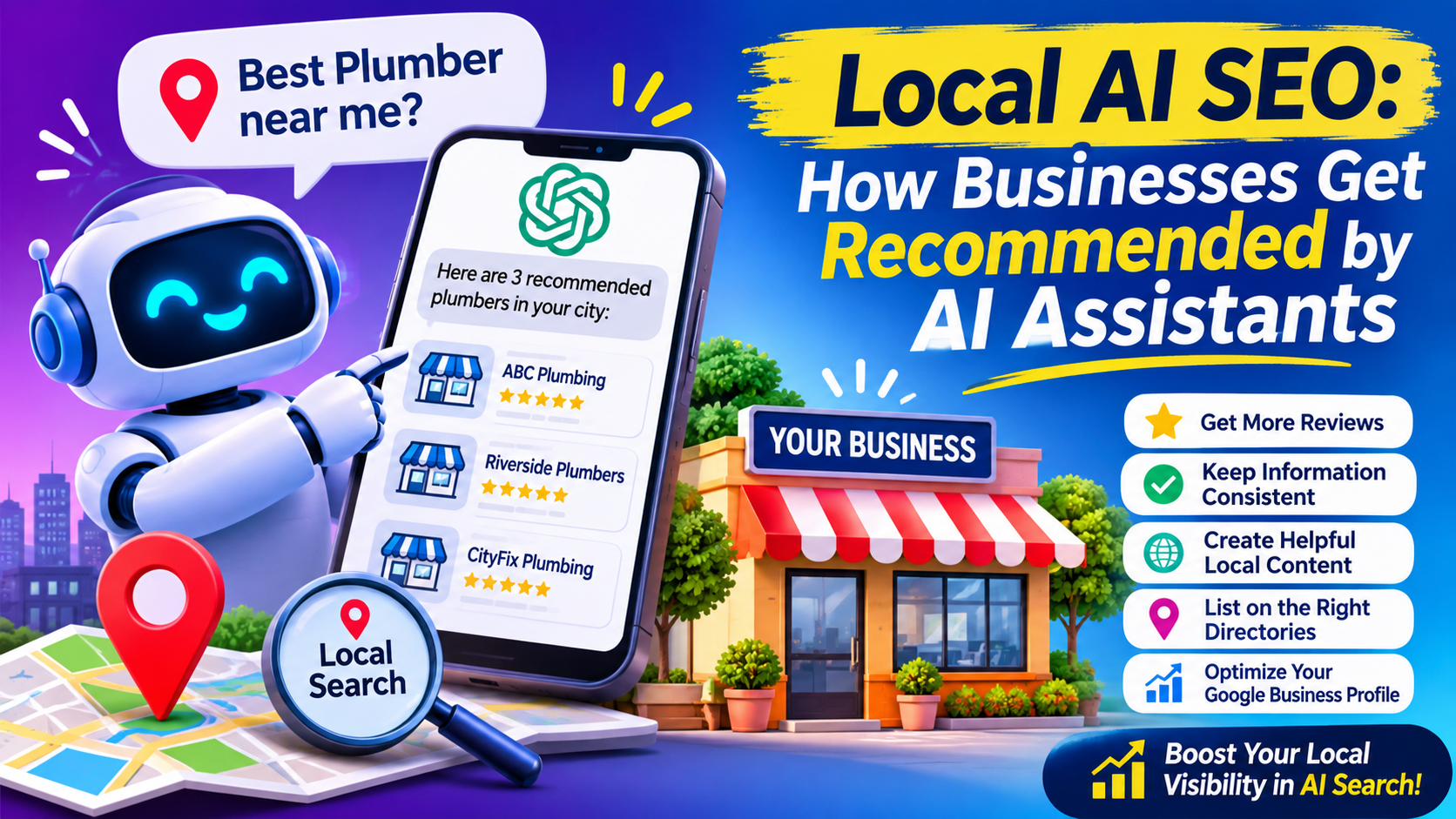
A customer in your city asks an AI SEO assistant for “a reliable plumber near me” or “the best family dentist in this neighborhood.” The assistant names three businesses. If yours is not one of them, you never knew the customer existed. That is the new local search problem, and it works differently from the map pack many owners have spent years optimizing.
Local Discovery Has Shifted Fast
BrightLocal’s 2026 consumer survey found that 45% of consumers now use AI tools for local business recommendations, up from 6% a year earlier. The sample was 1,002 US adults, so figures in other countries may differ, but the direction is hard to ignore.
Yet reaching those customers is difficult. SOCi’s 2026 Local Visibility Index analyzed more than 350,000 business locations and found that ChatGPT currently recommends just 1.2% of them. Another summary of the same research reports Gemini reaching 11 percent and Perplexity 7.4 percent, versus about 35.9 percent visibility in Google’s traditional local results. Being picked by AI is a far narrower door than ranking in a local pack.
Equally important: only a 45% overlap exists between brands that perform well in traditional local search and those that appear in AI recommendations. A strong map ranking does not automatically carry over.
What Seems to Correlate With Being Recommended
Insites studied 10,000 local businesses across ChatGPT and Perplexity, comparing more than 200 signals. The strongest correlates were Google review volume, Google Business Profile completeness and Local Pack presence. The gap was dramatic: businesses found by both assistants averaged 133 Google reviews, while businesses invisible to AI averaged just 11. natlawreviewinsites
Read this carefully. It is a correlation study from a marketing-software vendor. Businesses with many reviews are usually busier, better known and better managed, so reviews may be a symptom as much as a cause. As Entrepreneur’s coverage put it, a profile does not necessarily cause a recommendation, and the relationship is still developing.
Each Assistant Draws From Different Data
Local answers are not built from a single pool. One industry guide reports that ChatGPT search relies mostly on Bing’s index and, since 2026, on licensed Yelp reviews and photos, while Gemini and Google Maps are built on Google’s own place and review data. That is a vendor article, and platform data deals change, so verify the current arrangements before building a strategy on them.
The practical lesson holds regardless: a business with one strong profile and nothing elsewhere is exposed. One analysis argues such a business is structurally weaker than one with moderate presence across Google, Yelp, industry directories and a few editorial citations. Presence needs to be broad enough to be found wherever each assistant looks.
Accuracy Is a Hidden Filter
Here is a finding most local owners overlook. SOCi reports that only 68% of business contact information surfaced by ChatGPT and Perplexity matches the details on the corresponding Google Business Profile, with Gemini, grounded in Google Maps, matching fully. The implication drawn by analysts is that inconsistency alone may be filtering businesses out of answers. emulentelementera
Wrong opening hours, an old phone number or a moved address do more than annoy customers. They create conflicting records that an assistant must reconcile, and conflict is a reason to leave you out.
A Practical Local AI SEO Plan
At Sarkar SEO, we approach local visibility as five jobs, in this order.
- Make your primary profile complete and current. Fill every field: categories, services, hours, holiday hours, attributes, description and photos. Treat it as your most important local page, because several assistants appear to draw on it.
- Earn reviews steadily and honestly. Ask satisfied customers right after service, make it easy, and reply to every review, including negative ones. Never buy or fake reviews or offer incentives that violate platform rules. A fresh, steady flow of real feedback is more credible than a burst.
- Audit consistency everywhere. Compare your name, address, phone number, website and hours across your profile, website, social pages and directories. Fix mismatches at the source. A single spreadsheet of “official” details, checked quarterly, prevents most drift.
- Build a website that answers local questions. Create genuinely useful pages for each core service and area you serve, with real details: what you do, who it suits, typical timelines, pricing guidance where possible, and common questions from real customers. Avoid templated pages with only the town name swapped.
- Show up on the directories your market actually uses. Platform popularity varies by country, so choose the review sites and local directories that dominate where you operate rather than copying a US checklist. Add industry-specific associations and any credible local press or sponsorship mentions.
Test Like a Customer
Write down the real questions customers ask, including neighborhood names and urgent needs (“emergency”, “open now”, “same day”). Run them in several assistants and record whether you appear, whether your details are accurate, and which competitors show up. AI answers vary between runs, so look for patterns across repeated tries rather than reacting to one result. Treat inaccurate statements about your business as tasks to fix at the source, not just curiosities.
