



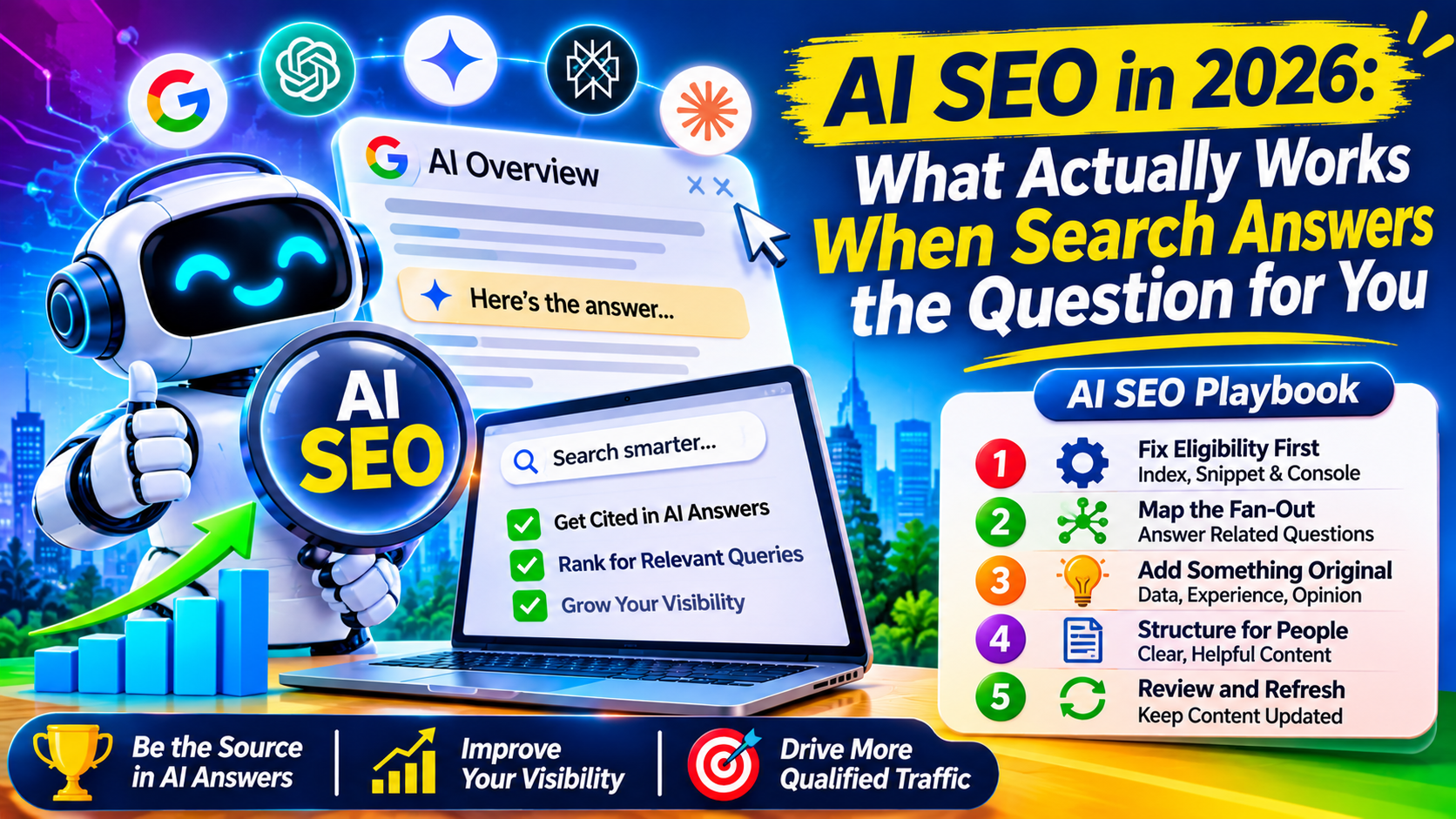
Search results no longer end with ten blue links. Google’s AI Overviews and AI Mode, along with chat-style answer engines, now summarize the web before a visitor clicks anything. That has produced a flood of advice, a pile of new acronyms, and plenty of confusion. The view at Sarkar SEO is simple: AI SEO is not a separate trick. It is classic search optimization applied with sharper discipline, and Google’s own documentation now says as much.
What AI SEO Means
AI SEO is the work of making your content easy for search systems to find, understand, trust and cite when they generate answers. It covers visibility in AI Overviews and AI Mode, and it also covers how other answer engines such as ChatGPT, Perplexity, Gemini and Claude may reference your pages.
The goal is no longer just a ranking position. It is being the source an AI answer draws on, and being the page the reader wants to visit next.
What Google Has Officially Said
On 15 May 2026, Google published a guide titled “Optimizing your website for generative AI features on Google Search”. Its central answer to whether SEO still matters is yes. The guide explains that Google’s generative AI features are rooted in its core ranking and quality systems.
Two mechanisms matter most:
- Retrieval-augmented generation (RAG): the system retrieves relevant pages from the Search index, then writes an answer grounded in them, with links to supporting pages.
- Query fan-out: the model fires off several related searches at once to gather more material.
The guide also addresses the AEO and GEO labels. In Google’s words, optimizing for generative AI search is optimizing for the search experience, and therefore still SEO.
This guide covers Google’s features only. ChatGPT, Perplexity and other engines have not published equivalent documentation that I could verify, so advice about them rests on general principles rather than official rules.
Query Fan-Out Changes How You Plan Content
Google’s own example is a user asking how to fix a lawn full of weeds. Behind the scenes, the system may also search for the best herbicides for lawns, removing weeds without chemicals, and preventing weeds from returning.
Your page is therefore competing across a cluster of related questions, not a single phrase. The practical response is to cover the full job a reader is trying to do:
- Answer the core question near the top.
- Address the obvious follow-ups a thoughtful reader would ask next.
- Cover them inside one well-organized page rather than a dozen thin ones.
Google warns against the opposite approach. Creating separate pages for every fan-out variation to manipulate AI responses can violate its scaled content abuse policy, and it is ineffective long term.
Write Non-Commodity Content
The guide says that unique, valuable content will likely influence your presence in generative AI search more than any other suggestion it lists. It separates commodity content from non-commodity content. A generic list of tips for first-time homebuyers is commodity content, because anyone could write it from common knowledge. A first-hand account of a specific decision, with real trade-offs, is non-commodity.
Before drafting, ask what this page contains that a language model could not produce unaided. Good answers include:
- original data, test results or screenshots from your own work;
- a clear, defensible opinion backed by reasoning;
- real examples, with numbers you can stand behind;
- expert review or a named author with relevant experience.
This is the filter Sarkar SEO applies before any article goes live. If the honest answer is “nothing”, the piece is not ready.
Get the Technical Basics Right
Technical SEO decides whether your content is even eligible. According to the guide, a page must be indexed and eligible to appear in Google Search with a snippet to be shown in generative AI features. The guide adds that a site must be included in Search generative AI features in Search Console.
The checklist is familiar:
- keep important pages crawlable and not blocked;
- follow JavaScript SEO best practices if your site depends on scripts;
- provide a good page experience on every device;
- reduce duplicate content;
- keep business details current through tools such as Google Business Profile and Merchant Center where relevant.
Even a page that meets every requirement is not guaranteed to be crawled, indexed or served.
Myths You Can Drop
Google’s guide lists several tactics it says you do not need for its generative AI features:
- llms.txt files and other special AI markup. Google Search ignores them. Creating one for other services will neither help nor harm your Google visibility.
- Chunking content into tiny pieces for AI. Google says its systems can understand multiple topics on one page.
- Rewriting content only for AI systems. Synonyms and meaning are understood without exact-match phrasing.
- Seeking inauthentic mentions across the web.
- Overfocusing on structured data. No special schema is required, though it remains useful for rich results.
Be sceptical of anyone selling these as secret advantages, at least where Google is concerned.
Measure What Matters
You cannot manage what you cannot see. Google now points site owners to the Generative AI performance report in Search Console, which shows how content performs in generative AI features on Search and Discover. The guide also warns that no third-party tool has access to Google’s internal ranking or AI systems, so treat claims of “internal” metrics with caution.
Sarkar SEO recommends tracking three things together: Search Console’s AI report, organic landing-page engagement, and conversions from AI-influenced visits. Visibility without business results is only a vanity metric.
A Practical AI SEO Playbook
- Fix eligibility first. Confirm indexing, snippet eligibility and Search Console setup.
- Map the fan-out. For each target topic, list the related questions a reader would ask, and answer them in one coherent page.
- Add something original. Include first-hand experience, data or expert judgment on every important page.
- Structure for people. Use clear headings, short paragraphs, and images or video where they genuinely help.
- Review and refresh. Watch the Search Console report, update pages as facts change, and prune thin content.
