



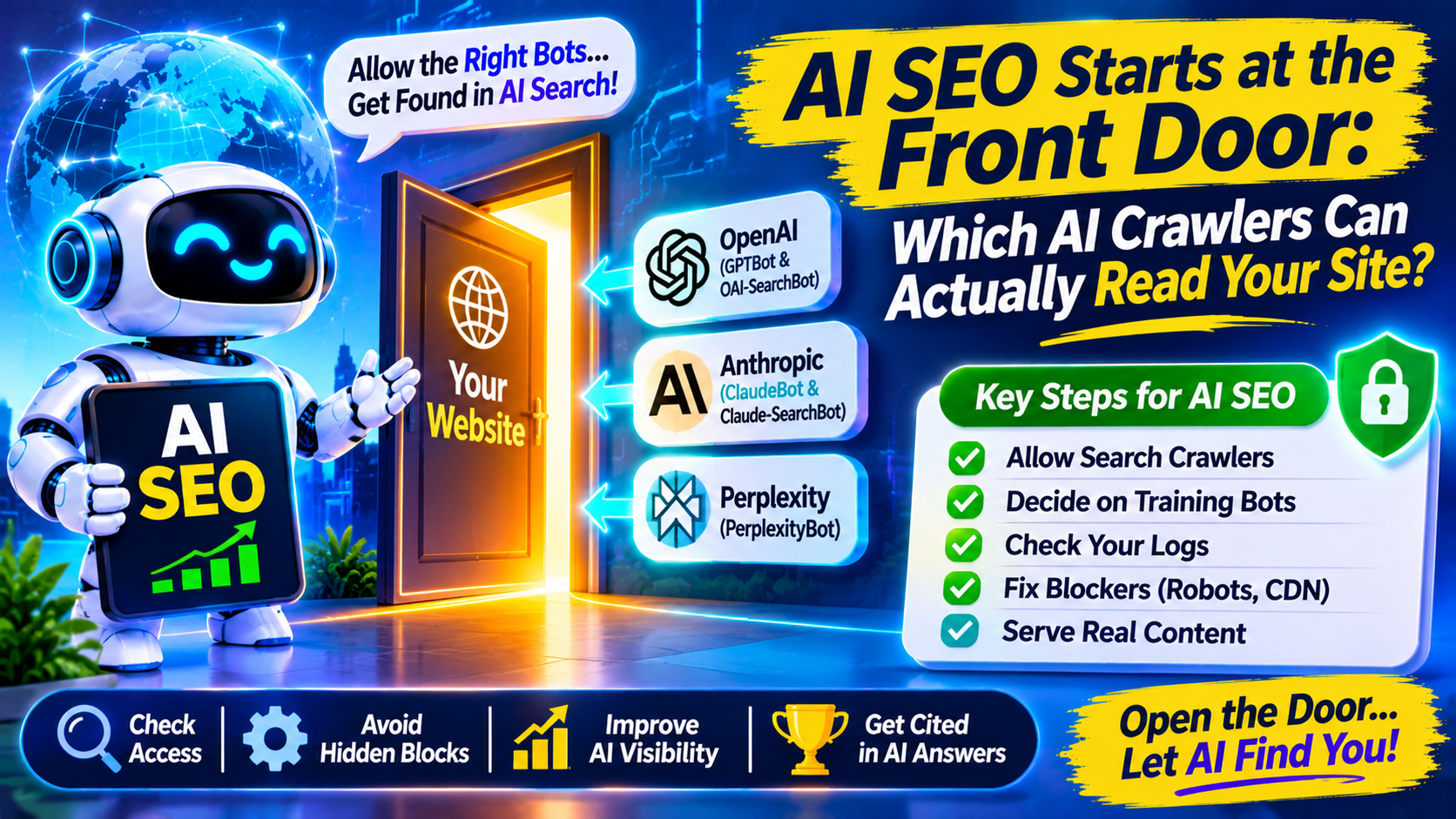
Most AI SEO advice begins with content: write clearer answers, add depth, earn mentions. That advice is sound, but it skips a more basic question. Can AI search products reach your pages at all? At Sarkar SEO, we treat crawler access as the front door of AI SEO. If it is locked, nothing behind it matters.
Why Access Comes Before Optimization
An answer engine cannot cite what it cannot fetch. A page that is blocked, challenged by a firewall, or hidden behind scripts a crawler will not run can be brilliantly written and still invisible. Unlike a ranking drop, this failure is silent. There is no error message and no warning, just absence.
The fix is rarely complicated. It does require understanding that “AI crawler” is not one thing.
One Brand, Three Jobs
The major AI companies now separate their automated visitors by purpose:
- Training crawlers collect content that may be used to train models.
- Search crawlers build the index that powers cited answers.
- User-triggered fetchers open a page because a person asked about it.
Treating all three as one bucket causes the most common mistake. Site owners block everything to avoid training use and accidentally remove themselves from AI search answers.
What the Companies Themselves Say
OpenAI. Its crawler documentation describes OAI-SearchBot as the bot used to surface sites in ChatGPT search. GPTBot is a separate bot for content that may be used in training. Sites opted out of OAI-SearchBot will not be shown in ChatGPT search answers, though they can still appear as navigational links. ChatGPT-User handles user actions, and OpenAI notes that robots.txt rules may not apply to it because a person initiated the request. For search, OpenAI says robots.txt changes can take around 24 hours to be reflected.
Anthropic. Its help center describes three bots. ClaudeBot collects web content that could contribute to model training. Claude-SearchBot analyzes content to improve the relevance and accuracy of search responses, and Anthropic says disabling it may reduce your visibility and accuracy in user search results. Claude-User retrieves pages in response to a user’s query, and disabling it may reduce visibility for user-directed search. Anthropic also cautions that blocking by IP address may not work reliably, because it can stop the bots from reading your robots.txt file.
Perplexity. Its documentation recommends allowing PerplexityBot in robots.txt if you want to appear in search results. Perplexity-User, which fetches pages on a person’s behalf, generally ignores robots.txt rules, according to Perplexity. Changes can take up to 24 hours to apply.
Bot names and behaviors change, so check each company’s documentation before you finalize anything.
A Sensible Default Policy
For a public site that wants AI visibility, a reasonable starting point is to allow the search crawlers and treat training crawlers as a business decision. Blocking a training bot is legitimate, and it is a separate decision from visibility.
OpenAI states that disallowing GPTBot indicates content should not be used in training, and Anthropic says the same about restricting ClaudeBot. Whether you block them is your call. Keep cart, checkout and account paths closed to every bot, and remember that robots.txt is a request, not a lock. For genuinely private pages, use real access controls.
The Hidden Blockers
Robots.txt is only one layer. Practitioners commonly report that CDN or firewall bot protection can reject AI crawlers even when robots.txt welcomes them. They also report that stock robots.txt templates sometimes carry broad disallow rules that catch these bots by accident. These are secondary reports rather than vendor documentation, so confirm the behavior on your own setup.
Rendering is another quiet risk. Google’s guidance says it can process JavaScript content when it is not blocked, but support across other AI crawlers is not uniformly documented. Serving your core text in plain HTML is the low-risk choice.
If a site tells us it has no AI visibility, access is where Sarkar SEO would start looking, long before rewriting a single paragraph.
Verify It in Your Logs
Never trust a user-agent string alone, since anyone can fake one. OpenAI and Perplexity publish IP ranges for their bots, so check claimed visits against those lists.
Then track each bot separately over several weeks. Training-bot activity tells you nothing about search access. If a search crawler never appears over a long period, treat that as a prompt to investigate your robots.txt, firewall and CDN rules.
What Access Will Not Do
Letting a crawler in makes you eligible. It does not make you chosen. Selection still depends on how useful, original and trustworthy your page is. Google’s guide says its generative AI features draw on core Search systems, and that a page must be indexed and snippet-eligible. Google also requires the site to be included in Search generative AI features in Search Console.
Treat access as the floor, then build content worth citing on top of it.
The Takeaway
AI SEO is often framed as a writing challenge, but it is first an access challenge. Sort bots by purpose, allow the ones that feed AI answers, decide training separately, and verify with logs. A short audit costs little, and Sarkar SEO can run one for you if you would rather not do it alone.
