



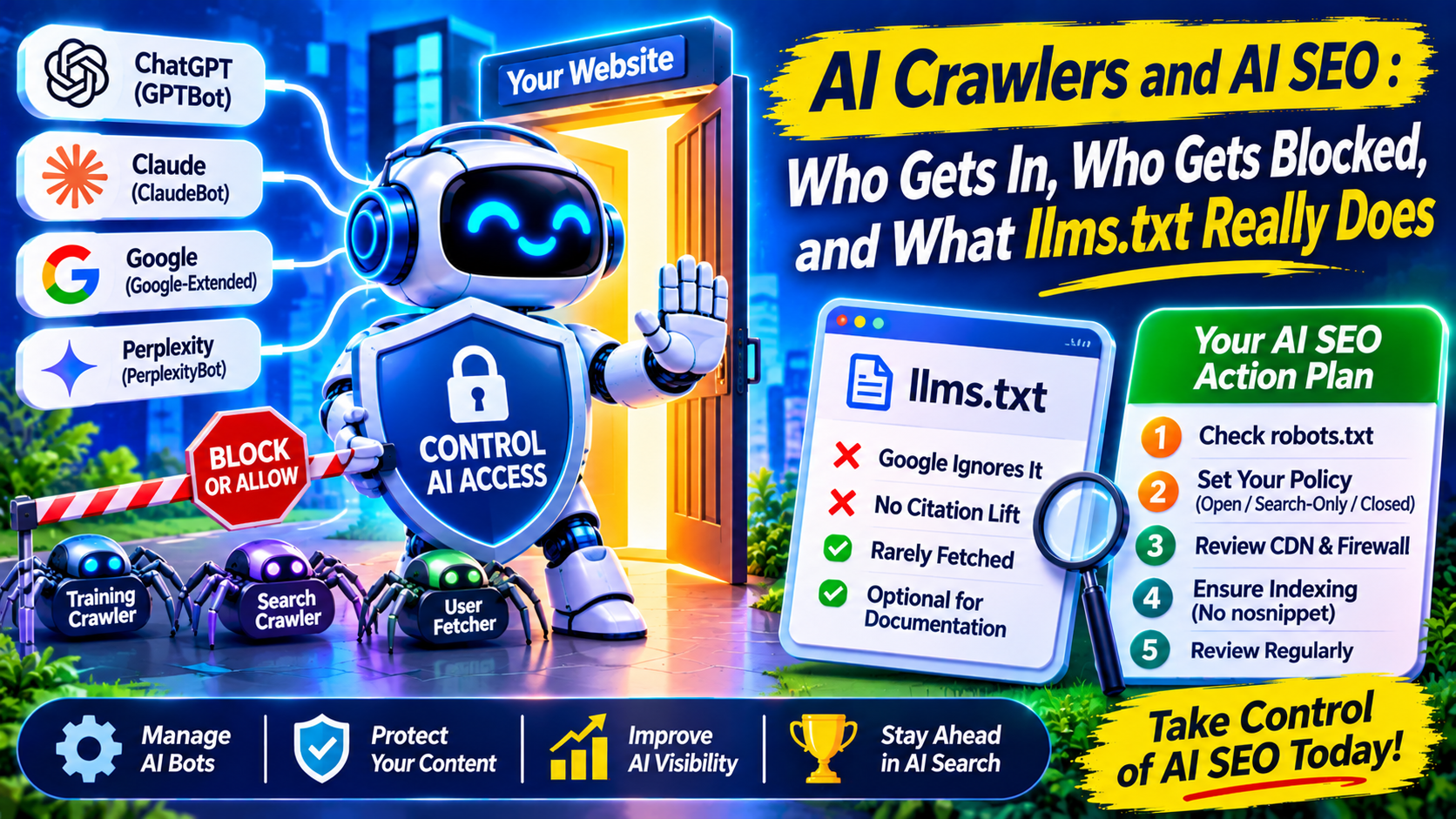
Most advice about AI SEO focuses on what to write. This guide covers a decision that happens before anyone reads a word: which automated visitors are allowed onto your site. A single line in a text file can make you invisible to an assistant, or hand your content to a model with nothing in return. Few site owners make that choice deliberately.
Not all AI bots do the same job
“AI crawler” is a loose label. Bots fall into at least three groups, and one analysis of robots.txt practice describes the split clearly. Training crawlers such as GPTBot, ClaudeBot, CCBot and Google-Extended collect data to build into a model, while AI search crawlers such as OAI-SearchBot, Claude-SearchBot and PerplexityBot index pages for answers that can cite a source. A third group fetches a page live when a user asks for it. The same source notes that OpenAI says robots.txt rules may not apply to its user-initiated agent, ChatGPT-User.
The practical consequence is that “block AI” is not one decision. Blocking a training bot keeps your content out of model training. By contrast, blocking a search crawler can remove you from AI answers and citations. You can choose each independently. For example, blocking GPTBot while allowing OAI-SearchBot says: don’t train on my content, but keep it eligible for ChatGPT search. studiohawkflaviocopes
The Google exception
Google adds a wrinkle. Google-Extended is a control token, not a separate crawler visit, and one tool provider states that it only controls Gemini and Vertex AI training and does not affect Google Search crawling or ranking, which Googlebot governs. Be careful here, because sources disagree. One crawler glossary claims Google-Extended also covers AI Overview generation. That conflicts with the description above, so check Google’s own crawler documentation before you rely on either account.
What Google’s AI features need is simpler. One summary of Google’s guidance says the pages must be indexed and eligible to appear with a snippet, with no extra technical requirements. That means snippet controls such as nosnippet can limit AI visibility on Google even when crawling is allowed.
The accidental block
The most common failure is not a strategy at all. It is a default nobody remembers setting. One guide to crawler management warns that many sites inherit default robots.txt or firewall rules that block GPTBot, ClaudeBot or Google-Extended without the team realizing, leaving them invisible to AI engines regardless of content quality. That is a vendor’s claim and I haven’t seen data on how widespread it is. But it’s easy to check, and the fix takes minutes.
Review these places, in order:
- Your robots.txt file at the root of each domain.
- Rules inside your CDN, firewall or bot-protection service, which can block crawlers even when robots.txt allows them.
- Your hosting platform’s settings, since some apply bot rules automatically.
- Subdomains. One technical reference notes that decisions are per host, so a subdomain needs its own robots.txt.
Choosing your policy
There’s no universal answer, but three patterns cover most sites.
Open. Allow everything. This suits businesses that gain from awareness and have no concern about training use: local services, consultants, most e-commerce.
Search-only. Block training bots, allow search bots. This is a popular middle path for publishers and creators. It protects against model training while keeping a path to citations. It trades away a little long-term familiarity in models, and whether that matters is a judgment call.
Closed. Block most AI bots. This fits paywalled or licensed content, where giving away text undermines the product.
Whichever you pick, remember a limit: robots.txt is an agreement, not a technical barrier. Well-behaved bots honor it, but hard blocking needs server-side rules or a firewall. Bot names also change over time, and one reference advises to read each vendor’s documentation, because user-agents change. A review every few months is a reasonable habit.
What about llms.txt?
The llms.txt file is a proposed list of key pages written for AI systems. It generates more hype than evidence. Here is where things stand:
- Google says it ignores the file. Reporting on a June 2026 documentation note says you don’t need machine-readable AI files or Markdown to appear in Google Search, because Search doesn’t use them, and keeping one won’t hurt or help.
- Large studies find no citation lift. An SE Ranking review of about 300,000 domains found no measurable connection between having the file and citation rates in prominent AI systems.
- Crawlers rarely ask for it. In a 90-day log study by OtterlyAI, only 84 of 62,100 AI bot requests hit the file, about 0.1%. That study measured requests, not whether a fetched file shaped an answer, and OtterlyAI sells AI visibility tools.
- It doesn’t protect anything. Another guide is blunt that if you want to stop AI companies training on your content, llms.txt won’t do it; robots.txt and firewall rules will.
There is a counterweight. It may be worth shipping for documentation-heavy and developer-facing sites, where coding agents do read it, and Chrome’s Lighthouse now flags whether a site has one. One practitioner who reported an 11% citation lift after publishing the file later said he no longer thinks that number supports a causal claim. Does llms.txt work? The honest answer, with receipts +2
The sensible position: treat llms.txt as optional housekeeping. Don’t spend a budget on it, and don’t expect it to fix a visibility problem.
A short action plan
- Fetch your robots.txt and list which AI bots are allowed or blocked.
- Decide your policy: open, search-only or closed.
- Check CDN and firewall rules against that policy.
- Confirm key pages are indexable and not set to nosnippet.
- Note the date and review it again next quarter.
Sarkar SEO often finds that this half-hour audit explains more than weeks of content tweaks, which is why it sits near the top of the checklist when we assess how visible a site is to AI search.
