



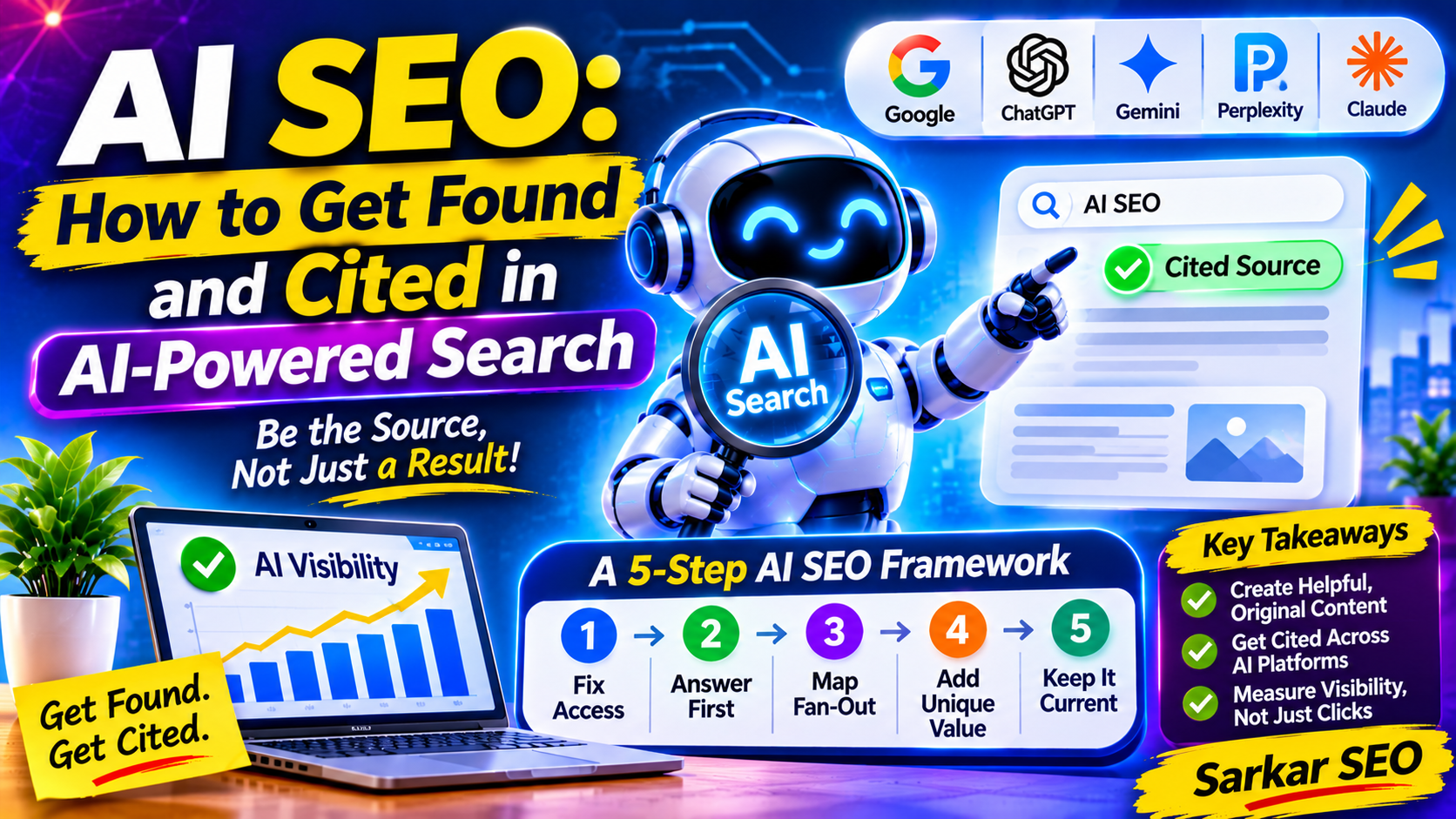
AI SEO is the work of making your content easy for search engines and AI assistants to find, understand and use in their answers. For Google, it remains ordinary good AI SEO: Google’s documentation says there are no additional requirements to appear in AI Overviews or AI Mode. Across other engines, the pages that earn visibility share a pattern: original substance, clear structure and evidence a model can lift into an answer.
More people now get an answer without opening a single result. The goal has shifted from ranking on page one to becoming part of the answer. Here is what the evidence supports, what it doesn’t, and how to act on it.
What AI SEO covers
Three labels circulate: AI SEO, generative engine optimization (GEO) and answer engine optimization (AEO). AI SEO is the broad term. GEO focuses on being cited inside generated answers, and AEO on being the direct answer to a question. The surfaces involved include Google AI Overviews, Google AI Mode, ChatGPT search, Perplexity and Gemini.
One mechanic matters more than the labels. Google says both AI Overviews and AI Mode may use “query fan-out,” issuing several related searches across subtopics to build a response. A page can therefore be cited for a question the user never typed.
What Google says you need
To appear as a supporting link, a page must be indexed and eligible to show in Search with a snippet. Google lists no further technical conditions. The same page says you don’t need new machine-readable files, AI text files or special schema.org markup. That documentation was last updated in December 2025, so check for newer guidance.
Your controls are the familiar ones. Robots.txt governs crawling by Googlebot, while nosnippet, data-nosnippet, max-snippet and noindex limit what Search displays. Google-Extended concerns AI training and grounding in some other Google systems, not Search itself.
For measurement, traffic from AI features is counted in the Search Console Performance report under the Web search type. Industry coverage from June 2026 reports that Google is testing a Search Console toggle for generative AI features. Confirm availability in your own property before relying on it. googledigitalinformationworld
What research shows about other engines
An April 2026 preprint by independent researchers, not yet peer reviewed as far as I could confirm, analysed 602 prompts and 21,143 citations across ChatGPT, Google and Perplexity. Average citations per answer were 6.88 for ChatGPT, 12.06 for Google and 16.35 for Perplexity. Yet ChatGPT’s cited pages showed far greater influence on the final answer, roughly 0.27 against about 0.06 for each of the others.
The pages that shaped answers most were longer, more modular, and richer in definitions, numerical facts, comparisons and procedural steps. Q&A formatting alone did not improve absorption. The authors warn that this is a static snapshot, so it shows correlation rather than cause.
The lesson: being cited and being used are different outcomes. Evidence density matters more than formatting tricks.
A five-step AI SEO framework
- Fix access first. A page that can’t be crawled or indexed can’t be cited. Check robots.txt, CDN and hosting rules, and make sure key content exists as text rather than inside images or scripts. At Sarkar SEO, this technical pass comes before any rewriting, because content fixes can’t compensate for a blocked page.
- Answer first, then expand. Put a two- or three-sentence answer directly under each major heading. Make it understandable if lifted out of context, with its qualifications attached. Define any technical term before using it.
- Map the fan-out. List the sub-questions behind your main query and cover them on one page or across a tightly linked cluster. For “AI SEO audit,” those might be crawl access, content gaps, entity clarity and measurement. A page that answers only the headline question is easier to skip.
- Add what only you can add. Industry coverage of Google’s newer guidance stresses unique, “non-commodity” content. A useful test: could a generic model write this page without your experience? If yes, add first-party data, original screenshots, test results or named expertise. Never invent them. A thin page with fabricated authority is worse than a modest honest one.
- Keep it current and measure it. Date your content and update it when facts change. Each month, run a fixed set of 20 to 30 target prompts across Google, ChatGPT, Perplexity and Gemini, and record whether you are cited, which page is used and what the answer says about you. Pair this with Search Console data.
Common mistakes
- Treating schema as a shortcut. Structured data should match visible text, but Google says AI features need no special markup.
- Stuffing FAQs. The preprint found Q&A formatting alone didn’t help absorption. Use questions where readers genuinely ask them.
- Publishing summaries of summaries. If your page repeats what ten others say, a model has no reason to prefer it.
- Optimizing for one platform. Engines retrieve differently. Sound fundamentals travel better than platform tricks.
- Promising citations. No one can guarantee them, and anyone who does is selling certainty that the research doesn’t support.
