



Almost every AI SEO team now uses AI somewhere in its process. The real question is where. Used well, AI speeds up research and removes tedious work. Used carelessly, it produces pages that search engines treat as spam. This guide shows where to draw the line.
The Rule Google Actually Enforces
Google does not ban AI-assisted content. Its guidance says generative AI can be useful for researching a topic and adding structure to original content, but using it to generate many pages without adding value may violate the scaled content abuse policy.
The policy is about purpose, not tools. Scaled content abuse means generating many pages primarily to manipulate rankings rather than help users, and the documentation names generative AI tools as one way it can happen. Human-written spam and AI-generated spam face identical consequences. ppcrankai
The stakes extend beyond classic results. Reporting on a recent documentation update says spam policies now explicitly govern what appears inside AI Overviews and AI Mode. A shortcut that fails in standard search will not work in AI answers either.
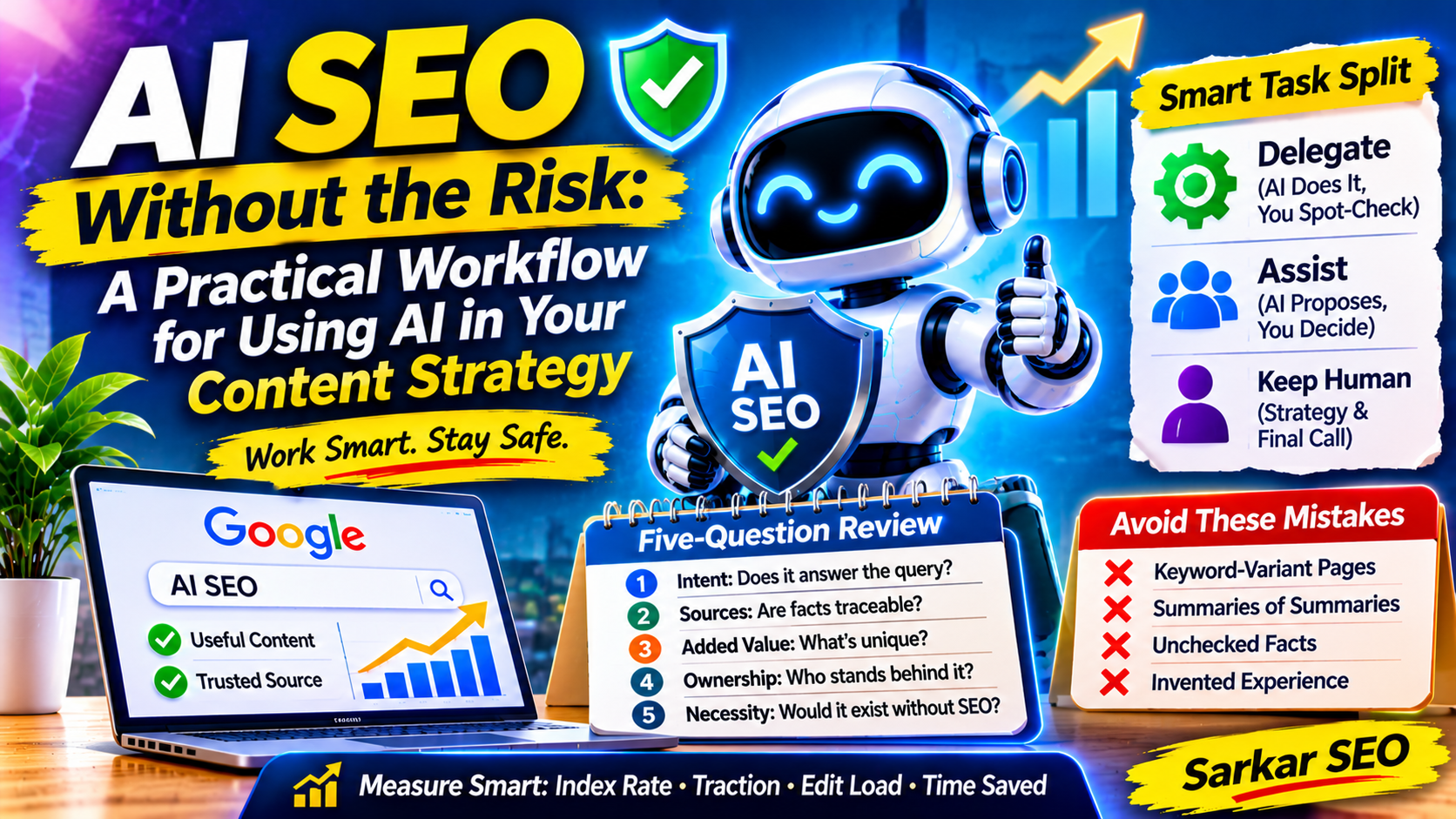
A Sorting System: Delegate, Assist, Keep Human
The framework below is a working model, not a Google standard. It sorts SEO tasks by how much judgment they need.
Delegate (AI does it, you spot-check):
- Clustering a large keyword export into topic groups
- Drafting several title tag options
- Building schema markup skeletons
- Summarizing call transcripts or customer reviews
- Finding duplicates or inconsistencies in redirect sheets
Assist (AI proposes, a person decides):
- Article outlines and first-draft FAQs
- Summaries of what currently ranks
- Internal link suggestions
- Meta description drafts
Keep human (no handoff):
- Positioning and which topics deserve a page at all
- Opinions, claims, and any original data
- Case studies and first-person experience
- Final edit and sign-off
- Anything touching health, legal, or financial advice
The principle is simple: the more a task depends on accountability or real-world experience, the less it belongs to a model.
Four Ways Teams Get Burned
- Keyword-variant pages. A spreadsheet of 400 near-identical queries turns into 400 pages. This is unnecessary, because Google’s models understand synonyms and general meanings, and rewriting copy for long-tail variations can run afoul of the scaled content abuse policy at scale. Build one strong page per intent instead.
- Summaries of summaries. Feeding the top ten results to an AI tool and asking for a “better” version yields a page with nothing new. Google’s rater guidance describes automated tools used as a low-effort way to make many pages that add little compared with what already exists on the topic. That is the pattern raters are told to look for.
- Unchecked facts. Google has added a warning that AI output may contain errors, along with advice to fact-check it by hand before publishing. A confident wrong statistic damages trust faster than a thin paragraph. searchenginejournal
- Invented experience. A model has never run a campaign or fixed a client’s migration. Publishing made-up first-person stories or testimonials is both dishonest and risky. If you lack real experience on a topic, say so or find someone who has it.
A Five-Question Review Before Publishing
Run every AI-assisted page through these checks:
- Intent: Does the opening answer what the searcher actually wants?
- Sources: Is every number, date, and policy traced to a primary source someone opened?
- Added value: Can you name one thing this page offers that top results lack? If not, don’t publish it.
- Ownership: Does a named, qualified person stand behind it?
- Necessity: Would this page exist if search engines didn’t?
One source summarizing Google’s guidance describes the editorial bar as accuracy, quality, and relevance, and says a page that fails those tests isn’t ready. The five questions above are a practical way to apply that standard.
A Sample Weekly Rhythm for a Small Team
This is an illustration of the model, not measured data:
- Monday: AI clusters new queries from a Search Console export. A strategist picks two worth pursuing.
- Tuesday: AI summarizes what ranks. A writer decides the angle based on real experience or fresh data.
- Wednesday: The writer drafts. AI helps tighten sentences and suggests headings.
- Thursday: An editor fact-checks and approves.
- Friday: Publish, add internal links from related pages, and log the page for later review.
Two pages a week with a clear reason to exist will usually beat twenty interchangeable ones. This is the kind of paced, review-first process Sarkar SEO recommends to clients who want AI speed without the quality penalty.
What to Measure Instead of Output Volume
Publishing counts reward the wrong behavior. Track these signals:
- Index rate: How many published pages actually get indexed?
- Traction: What share of new pages earn impressions within roughly two to three months? If many earn none, volume is outrunning value. This is a practical heuristic rather than a Google rule.
- Edit load: How much human rewriting does each draft need? A rising number can reveal weak prompts or weak source material.
- Time saved: How many hours did delegated tasks return to your strategists?
Sarkar SEO treats these four numbers as a basic health check for any AI-assisted content program.
