



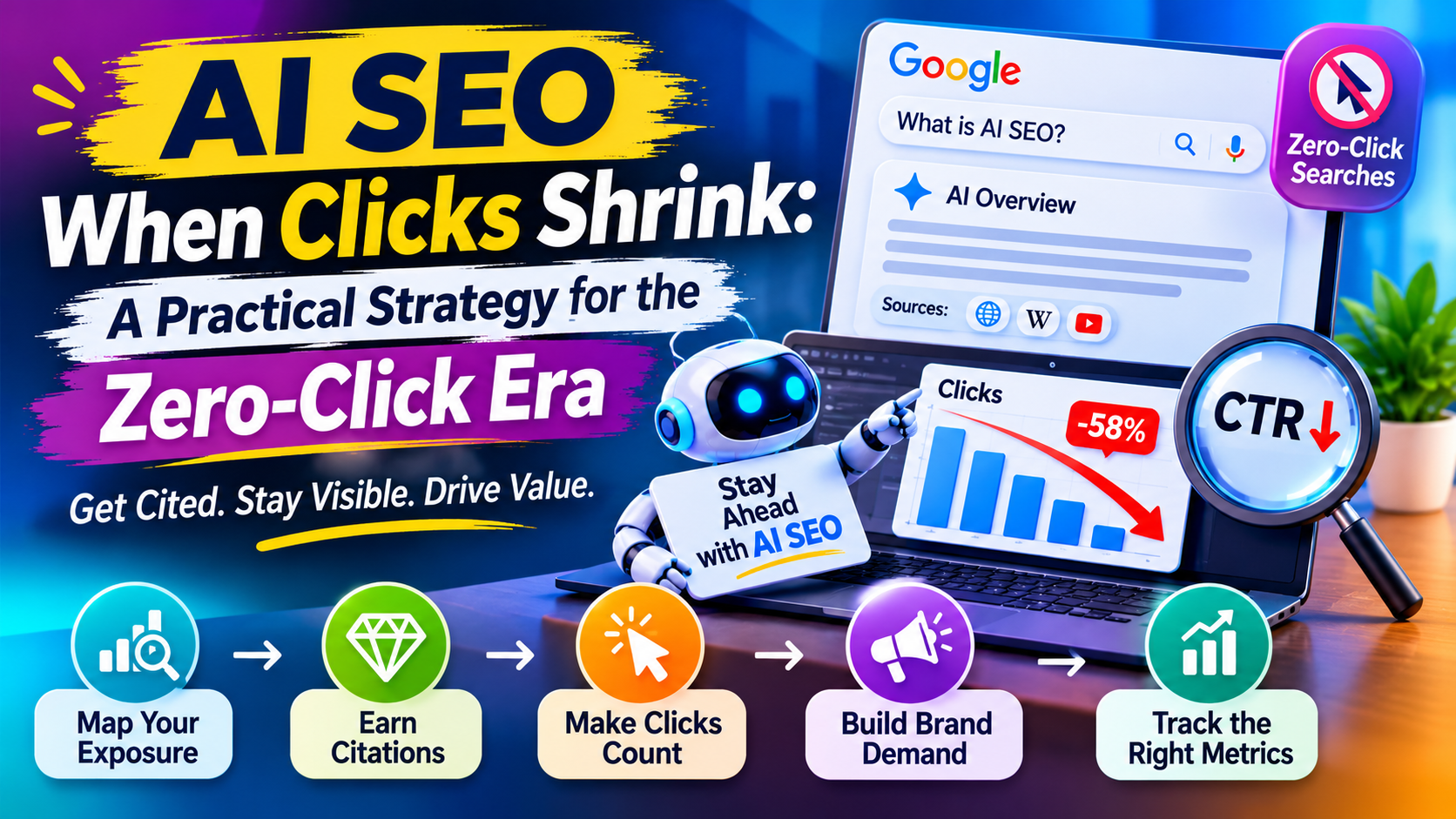
Ranking first used to mean a steady stream of visitors. Now many searchers read an AI-generated answer and leave. Traffic reports still look fine in some places and alarming in others, so what should a site owner do? This guide looks at AI SEO from the angle most articles skip: protecting revenue when impressions hold up but clicks don’t.
What the Click Data Says (and Doesn’t)
The evidence is mixed, and it’s worth knowing which numbers come from which method.
An Ahrefs analysis published in February 2026 reported that AI Overviews correlate with a 58% lower clickthrough rate for the top-ranking page, up from a 34.5% reduction in its April 2025 study. Correlation is not proof of cause, though. A randomized field experiment gave a cleaner read: AI Overviews reduced organic clicks by 38% on triggered queries, and zero-click searches rose from 54% to 72%. Earlier, Pew Research found that users click 8% of the time with AI Overviews, compared with 15% without. Ahrefs: AI Overviews Cut the Top Result’s CTR by 58% +2
Every method points the same way, but the size of the effect depends on the method. Plan around a meaningful decline, not a precise number.
There is one counter-signal. Seer Interactive’s later data suggests click-through rates on searches featuring AI Overviews are beginning to recover. Treat that as early and unsettled.
Where You’re Most Exposed
Not every page faces the same risk. Ahrefs found 99.2% of keywords that trigger AI Overviews are informational. That means “what is” and “how to” pages carry the most risk, while pages tied to buying decisions face less.
Exposure also varies by industry. In an Ahrefs study of French sites, health had the highest AI Overview rate at 22.2%, and its click-through rate fell 20.4%. The same study found a roughly linear relationship, with about one point of click-through lost per point of exposure.
So the first job is to measure your own exposure rather than relying on industry averages.
Step 1: Map Your Exposure
Export your top 200 queries from Search Console and sort them by intent. Then check which ones trigger an AI Overview. Ahrefs notes you can filter organic keywords by the AI Overview SERP feature, and most major SEO platforms offer something similar.
Sort your pages into three groups:
- High exposure: informational pages that trigger AI answers and have already lost clicks
- Medium exposure: comparison and evaluation pages
- Low exposure: pricing, local, branded and transactional pages
This map decides where you spend effort. Many sites over-invest in the high-exposure group because it holds their old traffic, even though that’s where clicks are least likely to return.
Step 2: Treat Citations as a Result, Not a Consolation Prize
When an AI answer cites you, you gain visibility even without a click. One aggregated analysis argues that a page that loses clicks to an AI Overview but is the cited source still captures brand exposure and authority credit. The same source reports that branded queries showed higher click-through when an overview appeared, though this comes from a compilation of several studies, so verify it against your own data.
To be the page that gets cited, write so a passage can stand alone. Lead each section with a direct answer, then add the evidence and the caveats. Include something an AI system can’t invent: your own pricing ranges, a documented process, a real before-and-after, or a clearly stated opinion. Sarkar SEO’s approach is to ask of every informational page, “what would be lost if this page disappeared?” If the honest answer is “nothing,” the page needs rework or retirement.
Step 3: Make the Remaining Clicks Count
If fewer people click, each visit matters more. Visitors who do click after reading an AI summary have already absorbed the basics. They tend to want depth, proof or a next step.
Rework high-exposure pages accordingly:
- Skip long preambles that repeat what the AI answer already said.
- Put the unique material, such as data, templates and tools, above the fold.
- Add a clear next step that matches the reader’s stage, such as a calculator, checklist or consultation.
- Link each informational page to the related commercial page.
A page can lose 30% of its visits and still produce more leads if the visitors who remain are better qualified. Judge pages on conversions, not just sessions.
Step 4: Build Demand That Doesn’t Depend on Rankings
Searches that include your brand name are the most resilient traffic you can have, because nobody has to choose you from a list of results. Brand demand comes from being known: consistent profiles, press mentions, expert contributions, webinars, newsletters, podcasts, and genuine participation in communities where your audience asks questions.
This work is slower than publishing blog posts, but it compounds. It also feeds AI engines, which rely on information about your business found across the web rather than only on your own pages.
Step 5: Rebuild Your Reporting
Old dashboards built around rankings and sessions will mislead you. Ahrefs’ advice from its French study is blunt: stop steering by impressions, because impressions didn’t drop; click-through rate is what took the hit.
A better scorecard includes:
- Click-through rate by exposure group, not sitewide
- Branded search volume and clicks over time
- Conversions and revenue from organic landing pages
- A monthly check of a fixed set of priority questions in several AI tools, noting whether you’re cited or mentioned
- Referral visits from AI platforms, which are small for many sites but often high in intent
What to Avoid
Panic deletion. Pages that lose clicks may still earn citations and support other pages. Review before removing anything.
Gaming tactics. Stuffing pages with artificial question-and-answer blocks adds length without adding value, and it doesn’t help real readers.
Ignoring paid search. One report summarized in Search Engine Land found paid click-through rose modestly from 14.6% to 16.2% when an AI Overview appeared. Consider paid support for high-value queries where organic clicks have dropped, but test it against your own numbers.
