



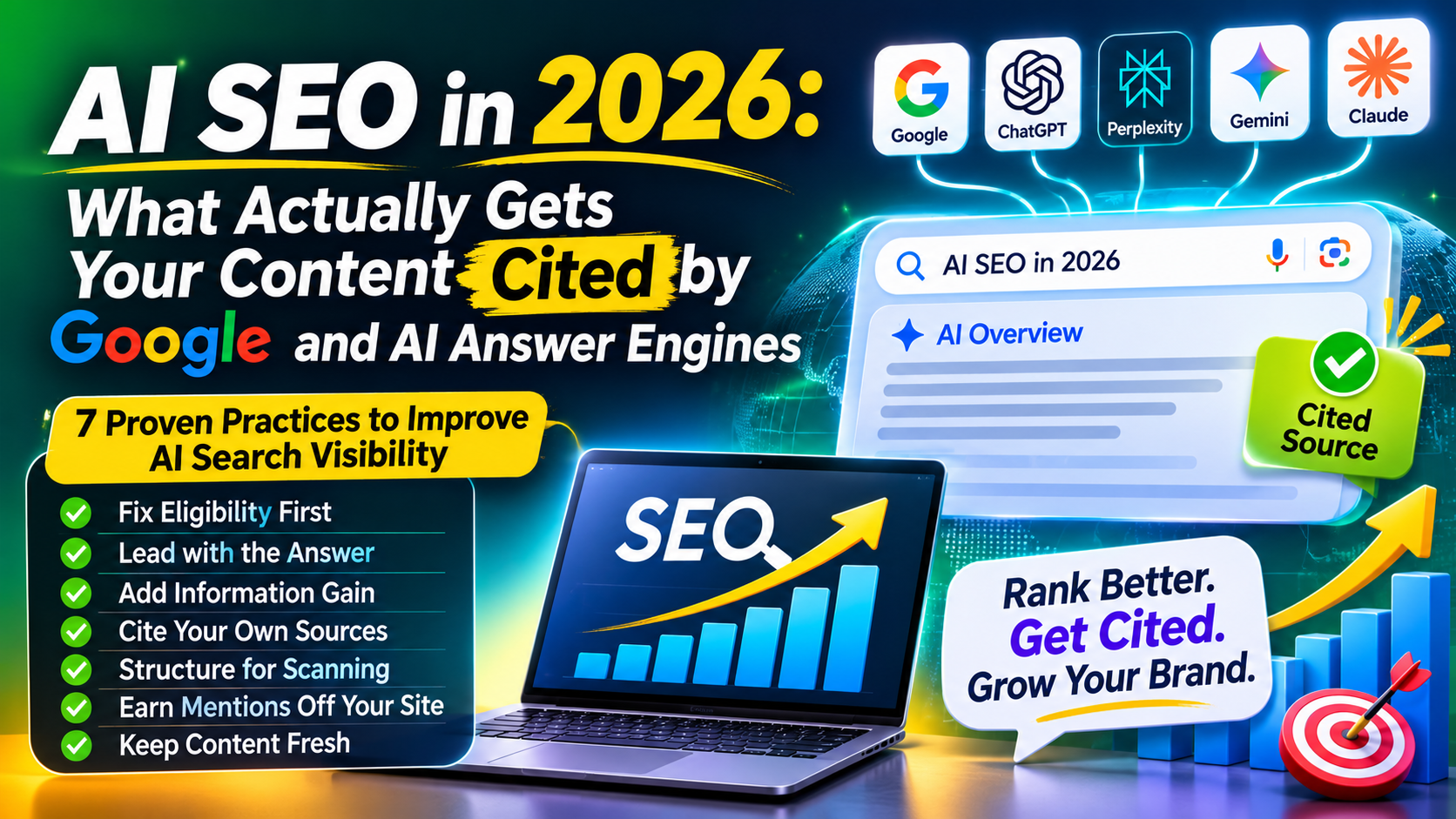
AI SEO means making your website easy for search engines and AI SEO assistants to find, understand, trust, and cite. Much of the advice online treats it as a new discipline with secret tactics. The evidence from Google’s own guidance and from citation studies says otherwise: the fundamentals still decide who gets visibility, and a few extra habits separate the pages that are cited from the pages that are ignored.
Is AI SEO a separate discipline?
For Google, no. Google Search Central published its guide on May 15, 2026, and its central claim is that SEO still matters because generative AI features are rooted in core ranking and quality systems. There is no separate “AI index” and no separate “AI ranking algorithm.” In practice, there are no extra requirements to appear in AI Mode beyond being indexed and eligible for a snippet. Back to Blog +2
That is why the team at Sarkar SEO treats AI SEO as an extension of strong search practice. The work doesn’t change in kind. Its priorities change.
What Google says you can stop doing
Several popular tactics get no support from Google’s guidance. Google does not treat llms.txt specially, and dedicated AI markup or Markdown copies of pages share the same fate. Rewriting pages “for machines” is also unnecessary. Google’s position is that content written clearly for people is what its systems are built to surface.
One nuance matters. llms.txt is optional for Google Search, not universally meaningless, so a company may still keep one for a specific tool or agent. Just don’t expect it to move your Google visibility.
Why ranking first no longer guarantees a citation
Many site owners assume a top-three ranking means an AI citation. The data suggests the link is weakening. One 2026 study of 863,000 keywords found that citations from top-10 pages in AI Overviews fell from 76% to 38% compared with mid-2025. This comes from a vendor-published study, so read it as direction rather than precise measurement. It still matches what many practitioners report: AI features increasingly pull from deeper in the index, and more of the long tail is in play.
For smaller publishers this is good news. You don’t have to outrank an industry giant for the whole query. You need the best, clearest answer to one specific part of it.
ChatGPT and Perplexity are not the same audience
Optimizing for “AI” as a single target is a mistake, because the engines behave differently. A Qwairy study of 118,101 AI-generated answers found Perplexity cites 21.87 sources per response while ChatGPT cites 7.92, and only 11% of cited domains overlap between platforms. A separate analysis points the same way: on the same question, Perplexity never touches 89.1% of the websites ChatGPT cites.
A research paper adds a useful distinction. Perplexity cites the most sources per prompt, while ChatGPT cites fewer sources with substantially higher influence on the generated answer. Being one of many citations earns a footnote. Being one of a few can shape the response itself.
The takeaway is to build broadly useful content and not chase a single engine’s quirks.
Seven practices that improve AI search visibility
- Fix eligibility first. If a page can’t be crawled, indexed, or shown as a snippet, nothing else matters. Google’s guidance references crawlability, site structure, mobile usability, page speed, and internal linking as factors that affect both traditional search and AI retrieval. Check Search Console before you rewrite anything.
- Lead with the answer. Place a direct, self-contained answer near the top of each section. Extractable pages tend to win. One analysis found that pages leading with a number, a clear definition, or a named framework are cited two to three times more often than pages burying the same fact in prose. Treat that as a vendor estimate, but the logic holds: a model can only quote what it can cleanly lift. digitalapplied
- Add information gain. Every page should contain something the top-ranking results lack: original data, a worked example, a real process, or a clear opinion backed by evidence. Summaries of summaries give an AI system no reason to cite you.
- Cite your own sources. The Princeton GEO study found that adding statistics, quotations, and source citations each improved AI visibility by 30 to 40 percent, while keyword stuffing decreased visibility by roughly 10 percent. Pages that show their evidence are easier for both people and models to trust.
- Structure for scanning. Use descriptive headings that mirror real questions, short paragraphs, and tables where comparison helps. Sections of roughly 120 to 180 words are reported to attract more ChatGPT citations, though that figure comes from a secondary roundup, so treat it as a guideline.
- Earn mentions off your own site. A University of Toronto study reported that AI engines favor earned media and institutional sources over owned content. Original research, expert commentary, and genuine partnerships create the third-party references that models rely on.
- Keep content fresh. Update pages that cover fast-moving topics, and show the date. Stale statistics are the quickest way to lose trust with readers and models alike.
How to measure what matters
Search Console will not show you everything. It won’t reveal when ChatGPT stops mentioning you. Track a fixed set of 20 to 30 priority questions monthly across Google AI Overviews, ChatGPT, Perplexity, and Gemini. Record whether you are cited, which page is used, and who else appears. Pair this with normal metrics such as impressions, clicks, and conversions.
Expect less click-through from some queries. One report claims 93 percent of AI Mode sessions end without a visit to a source website. Measure brand search growth and assisted conversions too, because visibility without a click still builds recognition.
A practical starting plan
Start with your ten most commercially valuable pages. Confirm each is indexable, rewrite the opening of every section to answer its heading directly, add one original asset such as a data point or a process diagram, and cite primary sources. Then publish genuinely new material instead of reworking old posts.
If you would rather have experts audit this, Sarkar SEO can review your site’s eligibility, content structure, and citation footprint. We’d rather start with an honest gap analysis than promise guaranteed placements, because no one can guarantee citations inside systems they don’t control.
