



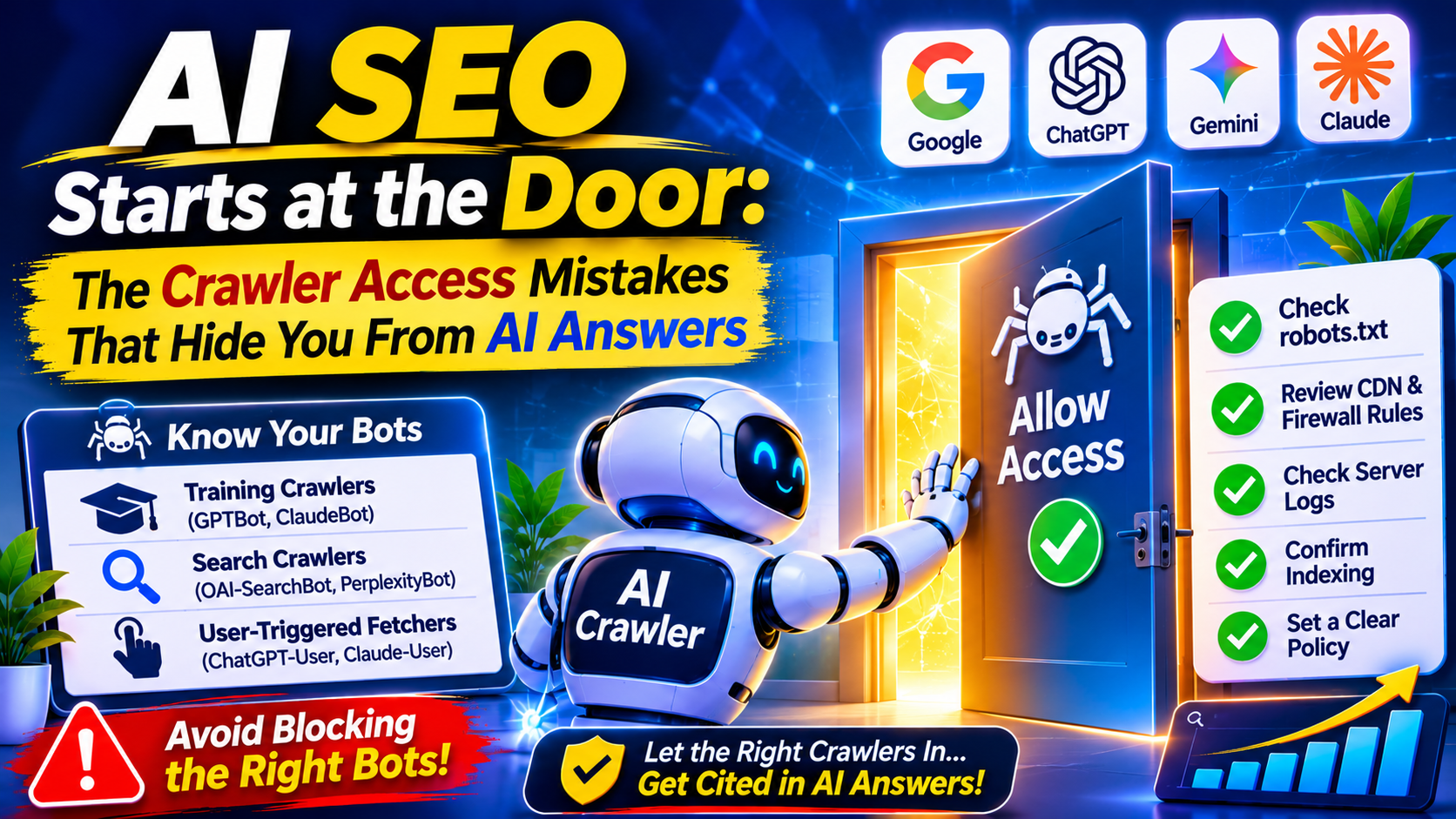
You can write the best answer on the internet and still never be cited, because the system that builds AI answers may never have read it. Many AI SEO plans start with content and skip a more basic question: are the right bots allowed in? At Sarkar SEO, this is the first thing we check, because it is cheap to fix and expensive to ignore.
One brand, three kinds of bot
“AI crawler” is not one thing. A useful breakdown separates training crawlers such as GPTBot, ClaudeBot and Google-Extended, search crawlers such as OAI-SearchBot, Claude-SearchBot and PerplexityBot, and user-triggered fetchers such as ChatGPT-User and Claude-User.
The roles differ sharply:
- Training crawlers gather text to train models. As one guide puts it, they send you nothing back.
- Search crawlers build the index an assistant searches when it answers a live question, then links its sources.
- User-triggered fetchers load a page when a person asks the assistant to. Reports disagree on whether they follow robots.txt rules, and one source says they generally ignore robots.txt by design, so blocking them may require CDN rules.
The key point is that each company runs these separately. Blocking one token does nothing to the others: GPTBot collects OpenAI’s training data, while OAI-SearchBot builds the index ChatGPT search retrieves from.
The most expensive misunderstanding
Plenty of site owners hear “AI is scraping my content” and block everything with “AI” in the name. That can remove you from the answers you want to appear in. Blocking OAI-SearchBot means ChatGPT search won’t show you, and disabling Claude-SearchBot stops Anthropic indexing you for search. lilachbullock
Google is a special case. Reporting on its guidance says Google-Extended doesn’t affect inclusion in Google Search and isn’t a ranking signal. Meanwhile, Googlebot matters far more than it looks, since it also gates AI Overviews and AI Mode eligibility. Google’s own documentation points the same way, listing crawl permission in robots.txt, including at the CDN and hosting level, among the fundamentals. lilachbullockguptadeepak
Publishers appear to understand the split. A robots.txt analysis across Cloudflare’s network reported that publishers block GPTBot about 2.3 times for every allow, but allow OAI-SearchBot outright. That is a deliberate trade: decline training, accept citation.
Your robots.txt is only layer one
Here is where audits usually surprise people. Your robots.txt file may say “welcome” while something upstream says “denied.” Security tools, content delivery networks and firewalls often classify unfamiliar bots as threats. One guidance piece recommends you check your CDN and WAF bot rules directly, then verify against server logs, not against intent.
The sequence to follow:
- Check robots.txt for every subdomain, since each has its own file.
- Check CDN and firewall rules for bot-protection settings that challenge or block unknown agents.
- Check server logs for actual hits from the search crawlers. Logs show what happened, not what you meant.
- Confirm page-level controls. Directives such as nosnippet or noindex can limit how your content appears. Google notes these controls apply to AI features too.
A sensible default policy
Your choice depends on your business model, and there is no universally correct answer. One guide calls training-crawler decisions a genuine judgment call, noting that blocking them costs nothing in today’s AI search results. That is one author’s claim about current behavior, and vendors can change how they use these systems.
Treat this as a starting template, not a prescription. Before deploying it, confirm current user-agent names in each vendor’s official documentation, because these tokens change and many of my sources are third-party guides.
A publisher selling premium research may reasonably block more. A local service business that wants customers to find it almost certainly should not. At Sarkar SEO, we usually recommend allowing search crawlers by default and revisiting the training question separately, with the business owner’s goals in mind.
What access does not do
Opening the door does not guarantee a citation. It only makes you eligible. Google states plainly that no specific optimization is required for AI Overviews and AI Mode, and the usual SEO fundamentals still apply. After access, the usual factors take over: clarity, originality, trust and relevance.
Do not expect a special file to rescue you, either. Coverage of Google’s guidance reports that llms.txt files are not necessary for Google Search, although other engines may treat them differently.
A thirty-minute access audit
Set aside half an hour and work through this:
- Open yourdomain.com/robots.txt and read it line by line. Look for blanket disallow rules left over from a staging site or an old developer.
- Search for any rule naming OAI-SearchBot, Claude-SearchBot, PerplexityBot or Googlebot.
- Ask your host or CDN provider what bot-management setting is active, and whether AI crawlers are blocked by default. Some platforms now offer one-click blocking, which is easy to enable by accident.
- Pull seven days of server logs and count requests from the search crawlers. Zero requests on a site that has been live for months is a signal worth investigating.
- Test a few of your key pages in Google Search Console’s URL inspection to confirm they are indexable and eligible for a snippet.
- Write down your training-crawler policy so the next developer does not undo it.
