



The most common question about AI SEO search is not technical. It is: will anyone still click? Marketers see AI answers filling the top of the page and wonder whether organic traffic has a future. This article looks at the evidence, explains why studies disagree, and gives a way to decide which pages are at risk. At Sarkar SEO, we think the answer is neither panic nor denial.
What the research shows
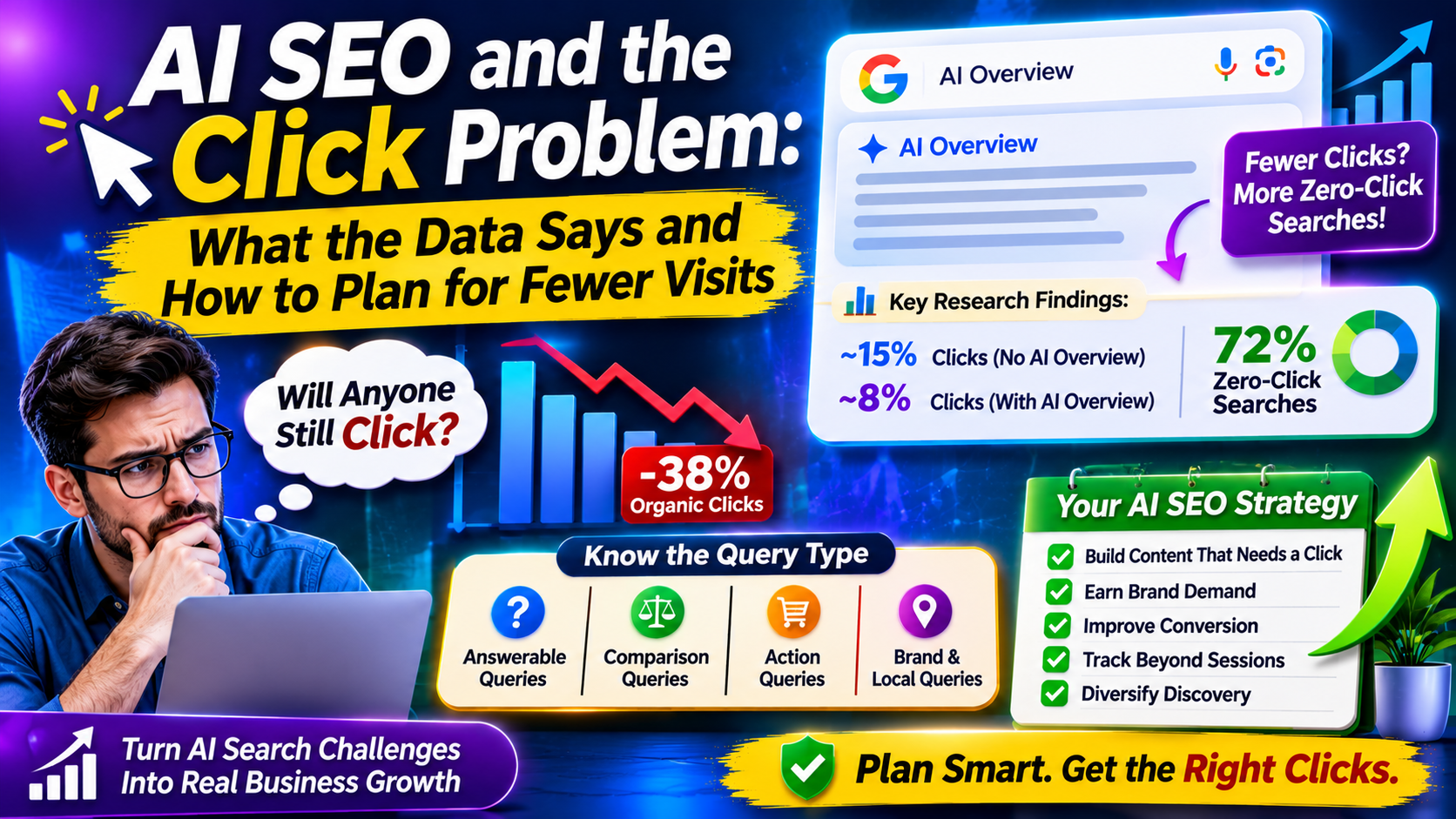
The strongest evidence comes from observing real behavior. Pew Research tracked about 900 US adults across roughly 68,000 searches and found that about 15% of searches without an AI Overview produced an organic click, versus around 8% when one appeared, and links inside the Overview were clicked in only about 1% of cases. Only about 18% of those searches triggered an AI Overview in the first place.
A randomized field experiment pushed further. According to Search Engine Journal’s report, it found AI Overviews reduced outbound organic clicks by 38% on triggered queries, with zero-click searches rising from 54% to 72%. Randomization matters here because it separates cause from coincidence, which most earlier studies could not. searchenginejournal
Ahrefs used a different method, analyzing Search Console data, and reported a 58% drop in click-through rate for top-ranking pages when AI Overviews appeared. Seer Interactive has reported even larger drops in a dataset of 53 brands, according to one aggregator, though I have not checked that study directly.
Why the numbers disagree
These figures look contradictory, but they measure different things. As one analysis explains, Ahrefs looked at click rates across large keyword sets, while Pew captured what people actually do on the search page. One counts only triggered queries, another counts all searches, and a third looks only at position one. The honest summary is that every credible study points the same way, while the size of the loss varies with query type, device and method.
Google disagrees on the quality side. Its documentation says clicks from pages with AI Overviews tend to be higher quality, with users more likely to spend more time on the site. Both claims can be true. Fewer clicks that are more engaged is a plausible outcome, but only your own analytics can show whether it holds for you.
Not all queries are equal
Averages hide the real story. One roundup suggests transactional queries, complex research and local services hold up better, because people still click when ready to buy, verify sources or book. Another reports that branded queries with AI Overviews saw an 18% increase in click-through rate, according to Amsive’s research. Treat that as one agency’s finding. superlinessearchenginejournal
The pattern suggests a simple triage. I use it as a working framework, not a published standard:
- Answerable queries (“what is,” “how many,” definitions). AI can fully satisfy these. Expect the steepest losses.
- Comparison and evaluation queries (“best X for Y”). Users want judgment and proof, so they click more often, but AI also names brands here.
- Action queries (pricing, sign-up, booking, buying). The click is the point. These are most resilient.
- Brand and local queries. People already know you or need your address, so visits remain likely.
List your top 50 landing pages and tag each with one of these four types. Within an hour you will see how exposed your traffic is.
A strategy for fewer, better clicks
Shift effort toward intent that needs a visit. If most of your traffic comes from simple definition pages, you are most exposed. Build more comparison guides, calculators, templates, checklists and tools, which an answer box cannot replace.
Make cited content earn the click. A summary can lift your fact, but it cannot lift your original dataset, your worked example or your downloadable resource. End answer-style sections with a reason to go deeper, such as a full methodology or a tool, not a vague “read more.”
Invest in brand demand. If people search your name, you keep traffic even when generic queries shrink. Webinars, newsletters, communities, original research and press work build that demand. Sarkar SEO treats this as part of AI SEO, not a separate branding project, because named brands are what answer engines tend to repeat.
Capture the visit you do get. Fewer visitors makes conversion rate matter more. Check page speed, clarity of the first screen, and whether the next step is obvious. A 20% drop in traffic is easier to absorb if conversion improves by the same amount.
Diversify discovery. Email, direct relationships, video, communities and partnerships all reduce dependence on a single results page. This is basic risk management, not an AI trend.
Measure beyond sessions
If you only watch sessions, you will see a decline and miss what AI visibility is doing for you. Track a wider set:
- Impressions and clicks together in Search Console. Rising impressions with falling clicks is the signature of an answer box absorbing demand.
- Branded search volume over time.
- Prompt tracking. Run a fixed list of 20 to 30 customer questions across engines each month and record mentions.
- Pipeline metrics. Leads, calls, demos and revenue by source, including “how did you hear about us” responses.
- Assisted conversions, since a person may meet you in an AI answer and return later by typing your name.
One caution: AI-referred visitors are still a small slice of total traffic for most sites, and tracking is imperfect. Report AI visibility as a directional indicator beside revenue, not a replacement for it.
What to do this month
Tag your top landing pages by the four types above. Choose the three most exposed answerable pages and add something an answer box cannot copy: original data, a tool or a deeper comparison. Then pick one brand-building action you can repeat monthly. Finally, set up a simple dashboard that puts impressions, branded searches and leads side by side.
