



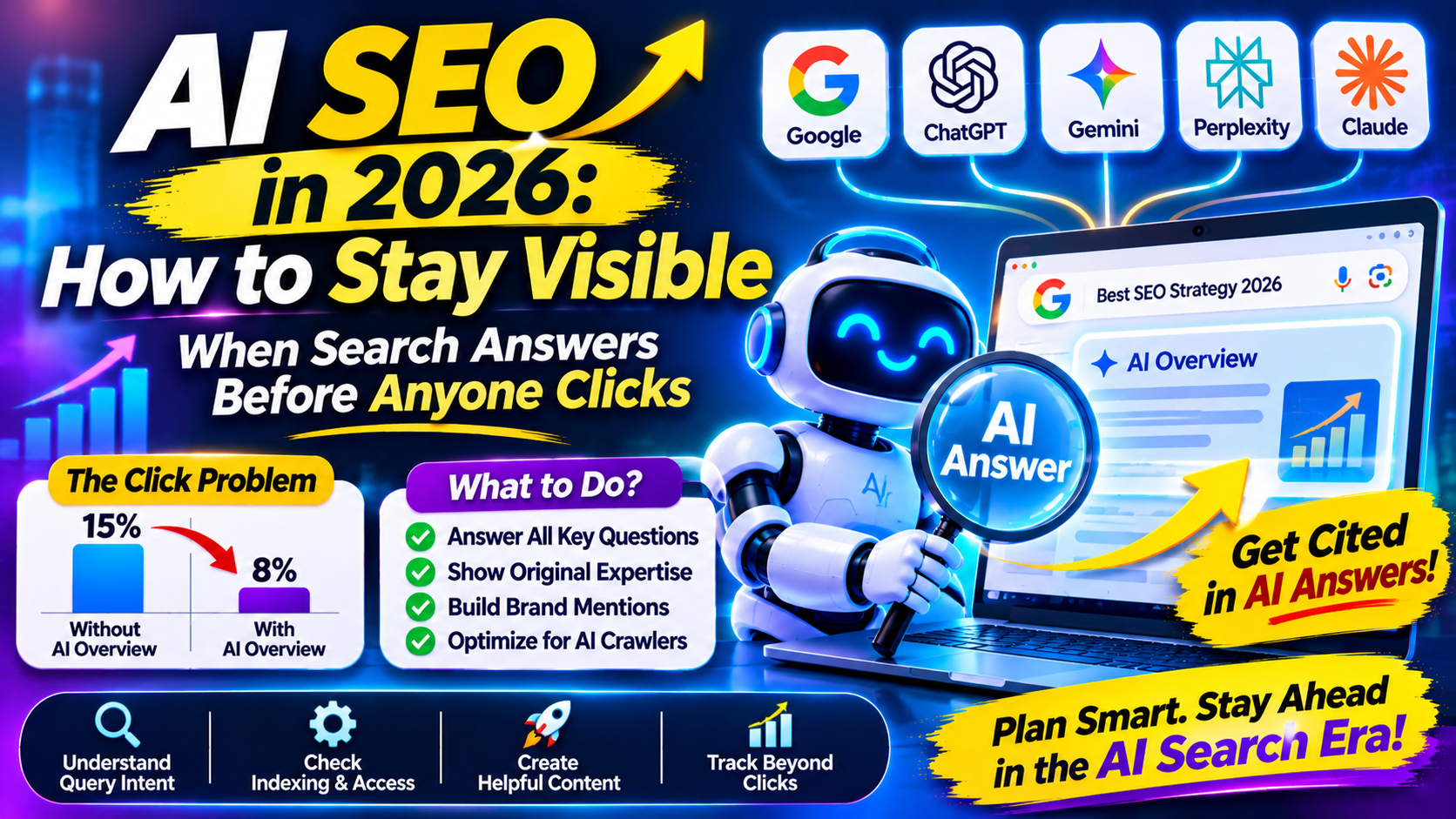
Your rankings may look healthy while your traffic quietly shrinks. Google, ChatGPT, Perplexity and Claude now answer many questions before a visitor reaches any website. AI SEO is the work of making sure your brand is still the answer they cite, and this guide separates what works from what is mostly noise.
What AI SEO Actually Means
AI SEO is optimizing your content and brand so they surface inside AI-generated answers. That covers Google AI Overviews and AI Mode, plus conversational engines like ChatGPT, Gemini and Perplexity. You will also see it called GEO, AEO or LLM optimization. The names differ, but the goal is the same: structuring content so it appears in Google AI Overviews, AI Mode, ChatGPT Search, Perplexity, Gemini, and similar answer engines.
The goal has moved from earning the click to earning the inclusion. At Sarkar SEO, we treat both as parts of one visibility system rather than rival disciplines.
The Click Problem, in Numbers
The traffic impact is measurable, though studies disagree on its size.
- An Ahrefs analysis of 300,000 keywords found that AI Overviews correlate with a 58% lower clickthrough rate for the top-ranking page. The same study measured a 34.5% drop in April 2025, so the effect roughly doubled in under a year.
- The damage reaches the whole first page. Position 10 still loses about 19.4%.
- A pre-registered randomized experiment, which isolates cause better than correlation, found that AI Overviews reduced organic clicks on triggered queries by 38%.
- Earlier, Pew Research reported that users click 8% of the time with AI Overviews, compared to 15% without. searchenginejournal
The numbers differ, but the direction is consistent. Informational queries are hit hardest, while two aggregated analyses suggest branded searches hold up better. That is a strong argument for building a brand people search for by name.
What Google Says Works, and What It Says to Ignore
On May 15, 2026, Google released its first official guide to optimizing for AI search, and on-site SEO is still the foundation. The guide says AI Overviews and AI Mode are built on the same Search infrastructure, with no additional technical requirements. If Google cannot crawl, index or understand a page, that page cannot appear in either feature.
The guide also lists five tactics you can ignore for Google’s AI features: llms.txt files, content chunking, AI-specific content rewriting, inauthentic mentions, and structured-data obsession.
The schema point is easy to misread. Google did not say to drop structured data. It said there is no special AI schema, and that treating markup as a citation lever is a mistake. One Ahrefs test supports this: 1,885 pages that added schema saw no meaningful citation lift on AI Overviews, AI Mode or ChatGPT. Keep schema for clear entity identity. Do not expect it to buy citations.
Write for the Questions Behind the Question
AI Mode and, to a lesser degree, AI Overviews use query fan-out, which breaks a question into sub-queries instead of running one search. A page targeting one keyword competes only for the surface question. A page that also answers the follow-ups, comparisons, objections and “what about my situation” angles can be pulled into several of those sub-queries at once.
This is where most competing guides stay generic. Before writing, list the five or six questions a buyer asks after your headline question. Then answer each one plainly, with your own data, examples or experience. Anything an AI can paraphrase from ten other pages gives it no reason to cite yours.
Beyond Google: The Off-Site Layer
Google’s guide covers Google. Semrush notes that Google’s AI features retrieve from Google’s index, while ChatGPT, Perplexity and Gemini draw on training data plus their own retrieval. So how the wider web describes you matters: reviews, expert commentary, directory profiles, podcasts and credible publications all shape what these engines say about you.
Agents are the next layer. Google’s guide notes that browser agents may analyze screenshots, inspect page structure and interpret the accessibility tree. Clean, accessible, fast pages serve both people and software.
A Practical AI SEO Plan
- Audit your AI footprint. Ask ChatGPT, Gemini, Perplexity and Claude the questions your customers ask. Record whether you appear, how you are described, and which competitors are cited.
- Fix the foundation. Confirm key pages are crawlable, indexable and fast, with accurate titles and clean internal links.
- Lead with answers. Put the direct answer in the first lines under each heading, then add depth. This helps readers and extractors alike.
- Add original information. Publish first-party data, real case notes, pricing ranges or tested processes. Never invent them.
- Show real expertise. Use named authors, credentials, dates and sources, which support trust signals.
- Build mentions honestly. Earn coverage and reviews. Google lists inauthentic mentions among the tactics to avoid, and they can backfire.
- Refresh on a schedule. Update statistics and screenshots on high-value pages, with visible dates.
Sarkar SEO’s view is simple: do fewer things, and make each page the most useful result for its question.
Measure Differently
Rankings alone no longer show the full picture. Track branded search growth, citation frequency across AI engines, referral traffic from AI platforms, and conversions rather than raw sessions. Impressions may hold steady while clicks fall, so click-through rate deserves its own line in your reports. Review citations monthly, since AI answers can change quickly. If your team lacks the tooling, Sarkar SEO can help you set up a repeatable tracking routine.
