



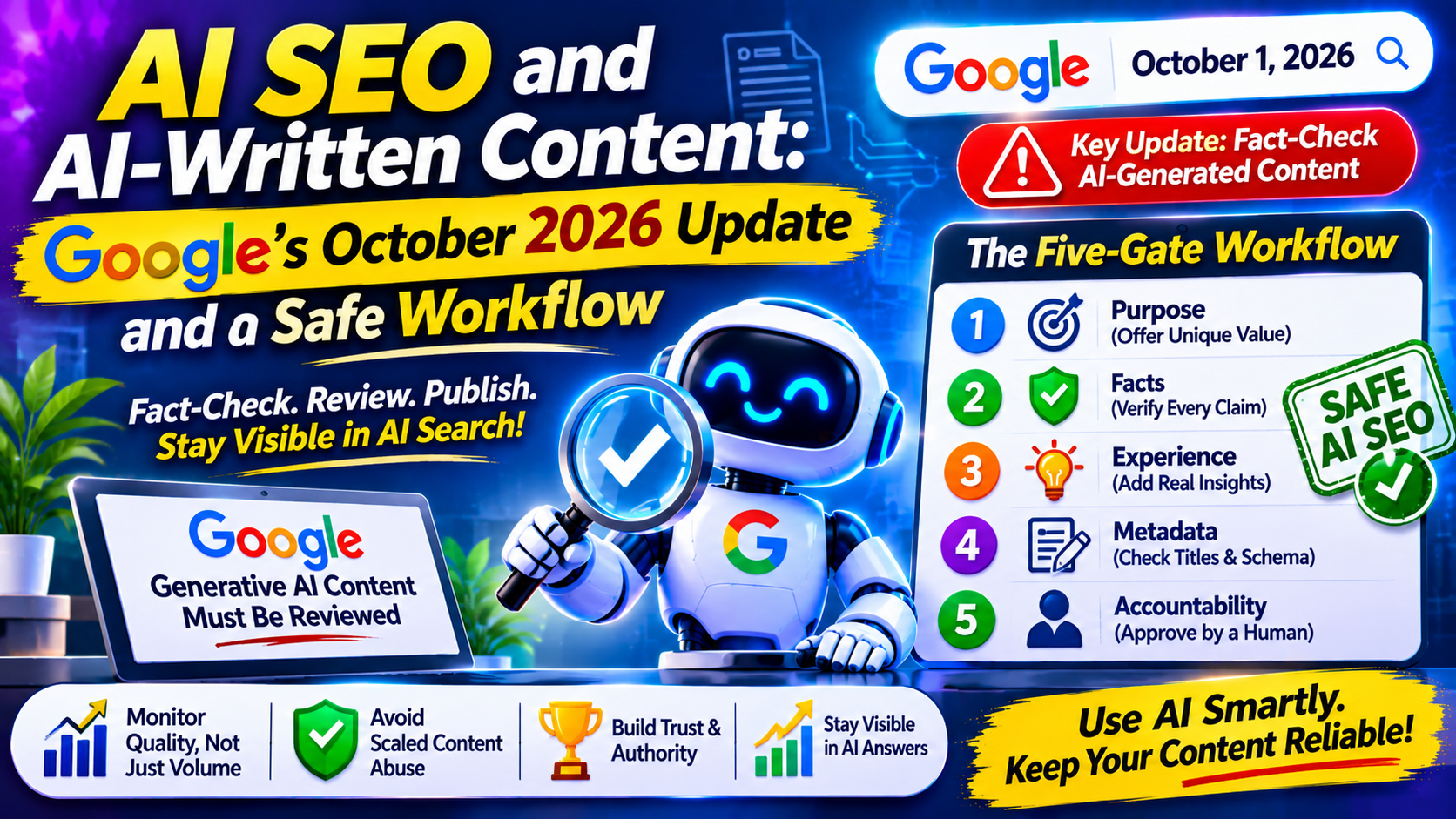
Almost every marketing team now uses AI SEO to draft content. The risk is not that Google dislikes it. The risk is publishing machine-written pages that nobody checked. On October 1, 2026, Google updated its guidance on exactly this, and the change is worth building into your process. This article explains what changed, what Google has said consistently, and how to set up a review workflow. At Sarkar SEO, we see AI as a good assistant and a poor publisher.
What Google changed on October 1
According to Search Engine Journal’s report, Google added three sentences to its guidance on generative AI content. They explain that generative models predict likely word sequences rather than retrieve facts, so outputs can contain errors, and that manually fact-checking and reviewing all AI-generated content before publishing is critical. The same report notes that the review also applies to metadata, including title elements, meta descriptions, structured data and image alt text.
That last point is easy to miss. Plenty of teams carefully edit body copy and then let a tool write titles and alt text in bulk. Google’s wording now covers those fields too.
The same report says Google’s changelog tied the update to information from its Search Quality Rater guidelines. It also notes Google has pushed human review before: Googlers made similar comments in 2024 and 2025. So this is a clearer statement of a long-standing position, not a reversal.
What has not changed
Google’s stance on AI use itself is steady. Its documentation says generative AI can be useful for researching a topic and adding structure to original content. The warning attached to it is just as consistent: using generative tools to make many pages without adding value for users may violate the spam policy on scaled content abuse.
Coverage of the rater guidelines adds detail. They treat as abuse using automated tools, generative AI or otherwise, as a low-effort way to produce many pages that add little to no value compared with other pages on the topic. Notice the phrase “or otherwise.” The standard is about value and effort, not the tool. A human content farm and an AI content farm are judged the same way. userp
One more reminder: raters’ scores do not directly influence ranking, according to the same Search Engine Journal report. They help Google evaluate its systems.
Why this matters for AI search
This is not only a Google Search issue. Answer engines quote what they retrieve, so a wrong claim on your page can become a wrong claim in someone else’s answer, attached to your brand. One analysis of Google’s guidance says spam policies are formally in scope for AI Overviews and AI Mode citations. Accuracy is both a quality rule and a reputation rule.
A five-gate workflow
Here is a process I recommend. It is my own framework, not a Google standard. Every AI-assisted page passes five gates before it goes live.
Gate 1: Purpose. Can you state, in one sentence, what this page offers that existing results do not? If the answer is “it covers the keyword,” stop. That is the profile of a low-value page.
Gate 2: Facts. Every number, date, name, quote and product claim gets checked against a primary source by a person. Keep a short log of what was verified and where. This directly answers Google’s fact-check instruction.
Gate 3: Experience. Add something a model cannot know: a client scenario, a test result, a photo you took, an opinion with reasoning, a mistake you made. Google’s guidance emphasizes expertise and experience, and AI cannot supply lived experience on its own.
Gate 4: Metadata. Read the title, meta description, schema fields and alt text yourself. Confirm they describe the page truthfully and that schema matches visible content.
Gate 5: Accountability. A named person approves the page and appears as author or reviewer. If something is wrong, a human owns the fix.
Where AI helps most
Used well, AI saves time without creating risk:
- Research prep: summarizing sources you then read yourself.
- Outlines and structure: testing heading order and question coverage.
- Editing: tightening drafts you wrote, spotting repetition.
- Repurposing: turning a verified article into email copy or social posts.
- Data cleanup: formatting tables you have already validated.
It is riskier for first-draft factual claims, medical or financial advice, legal statements, statistics and anything you cannot easily verify.
Audit what you already published
The October update also invites a look backward. If you published AI-assisted pages in the past two years, sample twenty of them. Check for unverifiable statistics, invented quotes, outdated product details and generic phrasing repeated across pages. Fix what you find, merge pages that overlap, and remove ones that add nothing. Sarkar SEO often finds that consolidating a dozen thin pages into three strong ones does more for visibility than publishing another dozen.
Watch for patterns that suggest scale without substance: many near-identical pages differing by a city name, templated intros, and articles with no named author.
What to measure
Track quality, not volume. Useful signals include indexed pages versus pages that receive impressions, engagement on AI-assisted pages versus fully human ones, edit rates in your fact-check log, and whether your brand appears accurately in AI answers. If a model repeats an error about you, trace it to its source and correct it there first.
