



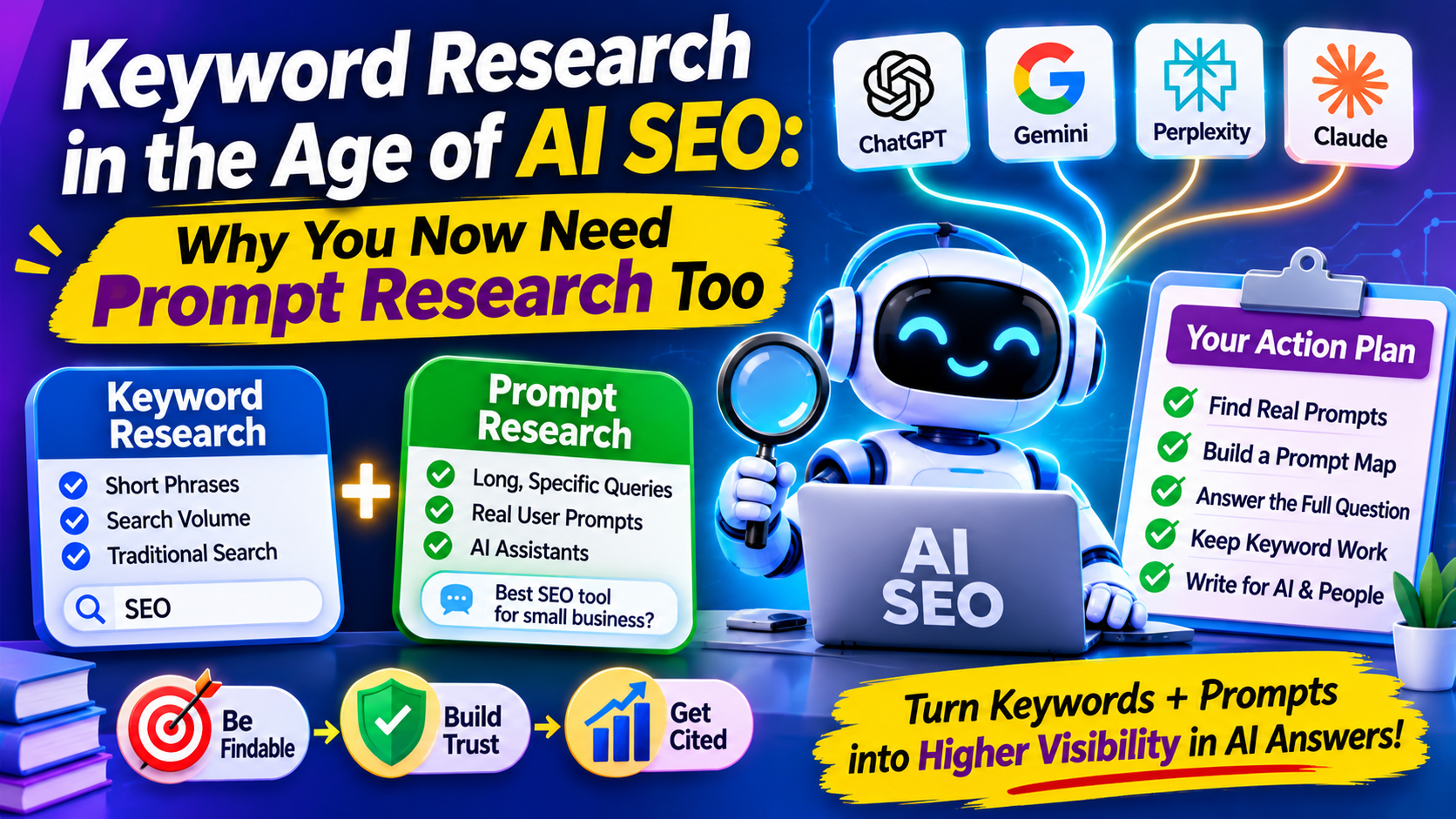
Your keyword tool says a phrase gets 40,000 searches a month. It looks like clean, reliable data. But it counts only what people type into traditional search engines. It cannot tell you what they ask ChatGPT, Gemini, Perplexity or Claude, and those questions are often longer, messier and more specific.
This is the practical problem at the heart of AI SEO. The work is not abandoning keyword research. It is adding a second layer to it.
Keywords and prompts are different things
A keyword is a short phrase typed to find pages. A prompt is an instruction or question given to a system that writes an answer. One industry explainer puts the difference this way: prompt research looks at the conversational, long-form questions people ask AI engines, while keyword research looks at the shorter terms used in traditional search.
The numbers people quote for prompt length vary a lot. One source claims prompts average about 60 words against 3.4 words for a typical Google query. Another puts the range at 10 to 25 words for prompts and 2 to 5 for keywords. A third cites around 23 words for a ChatGPT prompt without search. The estimates conflict, so treat all of them as rough. What they agree on is the direction: prompts carry far more context than keywords do. prompt volume vs search volume keyword strategy +2
That context is the opportunity. A prompt like “I run a ten-person accounting firm in Canada and need software that handles multi-currency invoices” tells you the buyer’s size, location and problem. A keyword like “accounting software” tells you almost nothing.
A surprising twist: short prompts still matter
It would be easy to conclude that everything is now conversational. The evidence is more mixed. A study covered by Search Engine Journal, run with Peec AI, reported that concise, keyword-style prompts such as “best CRM small business 2026” led to more brand mentions, with up to a 25% average visibility advantage. This is one study and its method deserves scrutiny, but it points to a useful principle: don’t throw away your keyword list. Short, commercial phrases still trigger recommendation-style answers.
Other claims in circulation deserve more caution. You will see statements that 58% of knowledge queries now begin as conversational prompts or that about 70% of searches contain conversational elements. Those come from vendor blogs without clear public methodology, so I would not build a strategy on them. textatexta
Where to find real prompts without special tools
You don’t need a new software subscription to start. Several free sources already hold the language your buyers use.
Search Console. One practitioner guide suggests filtering your queries for anything longer than six words, since those are closest to the conversational format people use with AI platforms. The cutoff is arbitrary, but the habit is sound. Your own data shows what people already ask before they reach you.
People Also Ask and related searches. These show the follow-up questions around a topic, and AI answers tend to resolve those same follow-ups.
Your sales and support conversations. This is the richest source and the one competitors cannot copy. Read recent emails, call notes and chat logs. The exact words a customer uses on a first call are the closest thing you have to a real prompt.
The assistants themselves. Ask ChatGPT or Perplexity a question the way a buyer would, then read which follow-up suggestions and sources appear.
Dedicated platforms now exist too. Semrush, Sistrix and others have launched prompt or AI-volume features. One of those vendors describes its approach as using topics instead of keywords, based on over 62 million real user questions. That is a vendor claim about its own product, but it shows where the tooling is heading.
A simple method: build a prompt map
At Sarkar SEO, the most useful planning exercise is a one-page prompt map for each service or product. It has four columns:
- The situation. Who is asking, and what is going wrong for them?
- The prompt. Write it the way they would say it, including constraints like budget, location and team size.
- The decision stage. Are they learning, comparing, or ready to buy?
- The page that should answer it. If nothing on your site does, you have found a content gap.
Aim for twenty to thirty rows. You will quickly see that many prompts blend several intents at once. A single prompt might ask for a definition, a comparison and a recommendation. Pages that handle only one of those leave work undone for the reader.
How to write for a prompt, not a keyword
Once you have your map, adjust how you write.
Name the situation in the page itself. If you serve small law firms, say so, and describe their problems in their own terms. Generic pages written for “businesses” are easy for an assistant to skip because they match nothing specifically.
State the constraints you handle. Pricing ranges, team sizes, industries, regions and limits make a page more useful to a person with a specific need. Honesty about who you are not for builds trust and also helps a system match the right reader to the right page.
Answer the likely next question. Conversations don’t end after one turn. One source reports an average of 4.7 turns per conversational session, against 1.3 queries per keyword session. I would treat the exact figures as unverified, but the behavior is easy to confirm in your own use. Put the obvious next question and its answer on the same page.
Keep the keyword work. Use your primary term in the title and opening, as always. The point is to add prompt language around it, not replace it.
What not to do
Do not write a hundred near-identical pages for a hundred prompt variations. Prompts vary endlessly, and the underlying need is usually the same. Cover each need once, thoroughly, instead of spinning versions of it.
Do not treat prompt volume numbers as precise either. Tools that estimate them rely on models and samples, and the market is young.
Where to start this week
Pick one service. Spend an hour reading customer emails and Search Console queries. Write ten real prompts. Check which of your pages answers each one, and rewrite the weakest page first. That single exercise usually reveals more than another round of keyword exports.
If you want help turning this into a plan for a full site, Sarkar SEO at www.sarkarseo.com works on exactly this blend of classic search and AI visibility.
