



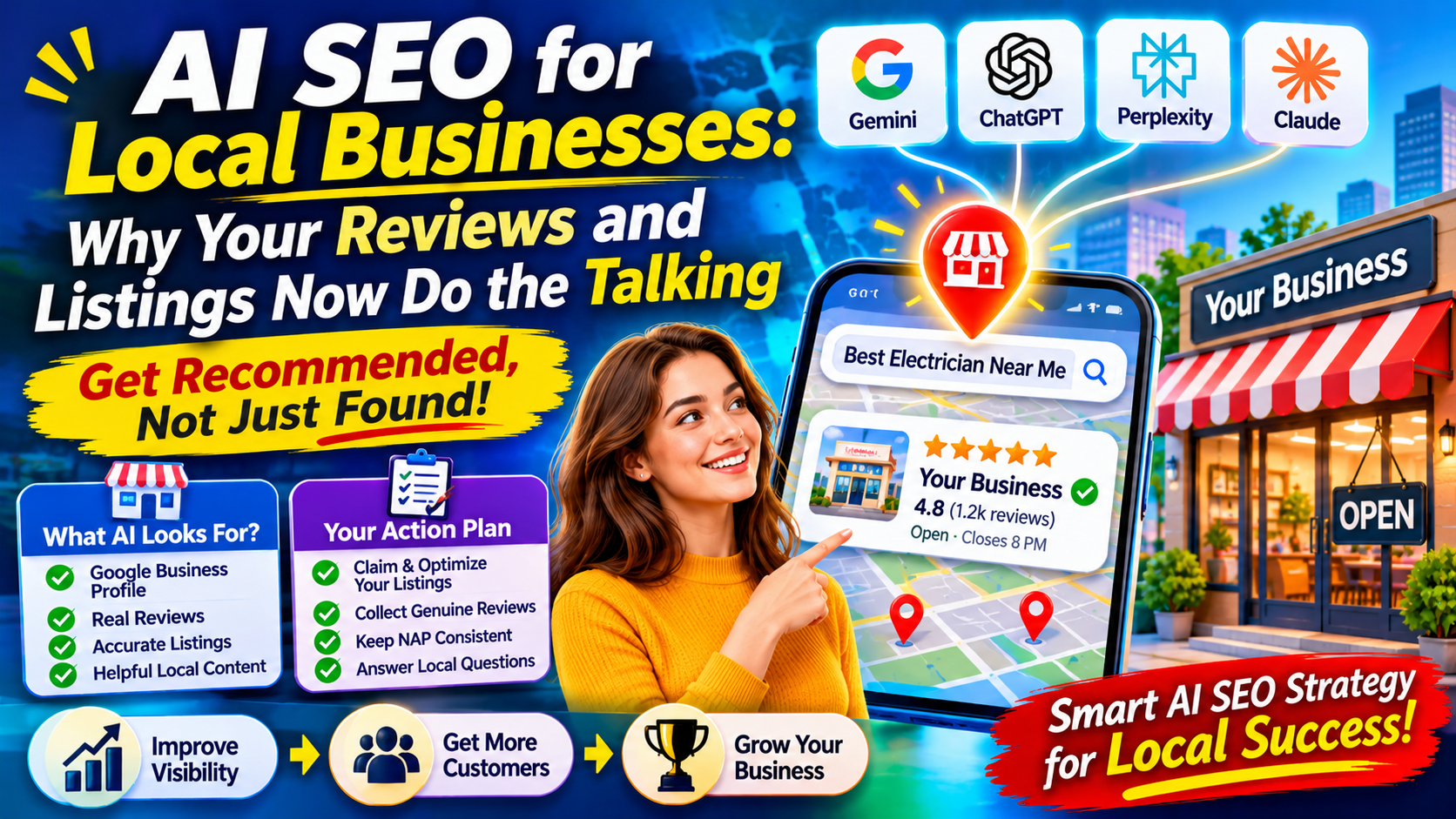
Ask an AI assistant for “a reliable electrician near me” and it won’t hand you ten links. It will name two or three businesses. If yours isn’t one of them, the customer may never know you exist.
For local firms, this is the sharpest edge of AI SEO. The gap between being listed and being recommended is wide, and the evidence suggests it is decided mostly outside your website.
The recommendation gap
SOCi’s 2026 Local Visibility Index studied more than 350,000 business locations across 2,751 brands. Its headline finding: AI platforms recommend only 1.2% of locations on ChatGPT, 7.4% on Perplexity and 11% on Gemini, against 35.9% visibility in Google’s local 3-pack.
SOCi sells local marketing software, so read the figures as one vendor’s dataset, not settled fact. Still, the direction is plausible. A local pack shows three businesses for any search. An AI answer may name one or two, and each platform picks differently.
Demand is real too. One summary of BrightLocal’s 2026 survey of 1,002 US adults reports that 45 percent had used an AI tool for local business recommendations in the past year, up from 6 percent in 2025. That is a secondhand summary of a US-only sample, so treat it as a signal and not a global figure. omnionlinestrategies
Strong Google rankings still help
Here is the encouraging part. A UK study from Whito asked Google AI Mode to recommend a trustworthy firm across eight trades in 20 UK towns, then compared the results with Google’s local top 20 for the same searches, covering 3,149 businesses. Among businesses in Google’s local top three, 54% had been named by AI Mode, against 8% for those ranked 11th to 20th.
Whito also sells monitoring services, and the sample covers one country and a handful of trades. Even so, the practical reading is useful: doing ordinary local SEO well appears to be the best predictor of AI recommendations. You may not need a mystery “AI service.” You may need your existing basics, done properly.
Each assistant looks in a different place
The most useful thing I found is that platforms don’t share a single source of truth.
Gemini and Google’s AI features lean on Google’s own data. SOCi reports that business profile accuracy is 100% on Gemini, which is grounded directly in Google Maps, against 68% on ChatGPT and Perplexity.
ChatGPT is murkier. One local analysis cites Search Engine Land testing that found ChatGPT relies on Bing-indexed web results, not directly on your Google reviews. SOCi, meanwhile, reports ChatGPT’s alignment with Google’s index rose from 12% to 33% in recent months. Those two claims pull in different directions, which tells you the behavior is shifting. Don’t bet on a single channel.
Perplexity is described in one guide as favoring vertical directories, reviews and Reddit threads. That is a single secondary source, so verify it against what you see when you test your own category.
The safe takeaway: your visibility depends on being accurate and consistent in many places, not perfect in one.
What to fix first
At Sarkar SEO, local audits tend to follow a fixed order, from the most reliable fixes to the most speculative ones.
- Claim and complete your Google Business Profile. Categories, services, hours, photos and a clear description. Several sources agree this is the foundation, and one notes that Google’s AI Overviews and AI Mode both use the profile as their main source of local business information.
- Claim Bing Places. This is often forgotten. One guide argues that an unclaimed or inaccurate Bing Places profile is a meaningful disadvantage in ChatGPT local recommendations. The reasoning follows from the Bing dependence above, though it is a vendor claim. Claiming the profile costs nothing, so the downside is small. pages
- Make your name, address and phone number identical everywhere. Small differences, such as “Street” versus “St.”, confuse systems that cross-check sources. Fix directories, social profiles and your own site.
- Earn reviews steadily and honestly. Reviews carry heavy weight in local results. One Search Engine Journal piece calls them the heaviest signal for local intent, covering volume, recency, sentiment and the actual language customers use. That last point matters: a review that mentions the specific service and neighborhood is more useful than “great!” searchenginejournal
- Never buy or incentivize reviews. Google has been tightening Business Profile review policies, cracking down on bulk solicitation, incentivised reviews and coordinated campaigns. A penalty costs far more than the shortcut saves.
- Write pages for real local questions. A page titled “Emergency boiler repair in Leeds: what it costs and how fast we arrive” does more than a generic services page. State prices where you can, areas you serve, and what a first visit involves.
What the data does not tell you
Be cautious with precise percentages. Different studies attribute very different weights to reviews, profiles and on-page content, and those figures vary by method and year. One source says reviews account for 20% of local ranking weight, up from 16% a year ago. Another summary of a different survey puts reviews at 16% of AI citation influence. They measure different things, so don’t treat any one number as a recipe.
Likewise, claims such as AI Overviews influencing 47% of local queries come from a podcast summary and I couldn’t trace them to a primary study. I’d avoid quoting them.
How to check where you stand
You can test this in an hour, with no software.
- Write five questions a customer would ask, such as “best family dentist in Denver.”
- Ask each one in ChatGPT, Gemini, Perplexity and Google AI Mode.
- Record whether you appear, who does, and which sources they cite.
- Repeat monthly. Answers change, so look for trends, not single results.
Pay special attention to competitors who appear without ranking well. Their listings and reviews will usually show what you’re missing.
