



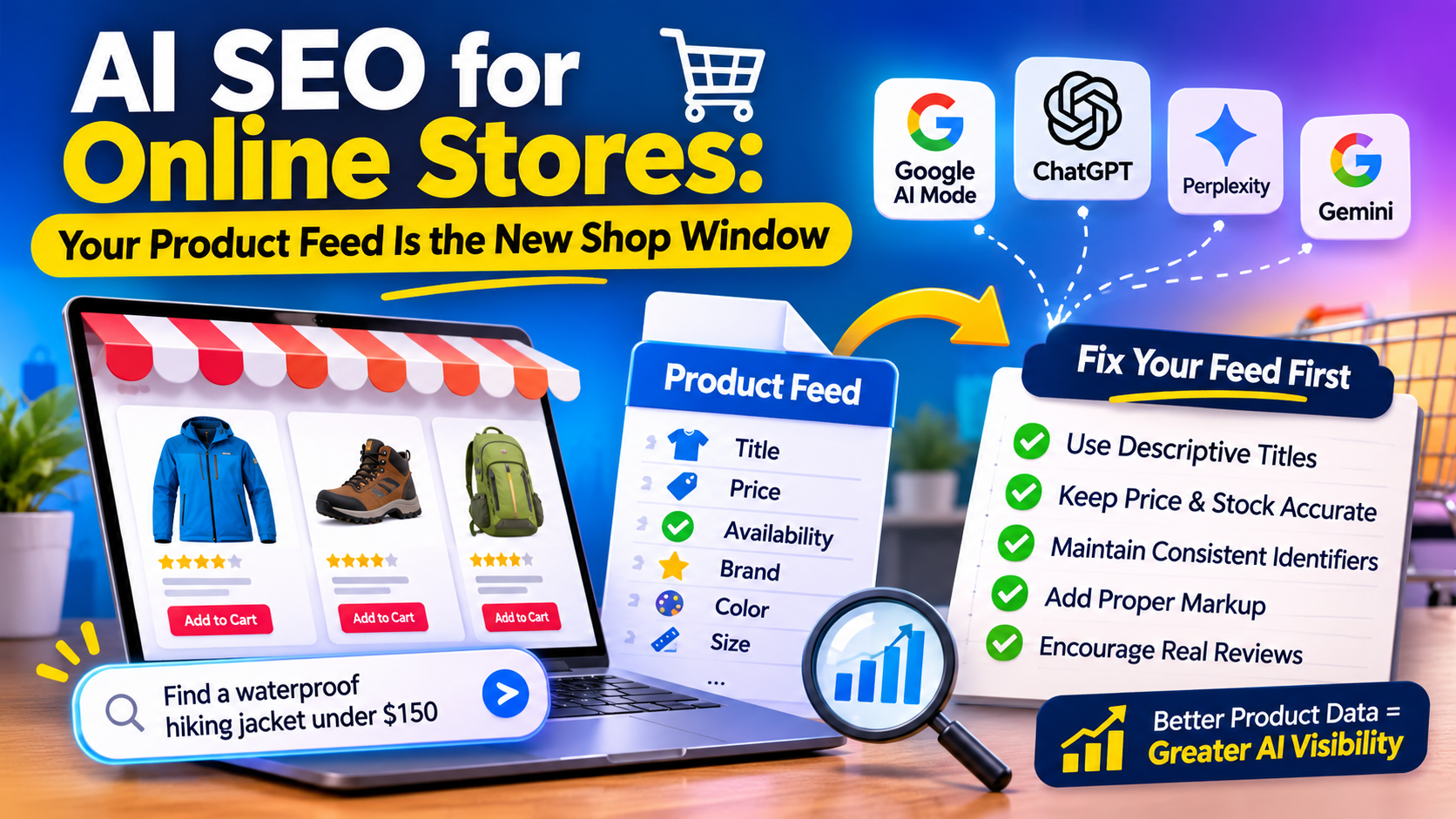
Most online retailers put their effort into product pages: better photos, longer descriptions, cleaner design. That still matters to shoppers. But when someone asks an AI assistant to “find a waterproof hiking jacket under $150,” the answer may be built from something your customers never see, which is your product data.
For e-commerce, AI SEO is less about writing and more about data. This article explains why, and what to fix first.
Feeds sit underneath AI shopping
A product feed is a structured file listing every item you sell, with fields for price, availability, brand, size, color and so on. Merchants have long sent these to Google Merchant Center for Shopping ads and free listings.
What’s new is how far that data now reaches. One analysis of Google’s own guidance notes that it names Merchant Center feeds and Google Business Profile as ways to improve visibility for product listings and local information. Another reviewer reads the same guidance as showing an asymmetry: structured data unnecessary, feeds recommended. I could not open Google’s guidance myself, so check the exact wording before relying on that reading.
OpenAI works similarly. According to Search Engine Journal, OpenAI’s Help Center says ChatGPT picks products using structured product data, such as price and description, from data providers and from stores themselves. A separate piece from the same publication reports that most ChatGPT Shopping product picks come from feed-integrated sources, according to Profound’s data. That is one analytics vendor’s dataset, so treat it as a strong hint, not a rule. searchenginejournalsearchenginejournal
Treat the big percentages with care
You will see precise claims online. One source states that ChatGPT pulls 83% of its shopping product data from Google Shopping’s organic results, with 60% from the top ten positions. Another repeats that 83% of ChatGPT recommendations come from Google Shopping’s top 40. Notice that these two don’t quite match, and both come from marketing sites without a method I could inspect. I’d call them directional at best.
The sensible lesson is a modest one. If your products rank well in Google Shopping, you are probably better placed elsewhere too. That is a reason to keep your Merchant Center data healthy, not a guarantee of anything.
Fix the feed before the copy
At Sarkar SEO, the first audit question for an online store is not “how good is your blog?” It is “how complete is your catalog data?” Here is the order I would work in.
- Titles that match how people search. Feed titles written like internal stock codes (“JKT-WP-M-BLK”) tell a machine very little. A title like “Men’s waterproof hiking jacket, black, packable” says what it is. One source recommends natural-language titles and expanding attributes to 30 or more. The number is arbitrary, but the principle holds: fill in every field that genuinely applies.
- Accurate price and stock. AI answers can quote outdated prices, and shoppers notice. A stale feed produces mismatches between what an assistant says and what your site shows. One source warns that structured data cannot repair a stale feed or a thin product page.
- Consistent identifiers. Brand names, product codes and variants should read the same everywhere: feed, product page, marketplaces. Mismatches make it harder for systems to tell that two listings describe the same item.
- Product page markup that matches what’s visible. Google documents merchant listing structured data for product pages. Use it, but keep it truthful. The markup should reflect facts a visitor can see on the page, not extra claims.
- Real, attributed reviews. Systems gather opinions from across the web. One guide says ChatGPT draws product data from sources like Bing Shopping, Shopify and merchant feeds, and also gathers reviews from across the web. Encourage honest reviews that mention specific uses (“kept me dry on a six-hour walk”), not just star ratings.
Don’t forget Bing
Many sellers optimize for Google only. One retail SEO article argues that ChatGPT Shopping Research frequently mirrors Bing Shopping’s product data, so optimizing for Bing can increase AI visibility. I found this in a single secondary source, but the cost of testing it is low. If you already have a Google feed, importing it into Microsoft’s merchant tools is usually straightforward. hbfreelance
Check what’s available where you sell
AI shopping features don’t launch everywhere at once. One guide reading OpenAI’s merchant page in October 2026 quotes it as saying shopping was live for ChatGPT users in the U.S. If you sell in India, Europe or elsewhere, find out which features reach your customers today. Don’t assume US rules apply, and recheck periodically as rollouts change.
Platforms matter as well. Another source notes that Shopify and Etsy sellers already have their catalogs connected to ChatGPT. If you use one of those, check your settings before building anything custom.
What no feed can do
A clean feed gets you considered. It does not get you chosen. Assistants still weigh price, availability, reviews and relevance to the shopper’s exact request. As one guide puts it, ChatGPT shopping visibility is not a conventional marketplace rank that a merchant can lock in.
That’s good news in one respect: you can’t be shut out by a rival gaming a ranking. It’s bad news in another: there is no ranking to monitor.
A realistic testing routine
Make a list of ten products you most want to sell. For each, write the question a shopper might ask. Run those questions monthly in Google AI Mode, ChatGPT and Perplexity. Note which products appear, which competitors do, and what data the answer shows: price, rating, shipping. Gaps usually point to fields you’ve left blank or mismatches between feed and page.
Keep expectations measured. Answers change from run to run, so look for patterns across months.
