



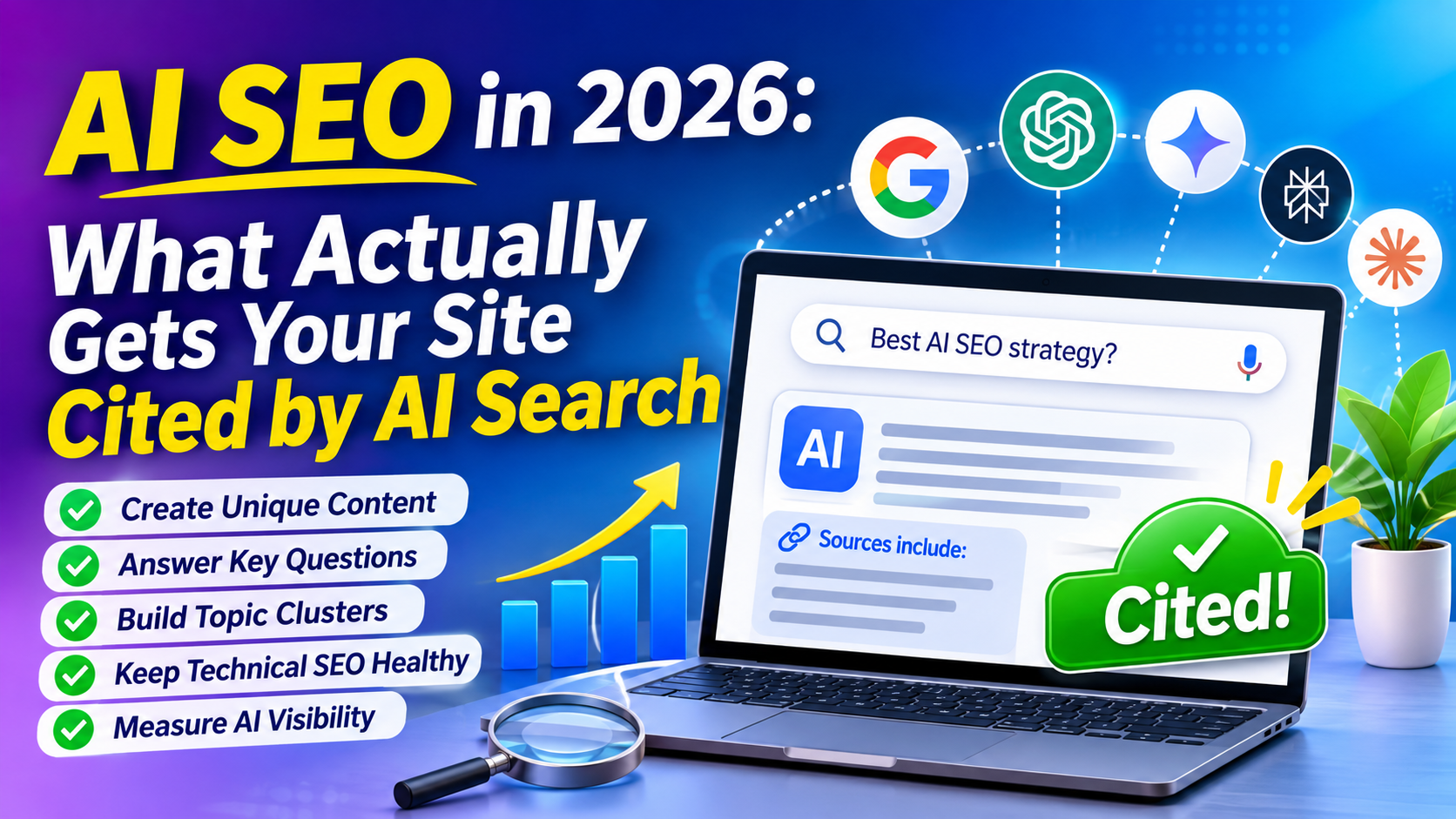
AI SEO means making your pages findable, understandable and trustworthy enough for AI-driven search to use them as sources. That covers Google’s AI SEO Overviews and AI Mode as well as ChatGPT, Perplexity, Gemini and Claude. The hype around it has been loud. The reality is more practical, and good news for sites that already do the basics well.
What AI SEO Really Is
AI search SEO is not a separate ranking system you can hack. It is the practice of making pages eligible, useful, extractable and trustworthy enough to appear as supporting links in AI features. The two main Google formats work differently. AI Overviews summarize answers at the top of classic results, while AI Mode is a conversational experience that researches answers in several steps and links its sources.
Google made its position official in May 2026. John Mueller announced a Search Central guide titled “Optimizing your website for generative AI features on Google Search.” The guide treats optimizing for generative AI search as still being SEO, and it rejects AEO and GEO as distinct disciplines. writtenlyhubthekeyword
That claim has limits. The guidance covers Google Search only. Bing and Copilot, Perplexity and ChatGPT Search use different retrieval architectures, so tactics Google rejects may carry more weight there. Treat Google’s advice as the baseline, not the whole picture.
Why the Fundamentals Still Decide Visibility
Google’s AI features are built on its existing systems. They rest on core Search ranking and quality systems, including retrieval-augmented generation and query fan-out. In plain terms, the AI breaks a question into several related searches and pulls from pages that already rank well and read clearly.
Eligibility comes first. Pages must be indexed and eligible to appear in Search with a snippet to show up as supporting links in AI Overviews or AI Mode. Google also says there are no additional technical requirements to appear in them. If a page is blocked, noindexed or stripped of snippets, no AI tactic will rescue it.
What Changes in Practice
The work does not disappear, but it gets stricter. Technical SEO needs to be cleaner, and content needs to be less generic. Here is where to focus.
- Publish content that cannot be copied from a template
Google points to unique, non-commodity content with a first-hand point of view. If your page restates what ten others already say, an AI system has no reason to pick yours. Add your own data, tested processes, client observations or a clear opinion. Nothing here needs invented numbers. A small original dataset, a documented experiment or a worked example is enough.
- Structure pages so answers are easy to lift
Google recommends organising content with paragraphs, sections and clear headings that help readers navigate. Open each section with a direct answer, then add depth. Machines extract from this layout, and so do busy human readers. Write headings as the questions people actually ask.
- Build topic clusters, not isolated keyword pages
Thin pages built around a single keyword do little. Build a topic cluster and connect related pages internally. Google’s link guidance recommends crawlable, descriptive internal links that help users and Google understand related pages. A cluster also covers the sub-questions that query fan-out generates. w3erathekatynews
- Keep the technical layer healthy
Check indexing, canonical tags, page speed, mobile usability and snippet settings. Make sure structured data matches what visitors can see on the page. Google also lists high-quality images and video among the things that matter.
- Use AI tools carefully
AI-assisted writing is allowed, but quality still decides the outcome. Google’s people-first guidance warns against content made mainly to attract search traffic, automation spread across many topics, and summaries that add little value. Use AI for research and drafting, then add human expertise and edit hard.
What to Skip
Be wary of anyone selling a secret AI formula. Google’s current guidance is less exciting than the hype suggests: fix crawlability, snippets, useful service pages, business details and page experience before chasing GEO hacks. Keyword-stuffed “AI-friendly” paragraphs and bulk-generated pages add risk and no advantage.
Measuring AI Search Performance
Measurement is improving but still imperfect. In June, Google began exposing generative-search impressions and related dimensions, but not a clean split between AI Mode and AI Overviews. Impressions show how often pages appeared, not whether anyone clicked, and the question of clicks remains open.
So track more than rankings:
- Impressions and clicks in Search Console
- Branded search growth over time
- Manual checks of target questions in several AI tools
- Whether your brand and pages are named as sources
- Leads and conversions, not just sessions
Being cited has value even without a click. A citation in an AI answer puts your brand in front of the user.
A Simple 30-Day Starting Plan
Week 1: Audit indexing, snippet settings and structured data on your ten most important pages.
Week 2: Rewrite those pages with direct answers up front, clearer headings and one piece of original insight each.
Week 3: Map a topic cluster around your main service and connect the pages with descriptive internal links.
Week 4: Test your target questions across Google, ChatGPT, Perplexity, Gemini and Claude. Record which sources appear, find the gaps and refine.
This is the kind of structured, evidence-led approach we follow at Sarkar SEO. We favor clean fundamentals over shortcuts, because those fundamentals are what AI systems draw on.
