



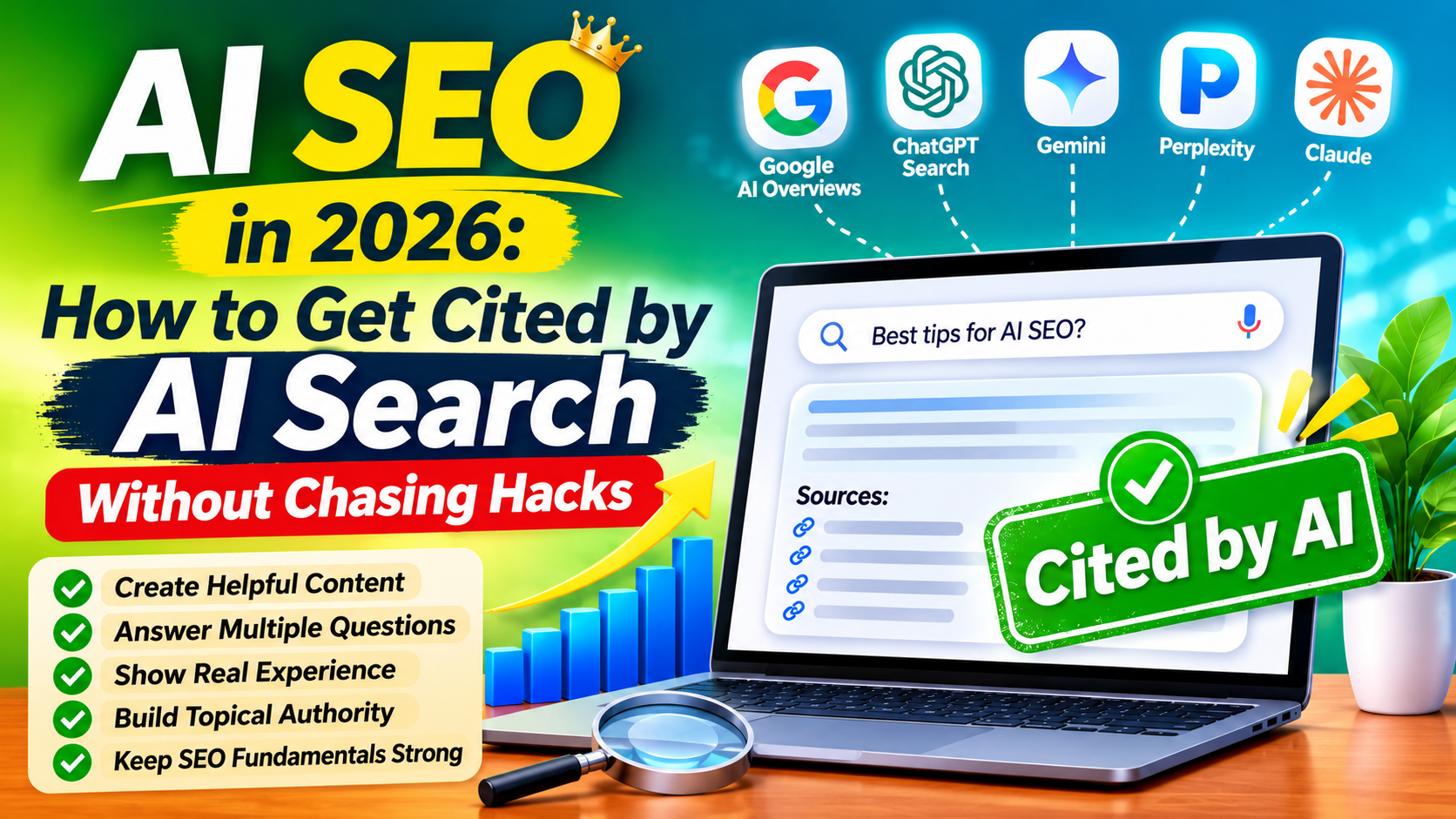
Search no longer ends with ten blue links. People ask a question and get a written answer with a few sources underneath. That shift created a new label, AI SEO, and a lot of noise around it. At Sarkar SEO, we think the useful version is simpler than most vendors admit: make your page the one worth citing.
What AI SEO Actually Means
AI SEO is the work of making your content findable, understandable and worth citing in AI-generated answers. That covers Google AI Overviews, AI Mode, ChatGPT, Perplexity, Gemini and Claude.
Google’s May 2026 guide for site owners says that optimizing for generative AI search is still SEO, because its AI features are rooted in core ranking and quality systems and use retrieval-augmented generation to pull relevant pages from the Search index. The labels AEO and GEO describe the same job under different names.
So for Google, you don’t need a parallel playbook. The other assistants, though, don’t behave identically.
Different Engines, Different Habits
Ahrefs tested 15,000 long-tail prompts in 2025. On average, only 12% of links cited by ChatGPT, Gemini and Copilot appeared in Google’s top 10 for the same prompt. Perplexity was the closest to Google, with 28.6% of its citations landing in the top 10. That study is a snapshot from mid-2025, and these systems change quickly, so treat the numbers as directional.
The lesson is practical. Ranking well still matters, especially inside Google’s own AI features. But being cited elsewhere depends on how completely and clearly you cover a topic, not only on holding position one for a single keyword.
The Fan-Out Audit: Where Most Guides Stop Short
AI answers rarely rely on your exact query. Google describes query fan-out as a set of concurrent, related queries the model generates to fetch more results. Its example is a question about fixing a weedy lawn, which spawns searches on herbicides, chemical-free removal and prevention.
Ahrefs explains why this matters for citations: a page ranking around sixth across several related variations can beat one that ranks first for only a single variation.
Here is a simple audit you can run on any priority page:
- Write the main question your reader is asking.
- List eight to ten follow-ups a careful buyer would ask next, such as cost, risks, timing, alternatives and mistakes.
- Check whether your page answers each one with real substance, not a single vague sentence.
- Fill the gaps inside the same page, or in one tightly connected supporting article.
Do not publish a separate page for every variation. Google states that doing this primarily to manipulate rankings or AI responses violates its scaled content abuse policy.
The Non-Commodity Test
Google says unique, useful content will likely influence your AI visibility more than any other suggestion in its guide. It contrasts generic advice like “7 Tips for First-Time Homebuyers” with an experience-led piece about waiving an inspection.
Try this before publishing. Cover the byline and ask whether a generic AI model could have written each paragraph. If it could, add something only you have:
- Your own data or test results
- A framework you use to make decisions
- A mistake you made and what it taught you
- Original screenshots, charts or short videos
- An expert opinion that disagrees with the consensus
Never invent these. Readers and AI systems both do better with real evidence than with polished filler.
What You Can Safely Ignore
Google’s guide is blunt about several popular tactics. For Google Search, it says you do not need:
- llms.txt files or other special AI markup
- Chopping content into tiny “chunks”
- Rewriting pages in a special style for AI
- Buying or faking brand mentions across the web
- Obsessing over structured data, though it still supports rich results
The guide adds that llms.txt files won’t hurt you if other systems use them. Clear headings, sensible paragraphs and honest answers help human readers, which is the real goal.
A 30-Day AI SEO Routine
Week 1: Check eligibility. A page must be indexed and eligible to show with a snippet. Review robots rules, noindex tags, snippet restrictions and crawl errors. Confirm your site is included in generative AI features in Search Console.
Week 2: Choose your battles. Pick ten pages tied to revenue or leads. Run the fan-out audit on each.
Week 3: Add what only you know. Rewrite weak sections with first-hand experience, examples and relevant images or video. Remove anything that merely repeats the top results.
Week 4: Measure. Search Console now offers a Generative AI performance report. Pair it with manual prompt tests across several assistants, and record which of your pages get cited and for which questions. Google warns that no third-party tool can see its internal ranking systems, so treat visibility trackers as rough indicators only.
Local and ecommerce brands should also keep Google Business Profile and Merchant Center details accurate, since AI responses can draw on them.
