



“AI SEO” has two meanings. One is optimizing for AI search. The other is using AI tools to do AI SEO work, and that is where many teams quietly take their biggest risks. The speed is tempting: a draft in minutes, a hundred pages by Friday. But Google’s rules on this are clearer than most people realize, and one of them tightened in October 2026. At Sarkar SEO, we use AI heavily, and we have learned that the winning question is never “Can AI write this?” but “Who is accountable for it?”
What Google Actually Objects To
Google does not ban AI-assisted content. Its guidance says AI can be useful for researching topics and adding structure to original content, while warning that generating many pages without adding value for users may violate its scaled content abuse policy.
The method is not the offence. Google’s spam documentation notes that scaled content abuse can involve AI, human writers, scraping or stitching content from other sources, and that human-written spam and AI-generated spam face identical consequences.
Quality raters follow the same logic. Their guidelines say that even when unsure how a page was made, raters should use the lowest rating if they strongly suspect scaled content abuse after reviewing several pages. Raters do not directly change rankings, as Google notes, but their work shapes how its systems are evaluated. The practical reading is simple: unattended volume is the problem, not the tool.
The October 2026 Accuracy Rule
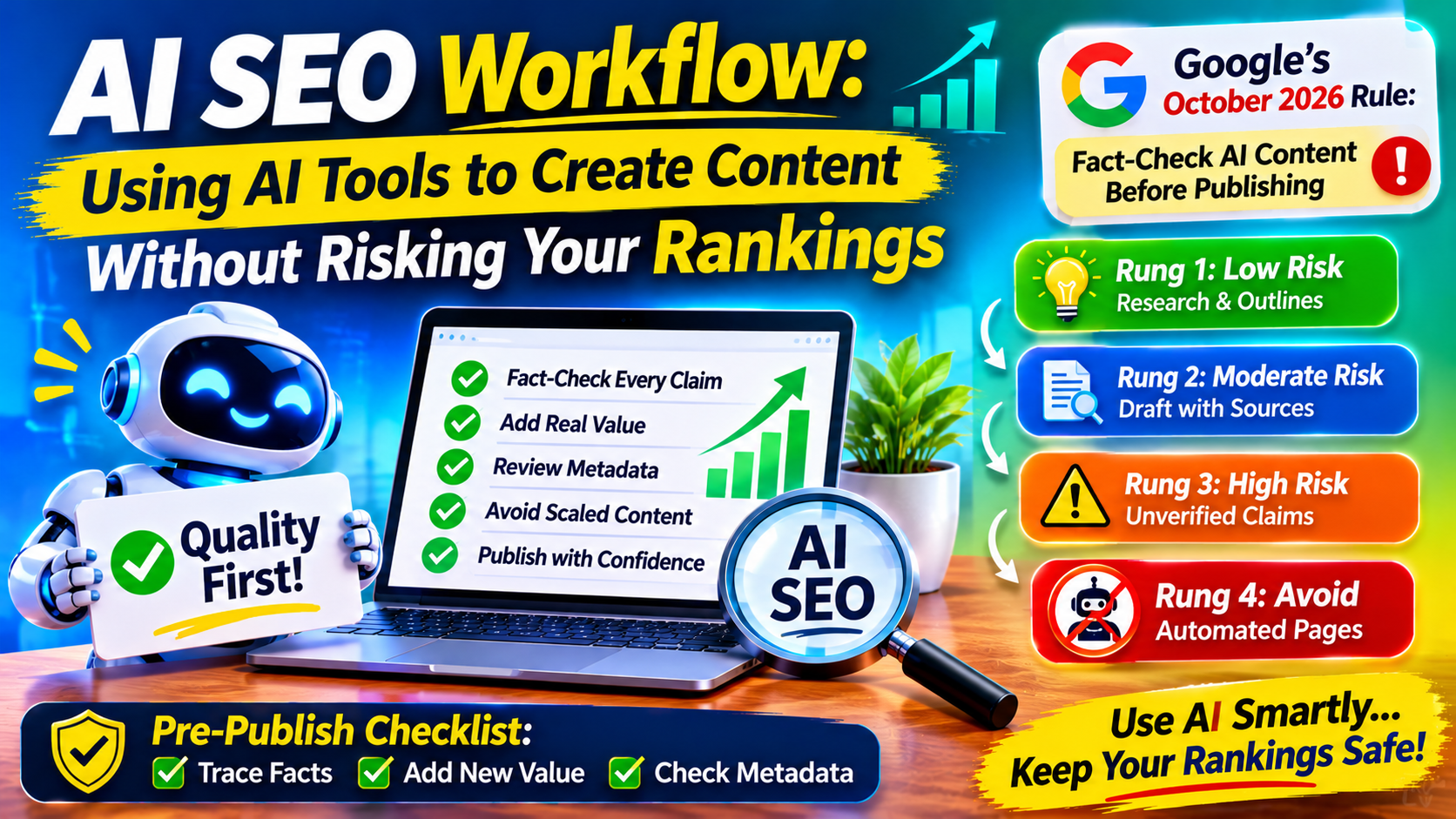
On October 1, 2026, Google added three sentences to its generative AI guidance. In essence, they explain that models predict likely word sequences rather than retrieve facts, so outputs may contain inaccuracies, and that it is critical to manually fact-check and review all AI-generated content before publishing. searchenginejournal
The detail most teams will miss is the scope. The same review extends to metadata, including title elements, meta descriptions, structured data and image alt text. A review process built only for article bodies now leaves a gap exactly where AI is most often used unsupervised.
The AI Content Risk Ladder
Here is a framework we use to decide how much human scrutiny each AI task needs. It is our own working model, not a Google classification.
Rung 1: Low risk. Research support, outlines, interview question lists, cleaning transcripts, summarizing your own notes. The output is scaffolding, not publication.
Rung 2: Moderate risk. Drafting from material you supplied, such as your data, expert interview or documented process, followed by a subject expert’s edit.
Rung 3: High risk. Drafting on topics you cannot personally verify, producing metadata or alt text in bulk, and writing product or technical specifications. Errors here look authoritative, which makes them dangerous.
Rung 4: Avoid. Generating pages from keyword lists, rewriting competitors’ articles, and producing near-identical location or product pages by swapping a few words. This is precisely the pattern Google’s policy describes.
The rule is proportional: the higher the rung, the more verification you need, and Rung 4 should not be automated at all.
A Pre-Publish Checklist
Before anything AI-assisted goes live, confirm each of these:
- Every fact is traced. Each statistic, date, name and quote links back to a source someone actually opened, not just one the model mentioned.
- A named person owns it. Someone with relevant knowledge has read the piece in full and will answer for its accuracy.
- It adds something. A reader who has already seen the top results should learn something new, whether that is your data, your process or a considered opinion.
- Metadata is checked by hand. Titles, descriptions, structured data and alt text are reviewed like body copy.
- No pages differ by one swapped keyword. If two pages are interchangeable, merge them.
- You publish in small batches. Release a handful, watch indexing and engagement, then decide whether to scale.
Where AI Genuinely Earns Its Keep
The safest gains come from work that supports judgment instead of replacing it. AI is excellent at grouping keywords by intent, spotting gaps in an outline, summarizing sales-call transcripts into recurring customer questions, checking schema for inconsistencies, and reading through large log files for patterns. Each of these saves hours and leaves the final call with a person.
