



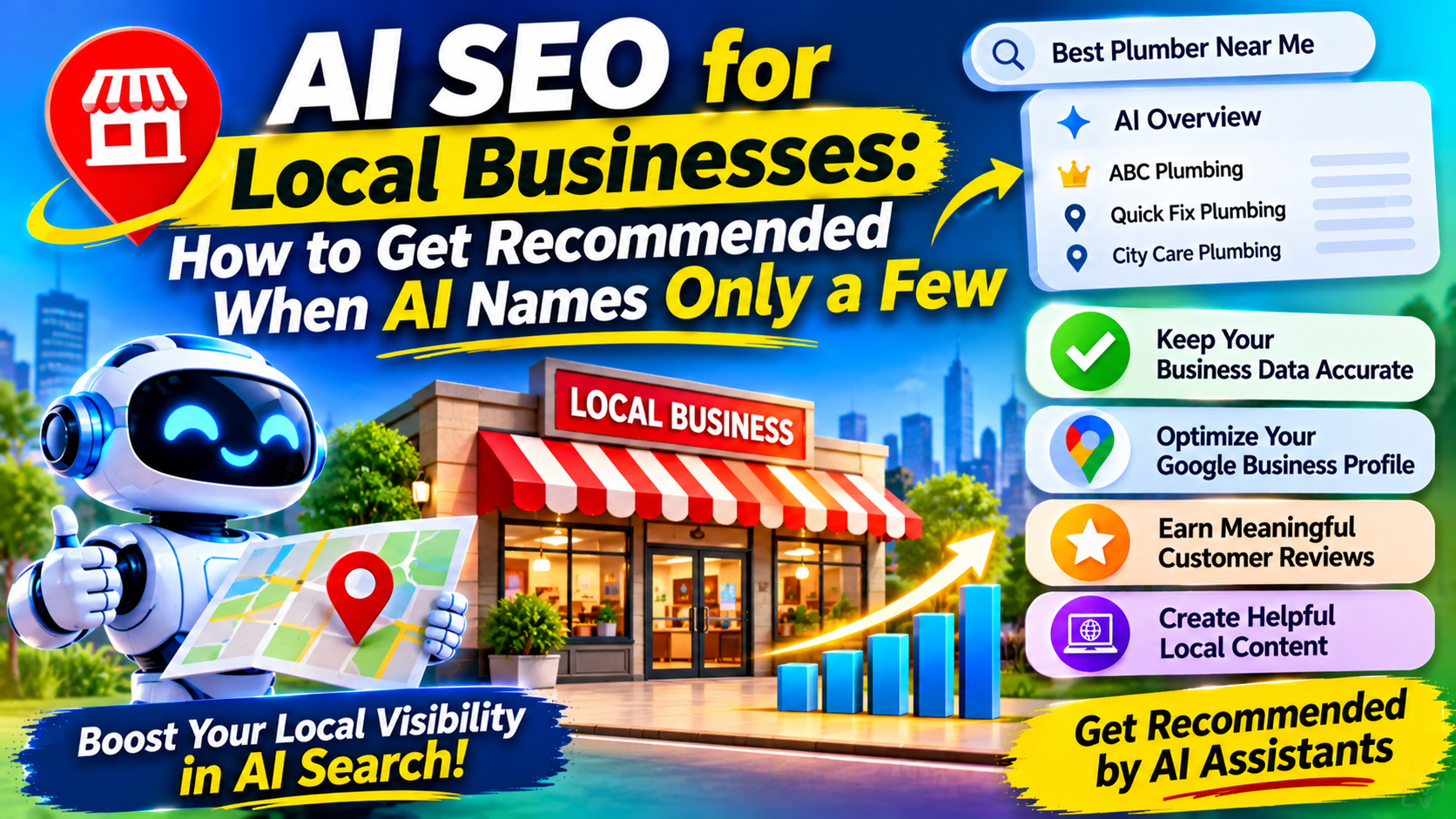
When someone asks an AI assistant for a plumber, dentist or café, the answer isn’t ten blue links. It’s usually a handful of names, sometimes just one. For local businesses, that makes AI SEO feel less like ranking and more like being chosen.
The good news is that local visibility is built from signals you can control. This article explains what the available data says about how AI picks local businesses, where studies disagree, and a practical plan for any market.
Local Recommendations Are Rare
The first thing to understand is how selective AI is. SOCi’s 2026 index analyzed more than 350,000 business locations across 2,751 brands and found that ChatGPT recommends just 1.2% of local business locations, compared with 35.9% appearing in Google’s local 3-pack. Other reported figures in the same study, as summarized by a third party, put Perplexity at 7.4% and Gemini at 11%.
Doing well on Google doesn’t guarantee a mention. In retail, fewer than half the brands performing well in traditional local search also appeared in AI recommendations.
Consumer behavior is shifting quickly too. BrightLocal’s survey of 1,002 US adults reportedly found that the share using AI tools for local recommendations rose from 6% in 2025 to 45% in 2026. That is one survey in one country, so treat it as a direction rather than a global number.
What Seems to Influence Local AI Recommendations
A study of 10,000 businesses by Insites looked at which signals correlated with AI visibility. The strongest correlations were Google review volume, Google Business Profile completeness and Local Pack presence. One summary reports that businesses in the Local Pack were recommended 3.5 times more often than those that were not. Another summary of the same research says businesses recommended by ChatGPT and Perplexity averaged 133 Google reviews, while ignored ones averaged 11. New Study of 10,000 Local Businesses Reveals What AI Actually Uses to Decide Who to Recommend +2
Two cautions apply. These are correlations, so they don’t prove that reviews cause recommendations. And the research comes from a vendor whose tools serve agencies. One source also notes that the relationship between a profile and an AI recommendation is still developing.
Different Engines, Different Sources
Local data flows differently by platform. One analysis lists Perplexity as leaning on vertical directories, reviews and Reddit threads, and Gemini and Google AI Overviews as leaning on Google’s own index and your Google Business Profile. The same source cites Search Engine Land testing that found ChatGPT relies on Bing-indexed web results rather than on your Google reviews directly. omnionlinestrategiesomnionlinestrategies
That conflicts with other claims that reviews matter for ChatGPT, which are described as working mostly indirectly. The sensible reading is that each engine uses a different mix, so a business needs a presence beyond one profile.
Local Search Isn’t Dead, It’s Layered
Don’t abandon the basics. One analysis argues that traditional local-service searches remain heavily dominated by Google’s Local Pack and Maps results, and that Google’s own documentation names relevance, distance and prominence as primary local ranking factors. The same piece notes that AI Overviews also show the local 3-pack when someone needs a business.
There are signs of change, however. One UK guide reports that Google has been testing AI-powered local packs that show one or two businesses instead of three, with some businesses reporting visibility declines of over 50% in January 2026. That is a single secondary report about a test, so keep watching rather than assuming it’s permanent.
A Practical Plan for Local AI SEO
At Sarkar SEO, we treat local AI visibility as four linked layers rather than one tactic.
- Make your business data identical everywhere
Accuracy is a quiet problem. SOCi’s index reportedly found that 68% of contact details shown by AI assistants did not match the business’s Google profile. A wrong phone number or old address loses a customer immediately.
Audit your name, address, phone, hours and categories across your profile, website and major directories. Fix any mismatch at the source.
- Complete and maintain your Google Business Profile
Treat it as your most important local asset. Choose the correct primary category, list services, add real photos and keep hours current. One source calls the profile the eligibility layer, mainly for Google’s own AI surfaces, with other engines relying more on your website, reviews, directories and mentions.
- Earn reviews that say something specific
Volume helps, but content helps more. AI systems read what customers actually write. A review that mentions the service, the neighborhood and the outcome gives far more to work with than “Great!” Ask customers to describe what they hired you for, and respond to every review with detail instead of boilerplate. Never fabricate or incentivize reviews in ways platforms prohibit.
- Build a website that answers local questions
AI now pulls from the profile, website, reviews, photos and third-party sites at once, with the website providing context and authority. Create genuinely useful pages for each core service and, where you truly operate, each area. Include pricing ranges, process steps, common questions and real project examples.
Avoid copy-paste city pages. Pages auto-generated for each city or branch with near-duplicate templated copy are described as a textbook scaled content abuse case. Fewer, richer pages beat dozens of thin ones.
Measure What Matters Locally
Rankings alone won’t tell you the story. Track:
- Profile views, calls, direction requests and website clicks
- Local pack positions for your main services
- Whether AI tools name you for your key questions
- Accuracy of what they say about you
- Review count, recency and rating
Run the same set of prompts monthly. Answers vary between runs, so track the same prompts over time and avoid judging on one answer. Good test prompts mimic real customers, such as “best emergency plumber near me” or “who offers same-day dental appointments in my area.”
An Opportunity for Smaller Brands
Selectivity cuts both ways. Because few businesses are named, the businesses that are named gain a large advantage. Many small operators haven’t even claimed their profile. One compilation reports that only 35% of small businesses had a Google Business Profile at all in 2025, though that is a single survey figure for one market. Basic completeness alone can separate you from competitors.
This is where Sarkar SEO often starts with local clients: fix the data, strengthen reviews, then build content worth citing.
