



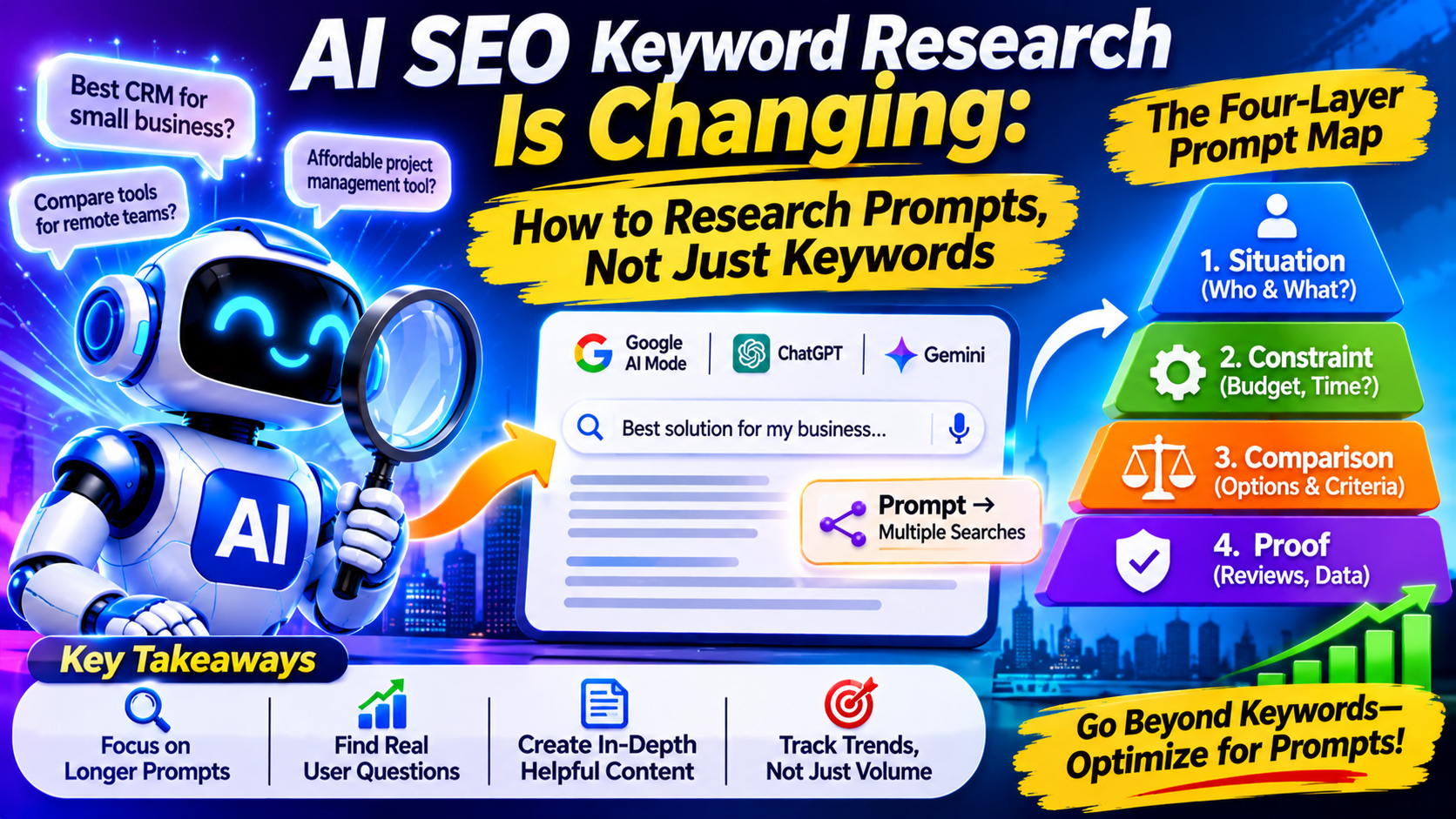
Keyword research was built for a world of short searches. People typed two or three words, and tools reported monthly volume. AI SEO search breaks that model. Customers now describe their whole situation in one message, and the engine quietly splits it into many smaller searches. This guide explains what that means for your research process and gives you a method to adapt. Sarkar SEO uses a prompt-first approach for this reason.
Queries are getting longer, but the numbers vary
The direction is consistent, though the exact figures are not. Semrush’s clickstream analysis found that search-enabled prompt length nearly doubled from 4.7 to 8.7 words between early 2025 and early 2026. A Search Engine Journal writer cites Google’s May 2026 usage data showing the average AI Mode query in the U.S. runs triple the length of a traditional search query. topifysearchenginejournal
Other sources report much higher averages, such as 23 words for Perplexity and ChatGPT Search. Those numbers come from a startup newsletter that compiles several studies, and they differ by method and sample. Use the trend, not a single statistic. Your own data will be more useful than anyone’s average.
The part customers never see: query fan-out
When someone types a prompt, the engine often does not search for it directly. It breaks the prompt into sub-queries, retrieves sources for each angle, then merges the results into one answer. Google describes AI Mode as using this technique to issue many queries at once.
AirOps studied ChatGPT behaviour and reported that in 89.6% of searches, ChatGPT expanded the original prompt into two or more fan-out queries before deciding what to cite. More striking for content teams, 32.9% of cited pages appeared only in search results for a fan-out query rather than the starting prompt. In plain terms, many pages get cited for questions the user never typed.
The machine-written sub-queries are fairly short. Nectiv’s analysis of more than 60,000 Google fan-out queries found an average length of 6.7 words, with 77% falling between five and eight words. The human prompt is long and messy. The searches behind it are narrower and more specific.
Why traditional tools miss this
Standard keyword tools rely on recorded search volume. Many fan-out queries have none. One analysis reports that Seer Interactive found 95% of Gemini’s fan-out queries had zero monthly search volume by traditional metrics. A topic with “zero volume” can still shape what AI says about your industry.
There is a second blind spot. AirOps found the prompts brands monitor peak at six to seven words, missing the ten-plus word long-tail queries that dominate real use. Teams that track only short, keyword-like prompts end up measuring the wrong part of the curve.
Keyword research is not obsolete. As one guide puts it, it is reframed: the unit of research changes from one head term to the cluster of sub-queries a topic is likely to produce.
A four-layer prompt map
The following is my own working method, built from the research above. It is not an industry standard, so test it against your own data.
Take one customer problem and write out four layers:
- Situation. How would a buyer describe their circumstances? Include role, size, budget, location and urgency. Example: a founder of a ten-person company needing a tool for a specific workflow.
- Constraint. What limits the answer? Price ceilings, integrations, regulations, timelines or required features. AI prompts often carry these details, which keyword searches rarely did.
- Comparison. Which alternatives would the buyer weigh, and on what criteria? Engines tend to run extra searches for “best,” “reviews” and “versus” style angles.
- Proof. What evidence would reassure them? Case studies, pricing transparency, certifications, independent reviews and clear limitations.
Each layer suggests specific sub-questions your content should answer. One page covering all four, honestly, is stronger than four thin pages.
Where to find real prompts
You do not need new tools to begin.
- Search Console. Filter for queries of ten or more words. A UK agency notes that these long-tail queries already behave like AI prompts. localiq
- Sales and support conversations. Record the exact phrases customers use, including their worries. This is original material competitors cannot copy.
- On-site search and chat logs. They show unfiltered questions.
- Community forums and reviews. People describe problems in natural language there.
- Test prompts. Ask several AI engines your customer questions and note which sub-topics appear in the answers.
Turning research into pages
A few practical principles follow from the data:
Match titles to questions. AirOps found that pages with 50% or more title-to-query overlap were cited at 20.1% versus 9.3% for pages below 10% overlap. That is one vendor’s result, but it supports writing clear, specific headings.
Build situation pages. Instead of one generic service page, create content for specific scenarios and answer the follow-up questions a buyer would raise.
Publish an honest comparison. Explain who your offer suits and who it does not. Candid trade-offs build trust with readers and give engines usable material.
Cover narrow questions properly. A direct answer to a specific sub-question often beats a broad overview that mentions it in passing.
Measuring without false precision
AI answers vary from run to run, so single results mislead. Build a fixed list of twenty to thirty prompts drawn from your map. Run them monthly across several engines, record whether you appear and in what context, and watch trends. A recent report claims 78% of marketing teams say their current approach to measuring AI visibility is inaccurate. Accept that uncertainty openly, and pair prompt tracking with business results such as enquiries and sales.
