



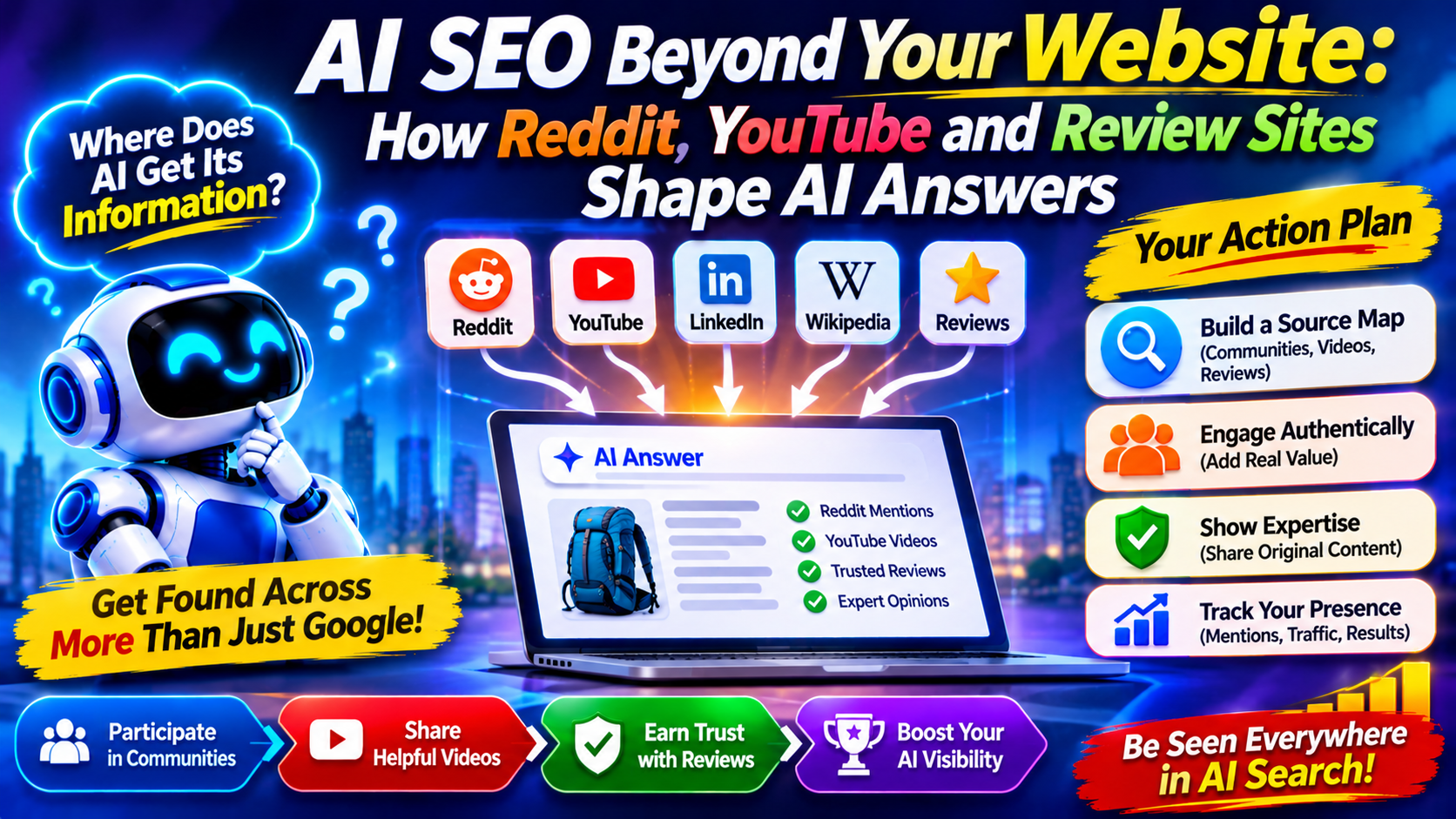
Many businesses spend months improving their own pages, then find that AI SEO tools recommend competitors based on what other websites say. Answer engines don’t rely only on company sites. They draw heavily on communities, videos, review platforms and reference pages. This article explains what the research shows, why the picture is messy, and how to build a presence where your category’s answers are actually formed.
What the Citation Studies Show
Peec AI analyzed 30 million cited sources across ChatGPT, Google AI Mode, Gemini, Perplexity and AI Overviews in the U.S. in March 2026. Its top four were Reddit, YouTube, LinkedIn and Wikipedia, followed by Forbes, G2, Yelp, Facebook, Medium and TechRadar.
The mix changes by engine. For AI Overviews, Peec’s top five were YouTube, Reddit, Facebook, LinkedIn and Medium, while Perplexity’s were Reddit, YouTube, LinkedIn, Wikipedia and G2. Peec also notes that Wikipedia appears strongly for ChatGPT and Perplexity but not for Google’s platforms, and G2 appears only for Perplexity, a detail that matters for B2B software companies. peecpeec
Why You Shouldn’t Copy the Leaderboard
It’s tempting to announce a “Reddit strategy” and move on. The data doesn’t support such a simple conclusion. ThriveStack compared several 2026 studies and found that Reddit, Wikipedia, YouTube and LinkedIn sit near the top of almost every list, but the order depends on who counted and which engine they counted. Search Engine Land has also argued that no universal top source exists for brands.
Volatility adds another warning. One secondary report claims that ChatGPT’s Reddit citation share fell from roughly 60% to 10% in six weeks in late 2025. I couldn’t trace that figure to its original study, so treat it as an illustration of instability, not a fact to quote. The sensible lesson is to check your own category instead of trusting a global ranking.
Build Your Own Source Map
A source map shows which outside sites shape AI answers in your specific market. It takes an afternoon:
- Write 15 questions your buyers genuinely ask, such as comparisons, “best for” queries and problem descriptions.
- Run each in ChatGPT, Google AI Mode and Perplexity.
- Record every cited domain and any brands named.
- Sort the domains into types: community, video, review platform, editorial, reference, or competitor-owned.
- Mark the gaps, meaning places where competitors are cited and you are absent.
Repeat monthly. Your map will show whether your category leans on forum threads, comparison articles or video, and that tells you where effort will pay off.
Participate, Provide, Prove
Once you know your sources, three types of action cover most cases. This is a working framework based on the evidence above.
Participate in Communities
Peec’s advice for Reddit is straightforward: monitor what’s said about your brand and, if you participate, be authentic and add real value. In practice, that means experts answering questions in the open, disclosing their affiliation, following each community’s rules and linking only when it genuinely helps. Don’t create fake personas or coordinate upvotes. Beyond ethics, the risk is practical: Google’s spam policies, as summarized by PPC Land, now apply to AI features and list inauthentic mentions among the covered practices. peecppc
Provide Video Answers
YouTube ranks high in several datasets, especially for Google’s own surfaces. For most businesses, the winning approach is not polished brand films. It’s short, specific videos that answer one real question each. Title them the way a buyer would ask, include accurate captions, and keep the content practical, such as a setup walkthrough or a side-by-side comparison. I recommend this as a reasonable tactic, not a proven ranking factor.
Prove Your Credibility
Review platforms and editorial coverage act as third-party proof. Peec’s results show review sites such as G2 and Yelp surface often in recommendation-style queries. Complete your profiles on the platforms your source map reveals, collect genuine reviews through honest requests, and respond professionally to criticism. For editorial presence, offer original data, expert commentary or case material that journalists and bloggers want to reference. LinkedIn deserves attention too, since it ranked third overall: let named experts at your company publish useful posts under their own names.
Know the Limits
- You can’t control third parties. A thread or review may say something unflattering. Respond openly and correct facts where you can.
- Don’t write your own Wikipedia page. It requires independent notability, and self-promotion usually backfires.
- Beware of single-study claims. Several figures circulating online come from vendors selling monitoring tools, and the numbers vary widely.
- Results won’t be instant. Reputation builds slowly, and citation patterns shift.
How to Tell If It’s Working
Track a small set of indicators monthly: how many of your 15 questions name or cite you, which new third-party pages mention your brand, changes in branded search, and referral visits from communities and video. Pair these with business results such as inquiries, because mentions that never reach customers are only vanity metrics. Sarkar SEO suggests keeping a simple spreadsheet and reviewing it alongside your normal SEO reports, so off-site visibility becomes a routine measure.
A Sensible First 90 Days
- Month one: Build the source map and fix incomplete profiles on the review and professional platforms it highlights.
- Month two: Publish five short videos answering your most common buyer questions, and begin genuine participation in one relevant community.
- Month three: Pitch one piece of original data or expert commentary to a publication your map identified, then rerun the map and compare.
