



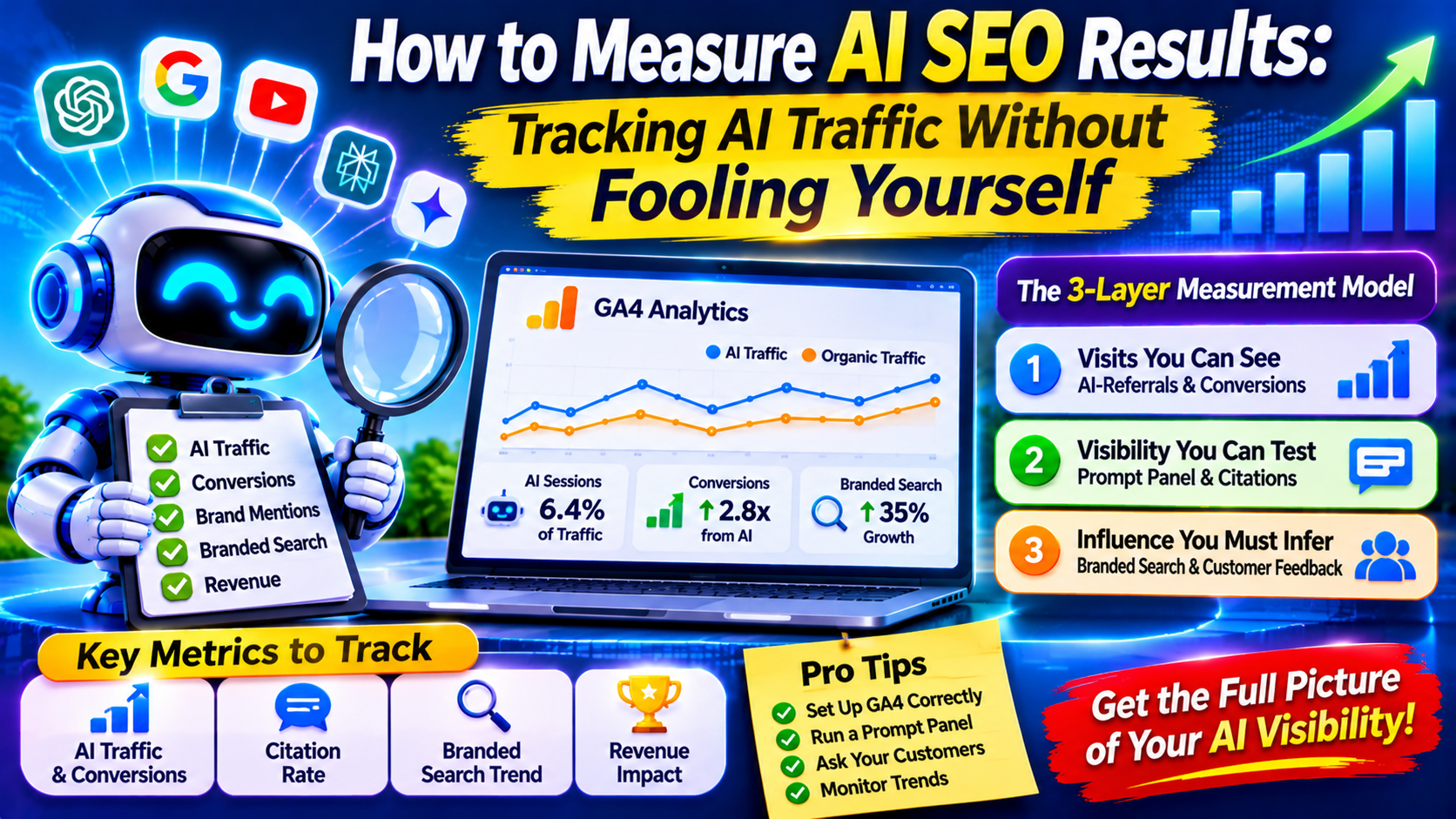
You can do everything right in AI SEO and still not know whether it worked. AI referrals hide in analytics, benchmarks contradict each other, and the biggest visibility channel may send no click at all. This guide shows how to measure what is measurable, how to treat what is not, and why you should distrust any single “AI traffic converts five times better” headline. Sarkar SEO puts measurement first, because a strategy you cannot evaluate is just a hope.
Why AI traffic is hard to see
Analytics tools were not built for answer engines. Until recently, GA4 had no clear place for them. One source reports that GA4’s AI Assistant channel started reporting tools like ChatGPT, Gemini and Claude as its own line, separate from Referral, on 13 May 2026. Before that, GA4 filed chatgpt.com under “Referral” along with forums and aggregators, with no separate line in the report. madxseoquick
Three gaps remain even now:
- Google’s AI features sit inside organic. Clicks from AI Overviews and AI Mode are indistinguishable from standard Google search clicks in analytics.
- Some AI visits arrive without a source. One attribution analysis describes Perplexity passing the referrer and GA4 logging it as referral, while ChatGPT strips the referrer and GA4 logs the session as direct. Another source says ChatGPT has appended a utm_source parameter to outbound links since June 2025. These accounts conflict, and behaviour may vary by access method, so check your own data.
- Many visits never happen. People read the answer and leave. Presence in an answer can influence a buyer without ever appearing in your reports.
The result is undercounting. Whatever your dashboard shows is a floor, not the real figure.
The conversion numbers: a lesson in why benchmarks mislead
Headlines claim AI visitors convert at several times the organic rate. Look at how far the claims spread. Seer Interactive’s case study, reported by one analyst, found within a single client ChatGPT at 15.9%, Perplexity at 10.5%, Claude at 5.0%, Gemini at 3.0% and Google Organic at 1.76%. That is one company’s data over a short period, where AI sessions were just under 11,000 against almost 14 million in total.
Contrast that with a larger sample. Orbit Media examined 97 B2B websites and roughly 29 million visits, and found organic search leads in traffic, AI leads in conversion rate, though its share of traffic is lowest. Their chart shows ChatGPT converting at a far lower rate than the single-client figure. One roundup claims AI traffic converts at 4.4x to 23x the rate of organic search visitors. A range that wide is not a benchmark. It reflects different industries, conversion definitions and traffic volumes.
The honest takeaway is narrower: AI referral visitors often arrive with strong intent, but small sample sizes inflate the figures. Your own numbers are the only ones that matter.
A three-layer measurement model
The following structure is my own, designed to keep different kinds of evidence separate.
Layer 1: Visits you can see. Sessions and conversions from identifiable AI sources.
Layer 2: Visibility you can test. How often your brand appears when buyers ask relevant questions.
Layer 3: Influence you must infer. Changes in branded search, direct traffic and the way new customers describe how they found you.
Treat each layer as a different instrument. None gives the full picture alone.
Layer 1: set up GA4 properly
- Check the built-in channel. If your property shows the AI Assistant channel, use it as the starting point.
- Add a custom channel group. Filter sources such as chatgpt.com, perplexity.ai, claude.ai, gemini.google.com and copilot.microsoft.com. One guide says this takes under thirty minutes and applies retroactively to historical data.
- Compare behaviour. Build a side-by-side view of AI versus organic: engagement, pages per session, conversions and landing pages. One study reports that ChatGPT visitors viewed 2.3 pages per session versus 1.2 for organic. Check whether your site shows the same.
- Watch Direct. A rise in direct visits after strong AI visibility work may be hidden AI traffic. Treat it as a hypothesis, not proof.
Layer 2: build a prompt panel
List twenty to fifty questions your buyers ask. Run them monthly across the engines you care about and record whether your brand appears, whether a link is shown, and what is said. One framework defines citation rate simply: the number of prompts where your brand is cited, divided by the total prompts tested. If you test 50 prompts and appear in 12, that is 24%. authoritytech
Keep the prompt list fixed, so month-to-month changes mean something. Expect noise, because answers vary between runs. Look for trends over several months.
Layer 3: ask your customers
The simplest attribution tool is a question on forms and sales calls: “How did you first hear about us?” Include a free-text box. Many buyers will name ChatGPT, Perplexity or a Google AI answer. This is imperfect, but it captures influence that analytics miss.
Also track branded search volume in Search Console. A steady rise can indicate growing awareness, though it has other causes too.
Metrics worth reporting to decision-makers
Keep the dashboard short:
- AI-referred sessions and conversions (Layer 1)
- Citation rate across your fixed prompt panel (Layer 2)
- Branded search trend and self-reported source (Layer 3)
- Revenue or qualified leads linked to any of the above
Avoid vanity figures such as raw impressions. One analysis warns of an impression inflation problem in this space, where large visibility numbers say little about results.
Keep perspective on scale
AI referrals are still a small share of most sites. One source reports that AI referral traffic reached roughly 6.4% of traffic for B2B tech firms by January 2026. Others suggest around 1% for typical B2B sites. Growth rates are eye-catching, but percentages from a tiny base can mislead. Do not reallocate your whole budget on the strength of one chart.
