



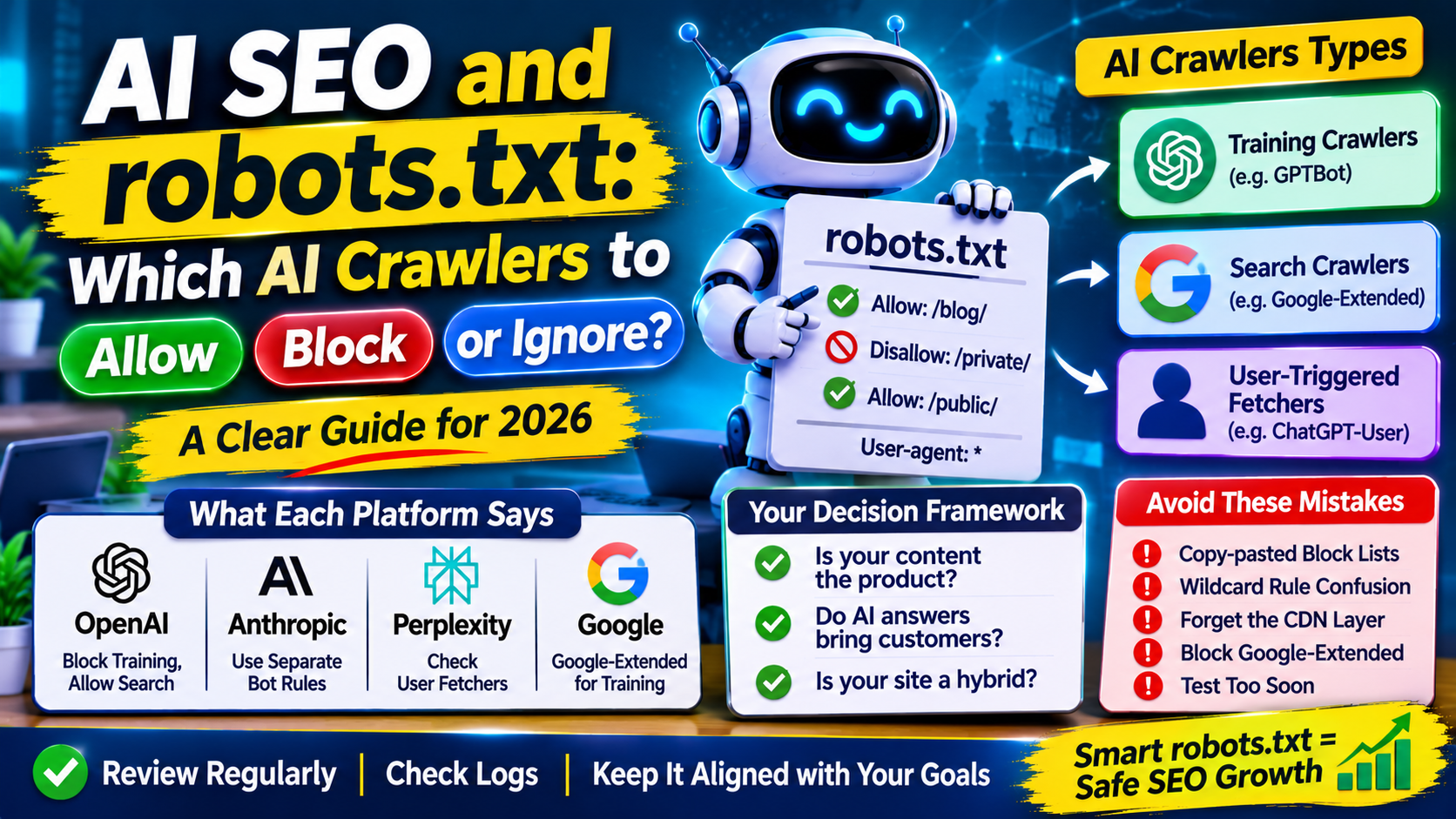
Your robots.txt file used to be a quiet technical detail. In AI SEO it has become a policy document, because it helps decide whether your pages train AI models, appear in AI answers, or both. Many sites pasted in a block list in 2024 and never looked again. Since then the bots have split into distinct roles, and one careless line can remove you from the answers your buyers are reading.
Three kinds of AI bots
Most AI crawlers fall into one of three roles:
- Training crawlers collect content for building models.
- Search crawlers build the indexes that answer engines cite from.
- User-triggered fetchers retrieve a page at the moment someone asks a question.
They are controlled separately. Search Engine Journal reports that for both Anthropic and OpenAI, blocking the training bot does not block the search bot or the user-requested fetcher. A single “block AI” rule no longer describes what you actually want.
What each platform says
OpenAI. Its documentation states that each setting is independent, so a site can allow OAI-SearchBot to appear in search results while disallowing GPTBot to signal that content shouldn’t be used for training. Sites that opt out of OAI-SearchBot won’t be shown in ChatGPT search answers, though they can still appear as navigational links. Changes can take about 24 hours to take effect. The user-initiated agent is different: because those actions are started by a user, robots.txt rules may not apply to ChatGPT-User. developers.openai.com +2
Anthropic. Its crawler documentation now lists separate bots for training, search indexing, and user requests. Per Search Engine Journal, Anthropic warns that blocking Claude-SearchBot may reduce your visibility in user search results, and says all three bots honor robots.txt. Anthropic also cautions that blocking its IP addresses may not work reliably and impedes its ability to read your robots.txt file, so use the file itself.
Perplexity. Search Engine Journal notes that OpenAI and Perplexity draw a sharper line for user-initiated fetchers, warning that robots.txt rules may not apply to ChatGPT-User and generally don’t apply to Perplexity-User.
Google. Google-Extended controls whether crawled content can be used for training Gemini models and for grounding in Gemini Apps. Google states that it does not affect a site’s inclusion in Google Search. Blocking it therefore won’t remove you from AI Overviews. One report says a separate Search Console setting controls appearance in AI Overviews, AI Mode, and Discover’s generative features. One 2026 study found that sites blocking Google’s AI crawler were less likely to be retrieved by AI Overviews, but its authors measured a correlation, not a cause, and Google states Google-Extended doesn’t affect Search inclusion. what opting out of googles ai search features means now +3
A decision framework
Skip the question “should I block AI?” and ask three narrower ones.
- Is your content the product? Paywalled journalism, licensed data, and paid courses carry real risk when copied into models. Blocking training bots is reasonable, and some owners restrict search bots on premium paths too.
- Does an AI answer send you customers? Service businesses, software vendors, and local companies usually benefit from being named. Allow search and user-fetch bots. Training access then becomes a legal and values decision, not an SEO one.
- Is your site a hybrid? Many sites have a public blog and a gated library. Allow search bots broadly, then disallow the private paths for every bot.
Sarkar SEO suggests writing this decision down before touching the file, so that the rules reflect a policy and not a copied snippet. Here is an illustrative example for a business that wants citations but not training. Adjust it to your own policy.
Mistakes that quietly cost visibility
- Copy-pasted block lists. Many snippets name both a training bot and its search sibling, so a rule meant to protect content also hides you from answers.
- Assuming a wildcard rule covers everything. Anthropic says that if your file names ClaudeBot specifically, it follows that rule even if your general setting says something different. Specific groups win, so a stray named block can override a permissive default.
- Forgetting the CDN layer. One resource roundup warns that a Cloudflare toggle can silently override your robots.txt. Check firewall and bot-management settings alongside the file.
- Expecting robots.txt to stop user-triggered fetches. As noted above, some platforms say it may not apply there.
- Blocking Google-Extended to leave AI Overviews. It won’t do that.
- Testing too soon. OpenAI says changes can take roughly a day.
Verify what is actually happening
Check your server logs for the bot names above, and confirm that suspicious requests are real. OpenAI, for example, publishes IP address ranges for its bots, so you can match a request against the official list. A spoofed user-agent string proves nothing on its own. At Sarkar SEO, we’d treat a quarterly robots.txt and CDN review as routine maintenance, because platforms add and rename bots often enough that a file written once will drift out of date.
