



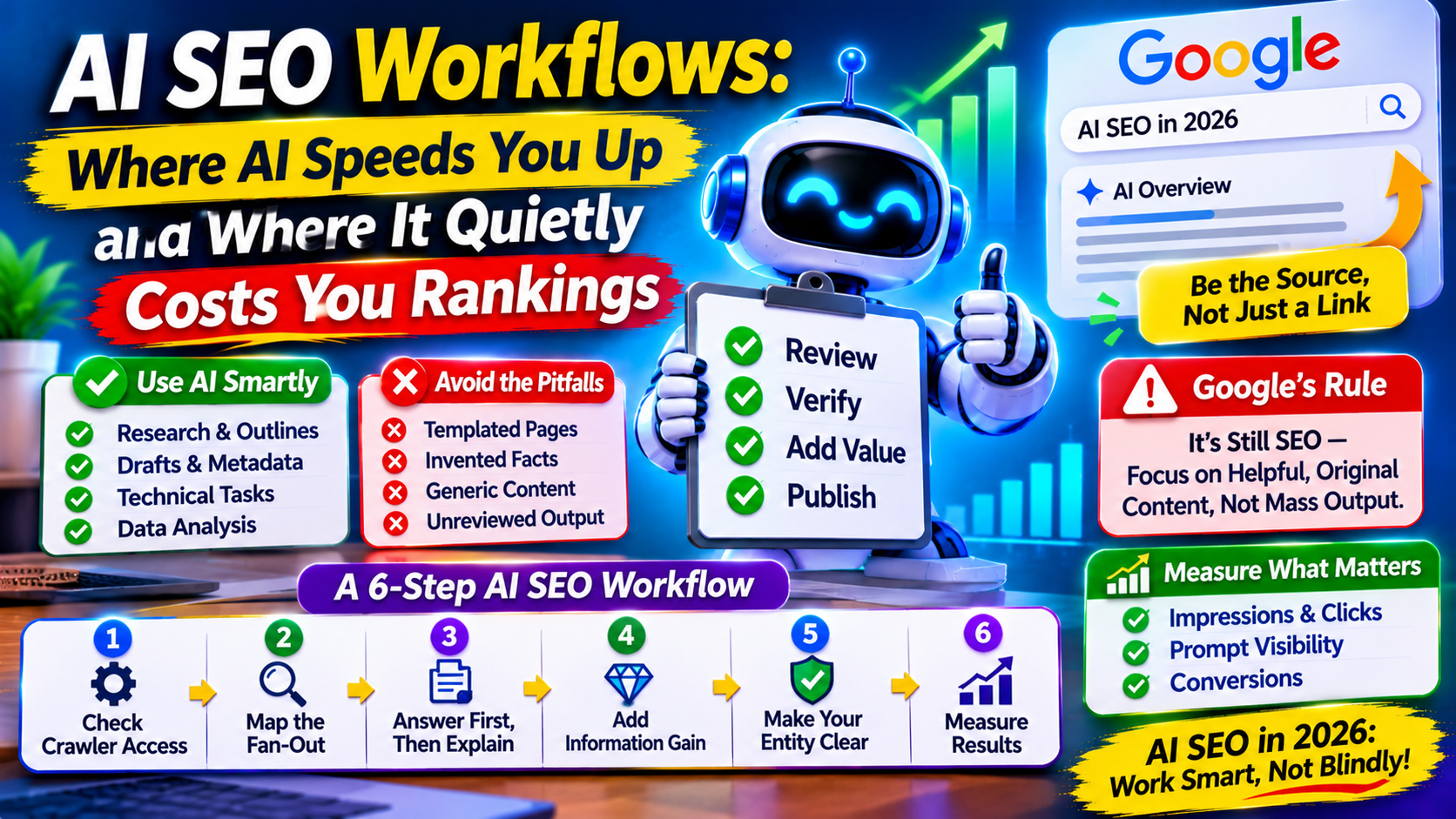
Most conversations about AI SEO split into two camps. One says to publish ten times faster with AI. The other says to avoid it entirely because Google will punish you. Both miss the point. The useful question is which parts of your SEO process benefit from a machine, and which need a person’s judgment and accountability attached. Sarkar SEO treats AI as a capable assistant that never gets the final say, and this article explains where that line sits.
What AI SEO Means Here
In this guide, AI SEO means using AI tools to carry out SEO work: research, drafting, metadata and analysis. Getting cited inside AI-generated answers is a separate topic. The workflow question comes first, because a careless process can damage a site long before any answer engine notices it.
The Rule That Matters: Purpose, Not Authorship
Google does not ban AI-generated content. Its policy targets low-value, unoriginal content created at scale to manipulate rankings, regardless of how it was produced. Google’s spam policy describes scaled content abuse as generating many pages mainly to manipulate rankings rather than help users, whether through automation, human effort or a mix of both. Google’s own AI guidance adds that using generative tools to create many pages without adding value for users may violate that policy. google policy on ai content +2
The reach is widening. Google’s spam policies now explicitly cover AI Overviews and AI Mode. Reporting on that change stresses that it applies existing rules to AI search surfaces rather than introducing new ones. So the test is not “did a machine write this?” but “does this page exist to help someone, or only to rank?”
What Changed in October 2026
On October 1, 2026, Google updated its guide on using generative AI content. The page now says generative models predict words rather than retrieve facts, that their output can contain hallucinations, and that manually fact-checking all AI-generated content before publishing is critical. Two details matter for real workflows:
- The check covers metadata. AI-generated title tags fall under the same manual review as article drafts. If a plugin writes your titles, schema or alt text unattended, that is now a gap in your process.
- Fake authorship is called out. Google’s helpful content guidance now treats a byline from a person who does not exist as deception.
It is worth keeping this in proportion. The guide does not say AI content is penalised for being AI-generated. It sets an expectation about review, not a new ban.
Where AI Earns Its Place
Used with a person in the loop, AI saves real time on tasks where speed matters more than originality:
- Query grouping. Sorting hundreds of keywords into intent clusters is tedious for humans and easy for models. You still decide which clusters deserve a page.
- Competitor gap summaries. Have AI condense what top pages cover, then decide what you can add that they lack.
- Briefs and outlines. A structured draft brief helps writers start faster, as long as the angle and evidence come from your own expertise.
- Technical chores. Redirect mapping, log file summaries, regex for crawl filters and spreadsheet formulas are good fits.
- Draft options. Ask for ten title variants or alt-text drafts, then choose and edit them yourself.
The pattern is simple. AI is strong at organizing and drafting, and weak at knowing what is true or what your business has actually experienced.
Where AI Hurts
- Templated location or service pages. Pages generated for each city using near-duplicate copy are a textbook case of scaled content abuse. birdeye
- Invented specifics. Models can produce confident statistics, quotes and case studies that do not exist. One fabricated figure can undo the trust built by a hundred accurate ones.
- Generic consensus content. An article that restates what ten others already say gives neither readers nor answer engines a reason to pick yours.
- Unreviewed automation. Publishing straight from a prompt, including schema and metadata, skips the step Google now names as critical.
- Made-up experts. Synthetic bylines and headshots are exactly what the new guidance labels deceptive.
A 15-Minute Review Gate
A short, repeatable checkpoint beats good intentions. This is the kind of gate Sarkar SEO suggests building into any AI-assisted publishing process:
- Verify every claim against a source you open yourself. Check numbers, dates, product names and quotations one by one. If you cannot find the source, cut the claim.
- Add something only you can add. That might be your own test results, a screenshot, a client scenario you are permitted to share, or an opinion you can defend.
- Read the metadata aloud. Title, description, schema, image alt text and anchor text all need human eyes.
- Confirm a real person stands behind it. A named author with a verifiable background, or a clearly attributed editorial team.
- Ask what the page adds. If the honest answer is “nothing the first page of results lacks,” rework it or do not publish it.
- Keep an edit log. A simple record of who checked what makes audits and future updates far easier.
Measuring Whether AI Is Actually Helping
Do not judge AI by output volume. Split your pages into two groups, AI-assisted and human-led, and compare them after eight to twelve weeks. Look at indexing rate, impressions, clicks, engagement and conversions, plus hours spent per page. If AI-assisted pages index slowly or stall on impressions, tighten the review gate before you scale. Also watch site-wide trends. Spam systems judge patterns, so a batch of weak pages can drag down a whole domain.
