



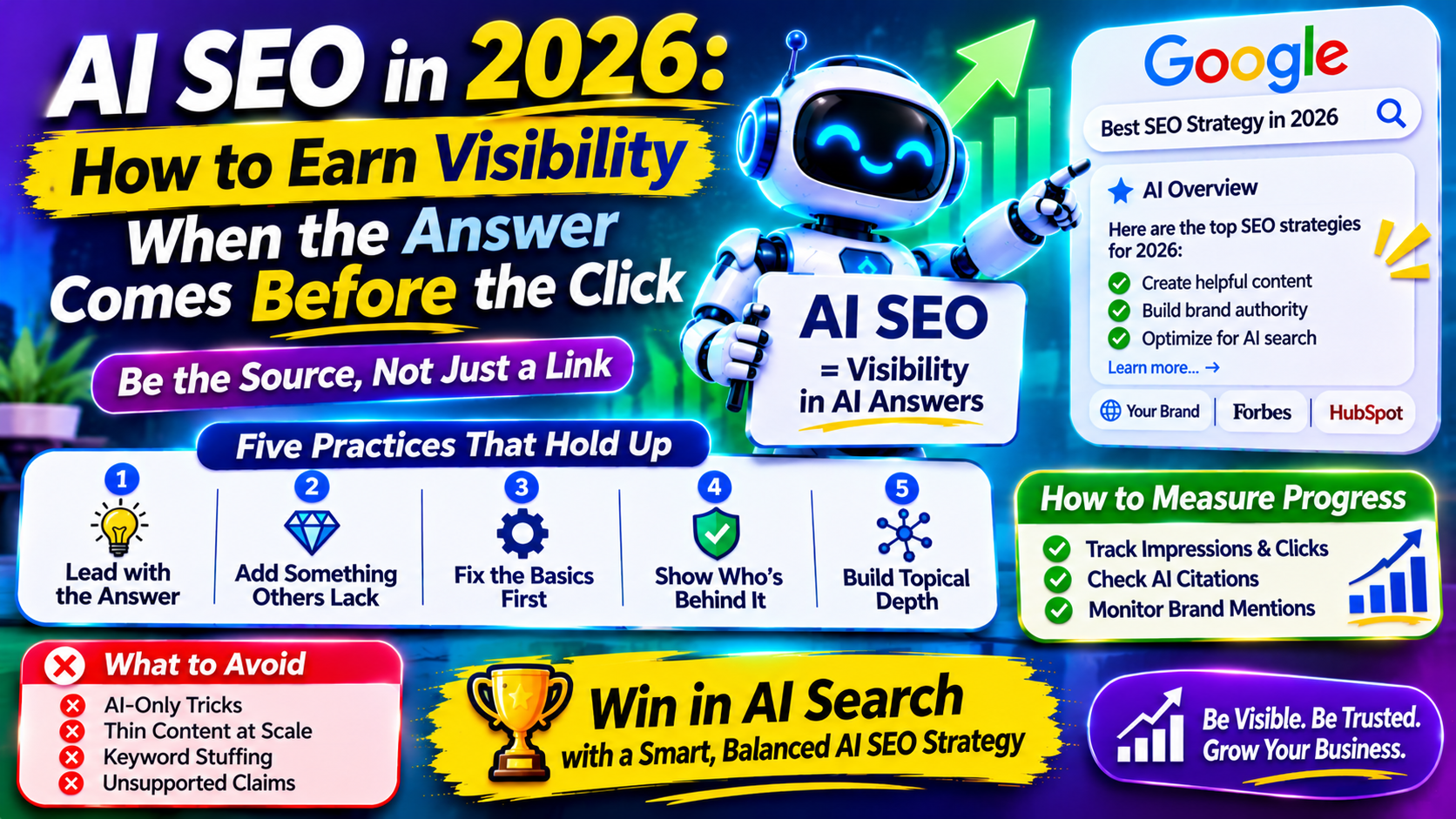
Search used to be a list of ten blue links. Now many queries return a synthesized answer first, and the links come second. For anyone publishing online, AI SEO is the discipline of making sure your pages are the ones those answers draw from.
The scale is hard to ignore. One recent industry guide reports that Google’s AI Overviews reach more than 2.5 billion monthly users, and AI Mode passed 1 billion monthly users as of May 2026, according to Google. Whatever your market, your audience is already meeting these formats.
What AI SEO Actually Means
AI SEO is the work of making content findable, understandable and trustworthy to both search engines and generative answer systems. You will also see it called answer engine optimization (AEO), generative engine optimization (GEO) or LLM optimization. These labels all describe the same goal of visibility in AI-generated responses.
It is not a replacement for SEO. It is SEO with a wider definition of success: being cited, summarized or recommended, not only ranked.
What Google Has Officially Said
The clearest signal came from Google itself. On May 15, 2026, Google published a documentation page on optimizing websites for generative AI features, covering AI Overviews and AI Mode. Its core message was reassuring and a little unglamorous. AI Overviews and AI Mode run on the same Search index and ranking systems as traditional results. Google also says there are no additional technical requirements to appear in them. Google Just Published Its First Official Guide to AI Search Optimization. Here’s What Actually Matters +2
So the schema “hacks” and special files that circulate online are not a shortcut. The practical priorities are the familiar ones: non-commodity content, demonstrated expertise, technical accessibility and strong reputation signals.
One caution is worth keeping. Google’s guide covers only its own surfaces. It says nothing about third-party AI engines. The same fundamentals appear to carry over to ChatGPT, Perplexity, Gemini and Claude, but treat that as a reasonable working assumption, not a guarantee.
Why Click Behavior Is Changing
The harder question is what happens after the answer appears. One analysis claims that 93 percent of AI Mode sessions end without a single visit to the source website. That figure comes from a single secondary source, so treat it as directional, not definitive. The underlying point still holds: ranking no longer guarantees traffic. Google’s own position, as summarized by Search Engine Journal, is that people run more queries in AI Mode, but the clicks are higher quality.
The goal shifts from winning every click to winning the right ones, and from being visible to being the source that gets named.
Plan Content Around Query Fan-Out
The most useful technical idea for writers is query fan-out. Instead of running one search, AI Mode and, to a lesser degree, AI Overviews break a question into several related searches.
Consider someone asking how to choose an SEO approach for a new online store. The system may quietly look up cost ranges, timelines, platform limits and common mistakes. A page that covers only one of those angles can be skipped. A page that answers the main question and its likely follow-ups gives the system more to work with.
When planning a topic, list the five or six questions a reasonable person would ask next, then answer each in its own clearly labeled section.
Five Practices That Hold Up
- Lead with the answer. Put a direct, self-contained answer in the first lines under each heading, then add nuance. This helps human skimmers and gives answer systems a clean passage to lift. HubSpot’s playbook lists answer-first formatting, clear heading structure and strong E-E-A-T signals as the foundation.
- Add something others lack. Commodity content, such as generic definitions and recycled lists, is the easiest to replace. Original data, real case notes, screenshots from your own tests and clear opinions backed by evidence all make a page worth citing. If you have not tested something yourself, say so.
- Fix the basics before the extras. Google’s guidance references crawlability, site structure, mobile usability, page speed and internal linking, which affect both traditional visibility and how AI Overviews retrieve content. One practitioner warns that teams often start with schema tweaks, which is backwards if the page has crawl or indexation problems. Confirm the page can be crawled and indexed first.
- Show who is behind the content. Name authors, state their credentials, cite primary sources and keep facts current. Reputation is a ranking input in Google’s framing, and it is also what makes a model comfortable quoting you.
- Build topical depth, not isolated pages. HubSpot notes that AI Mode additionally favors content ecosystems. A cluster of connected pages on one subject, linked sensibly, signals real coverage. This is where a consistent editorial plan pays off, and it is the approach Sarkar SEO builds into its content work.
How to Measure Progress
Traditional rank tracking will not show the full picture. Track three things separately:
- Organic impressions and clicks in Search Console.
- Whether your brand and pages are cited in AI answers for your priority questions.
- How AI systems describe you. Semrush suggests starting by auditing how AI systems describe you today.
Citation behavior can also differ from classic rankings, so one surface is not a proxy for another. Tracking visibility separately across AI Overviews, AI Mode, ChatGPT and other relevant surfaces remains worthwhile. Run the same set of questions monthly and record the results, because AI answers vary and a single check proves little. creative4all
What to Avoid
- Chasing “AI-only” tricks that Google says are unnecessary.
- Publishing thin pages at volume because a tool can generate them.
- Stuffing the primary keyword where it does not read naturally.
- Making claims you cannot source.
