



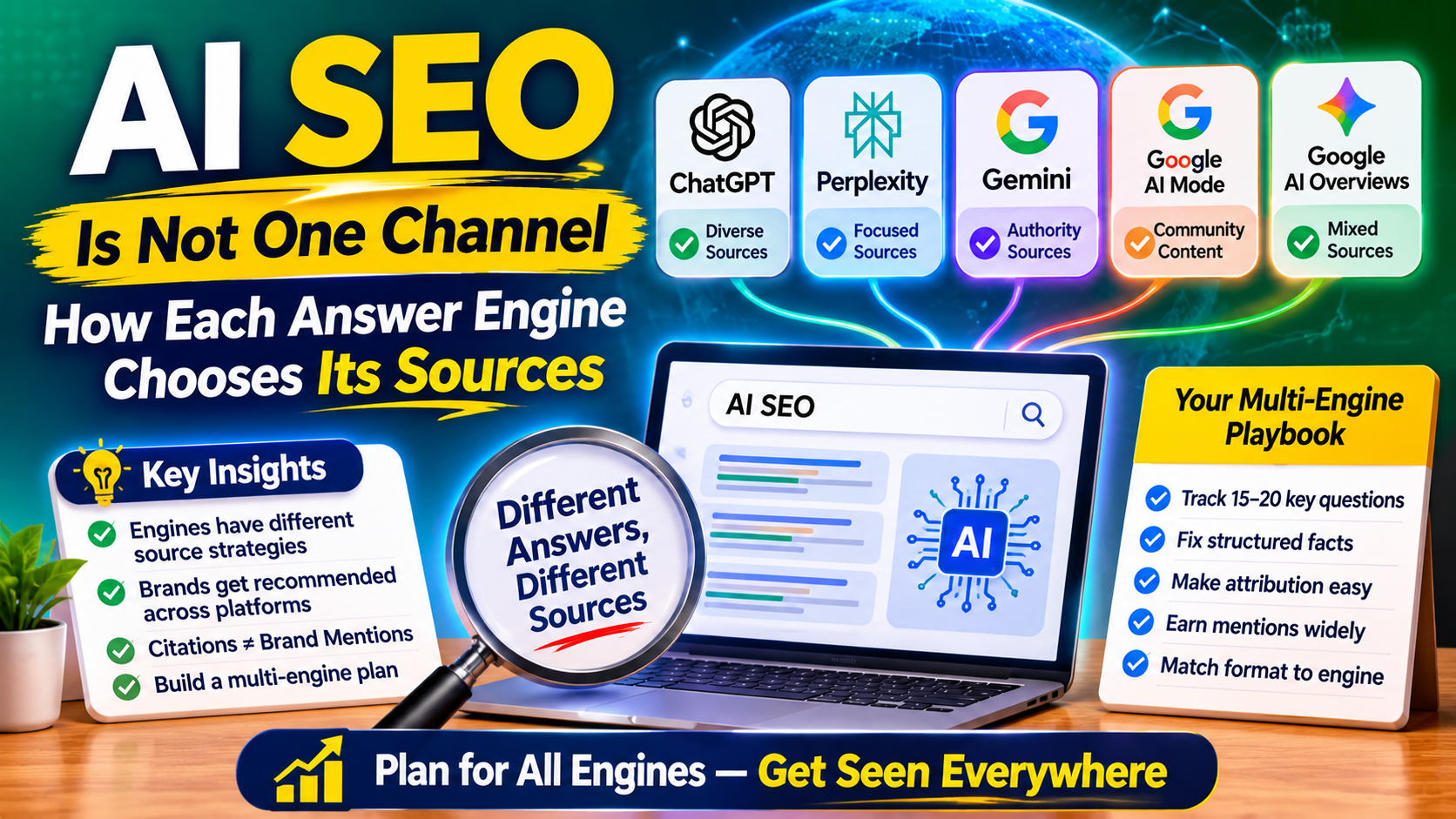
Ask ChatGPT, Perplexity and Gemini the same question and you will often get three different lists of sources. That is the first uncomfortable truth about AI SEO: a page that earns citations in one engine can be invisible in another. Treating “AI search” as a single target is the most common strategic mistake in the field.
This guide looks at how the major engines actually differ, what the 2026 data says, and how to plan for all of them without tripling your workload.
The Engines Disagree on Sources
BrightEdge’s April 2026 analysis compared five surfaces, ChatGPT, Perplexity, Gemini, Google AI Mode and Google AI Overviews, across prompts from ten industries. It found that the engines have fundamentally different editorial personalities when selecting the sources they cite.
The gap is easiest to see in the type of source. Gemini drew about 26% of its citations from authority sources and only 0.2% from user-generated content, while Google AI Overviews drew roughly 10% from authority sources and 18% from user-generated content. The concentration differs too. ChatGPT’s ten most-cited domains made up just 18.5% of its citations, against 26.7% for Perplexity. A flatter spread means a smaller site has a realistic chance in ChatGPT, whereas Perplexity leans on a tighter shortlist. brightedgebrightedge
Across the engines, the overlap in the top 100 cited sources ranged from 16% to 59%. In plain terms, a single “authority” list does not exist.
Yet They Recommend Similar Brands
The same research found something less obvious. Even when engines cite different pages, their brand recommendations converge. Citation selection and brand selection are different outcomes.
Ahrefs studied 75,000 brands and found that branded web mentions correlated at roughly 0.66 to 0.71 with brand visibility across ChatGPT, Google AI Mode and Google AI Overviews. The same source is careful to add that these are correlations, not proof that web mentions directly cause AI recommendations. That caveat matters, and I will come back to it.
The implication is practical. Your brand’s reputation across the wider web appears to travel with you from engine to engine, while the individual page that gets cited varies by platform.
The Ghost Citation Problem
Here is where AI SEO diverges sharply from classic SEO. Being cited is not the same as being named.
A 2026 Semrush and Kevin Indig study, as summarized by Mention Engine, looked at how brands appeared in AI responses. Of the appearances observed, 61.7% were citations where the brand itself was not named in the response, and another 25.1% were brand mentions with no citation. The engine gap was large: ChatGPT cited a source in 87% of observed appearances but named the associated brand in only 20.7%.
A separate report describes an extreme case, where Gemini cited one brand’s website 182 times in 30 days without ever mentioning the brand name in its text. Treat that as a single anecdote, not a benchmark. Still, it shows why a citation count alone can flatter you. If readers see your facts but never your name, you have supplied the answer and received no recognition.
Own Site or Third Parties?
The evidence here is split, and the split is itself useful.
On local, location-based business queries, Yext’s research found that Gemini and Perplexity directed 52.0% and 50.9% of citations to first-party websites. That scope is narrow, since those were business-location queries, so do not stretch it to every topic.
Other analyses point the opposite way for brand mentions. One roundup attributes to AirOps the finding that roughly 85% of brand mentions in AI answers come from third-party pages rather than the brand’s own domain. I could only see this through a secondary summary, so verify it before quoting it in client work.
Taken together, the sensible reading is that your own site wins when the question is about you, and outside sources shape the answer when the question is about your category.
A Multi-Engine Playbook
Build a prompt panel. Pick 15 to 20 questions your real customers ask. One source recommends running each prompt across ChatGPT, Perplexity, Gemini and Google AI Mode, tracking whether your brand appears, in what position and in what context. Repeat monthly, because answers drift.
Fix your structured facts first. Yext’s 17.2-million-citation study found that verified, structured, directly distributed data made up 54.53% of distinct citation sources. Make sure your name, services, locations, pricing model and leadership details are identical everywhere they appear. Inconsistency is cheap to fix and expensive to ignore.
Make attribution easy. Because ghost citations are common, write so your brand is attached to your claims. Publish named methodologies, original numbers and quotable statements that carry your name, not only generic advice a model can absorb anonymously. Sarkar SEO applies this to client content by pairing each key claim with the entity that owns it.
Earn mentions where engines look. Since the strongest correlations involve mentions across the web, invest in expert commentary, credible directories, podcasts, industry roundups and reviews. Chasing links alone is the weaker bet. Ahrefs-based figures reported by Topify put backlinks at 0.218 correlation with AI visibility, compared with 0.664 for branded web mentions. topify
Match format to engine. Where an engine leans on community content, as Google AI Overviews does in the BrightEdge data, a presence in forums and discussion platforms matters. Where it leans on institutions, as Gemini does, citations from research, standards bodies and established publishers matter more.
What the Data Cannot Tell You
Be skeptical of tidy numbers in this field. Most of these studies come from vendors who sell tracking tools, use different prompt sets and categories, and measure moving targets. Correlation is not causation, and an engine’s behavior can change after an update. The durable lesson is directional: engines differ, reputation is portable, and measurement beats guessing.
