



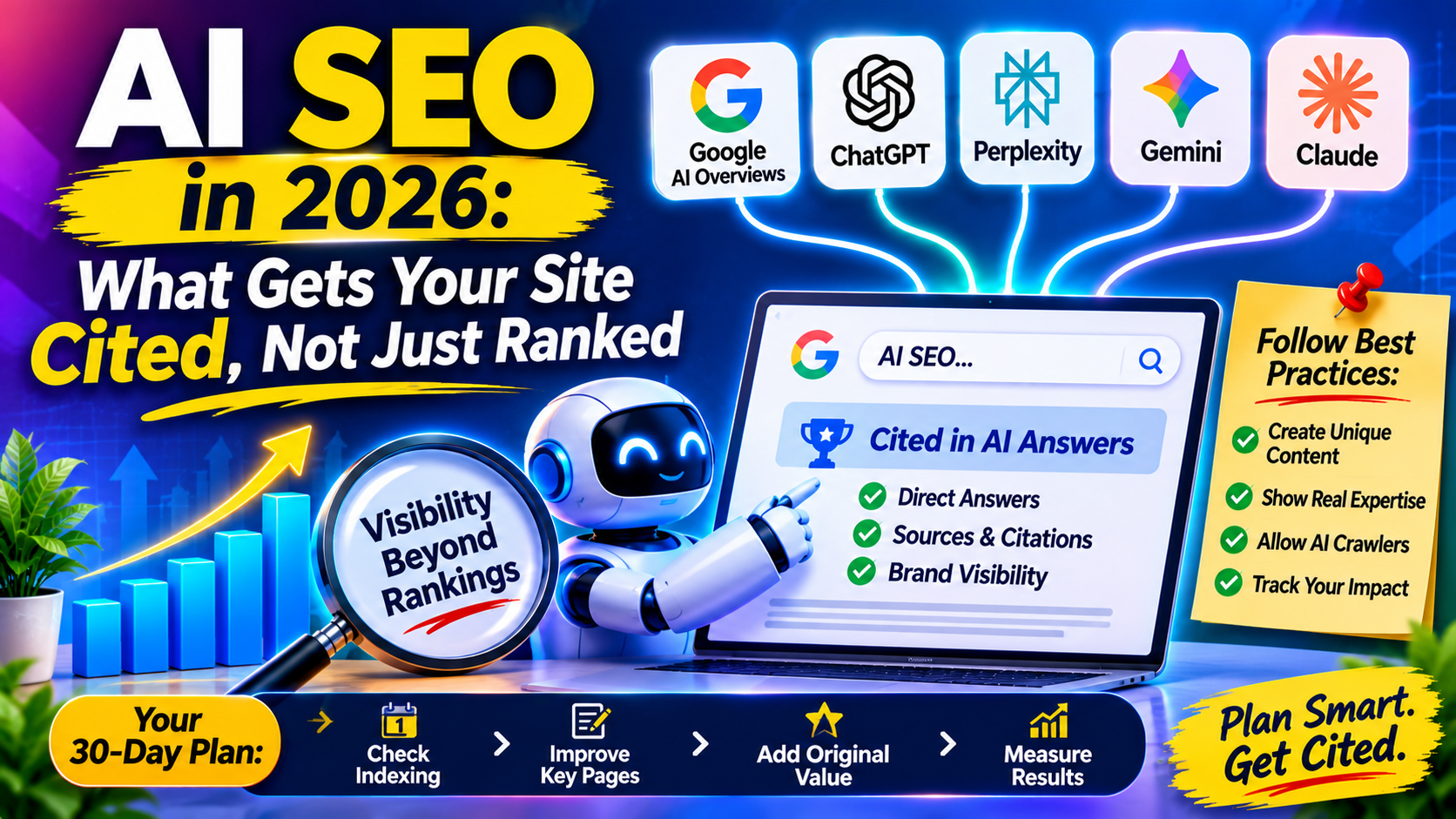
Search no longer ends with ten blue links. Google summarizes, ChatGPT answers in conversation, and Perplexity cites as it writes. For website owners, the question has shifted from “Where do I rank?” to “Will anyone quote me?” That shift is what AI SEO is about, and most advice on it is noisier than it needs to be.
What AI SEO Actually Means
AI SEO is the practice of making your content easy for search engines and AI answer systems to find, understand, and cite. It covers Google’s AI Overviews and AI Mode, plus assistants such as ChatGPT, Perplexity, Gemini, and Claude. Some people call it GEO (generative engine optimization) or AEO (answer engine optimization). The labels differ. The goal is the same: be the source an AI trusts enough to mention.
What Google Itself Says
In May 2026, Google published its first dedicated guide to generative AI features in Search, titled “Optimizing your website for generative AI features on Google Search.” Its message is calm and, for many marketers, a little disappointing: there is no secret layer.
Google’s documentation says the same fundamentals apply to AI Overviews and AI Mode as to regular search. A page must be indexed and eligible to appear with a snippet. Crawling must be allowed in robots.txt and by your CDN or host. Important content should be available as text, reachable through internal links, and supported by a good page experience. Google also says no special optimizations are required beyond that.
The guide also puts weight on unique, non-commodity content. A page that merely summarizes what everyone else already says gives an AI system no reason to choose it.
The Myths Worth Dropping
A lot of paid advice rests on tactics Google has not asked for. Commentary on the May guide notes that businesses do not need new machine-readable files, AI-specific text files, or special markup to appear in generative AI results. That includes llms.txt, which Google says is unnecessary for its own AI features. Other engines may treat such files differently, but no major platform has made one a proven requirement, so treat it as optional housekeeping rather than a strategy.
The same goes for publishing a separate page for every possible follow-up question an AI might generate. Google describes that approach as ineffective over the long term. Depth on one well-built page beats a pile of thin ones.
Build Information Gain, Not Word Count
If everyone can summarize the same ten sources, the summary is worthless. What an AI cannot produce on its own is original evidence: your own data, a tested process, a documented mistake, a clear opinion backed by reasoning.
Before you publish, ask what this page contains that a competitor’s page does not. Good answers look like:
- A small survey, benchmark, or audit you actually ran, with the method stated
- A decision framework with trade-offs, not a list of generic tips
- A real example, with specifics, from your own work or customers
- A position you can defend, written plainly
At Sarkar SEO, this is the first filter we apply to any content plan: if a page could have been written by anyone, it is not ready.
Write Passages That Stand Alone
AI systems often lift a passage rather than a whole page. That makes structure practical, not cosmetic.
- Put the direct answer in the first one or two sentences under a question-style heading.
- Keep each paragraph focused on one idea so it makes sense when quoted out of context.
- Use specific nouns instead of “it” and “this approach.”
- Add dates, units, and named sources where a claim needs them.
- Show real authorship: a named author, a short bio, and a visible update date.
This also happens to be good writing for people. Google’s own guidance favors organizing content for human readers rather than contorting it for machines.
Think Beyond Google
Google’s guide covers Google. ChatGPT, Perplexity, and Claude may weigh signals differently, and they do not publish ranking rules. Two habits transfer well across all of them.
First, let their crawlers in. If your robots.txt or firewall blocks AI bots, you remove yourself from their answers by choice. Decide deliberately, platform by platform.
Second, build brand presence outside your site. Consistent mentions, reviews, and profiles across credible places help systems recognize who you are and what you are known for. Keep your business name, descriptions, and details identical everywhere.
Measure What Matters
Google states that clicks from pages with AI Overviews tend to be higher quality, meaning visitors spend more time on the site. That is Google’s own claim, so verify it against your analytics. Clicks may fall while the value of each visit rises.
Track:
- Impressions and clicks in Search Console, including for question-style queries
- Conversions and leads from organic visits, not traffic alone
- Manual checks: run your 20 most important queries monthly in Google, ChatGPT, and Perplexity, and record whether you are cited
- Branded search growth, which often signals rising recognition
Be cautious with industry statistics on how often AI Overviews appear. Published figures vary widely by tool and query set, so use them as directional, not exact.
A 30-Day Starting Plan
Week 1: Confirm your key pages are indexed and snippet-eligible. Check robots.txt, redirects, and mobile speed.
Week 2: Pick your five highest-value pages. Rewrite their openings so each question gets a direct answer first.
Week 3: Add one piece of original evidence to each: a data point, example, or tested step.
Week 4: Set up your monthly citation check and tie organic visits to leads or sales.
Notice what is missing: no new file formats and no tricks. AI SEO rewards the work good SEO always required, done with more honesty about whether you add anything new.
