



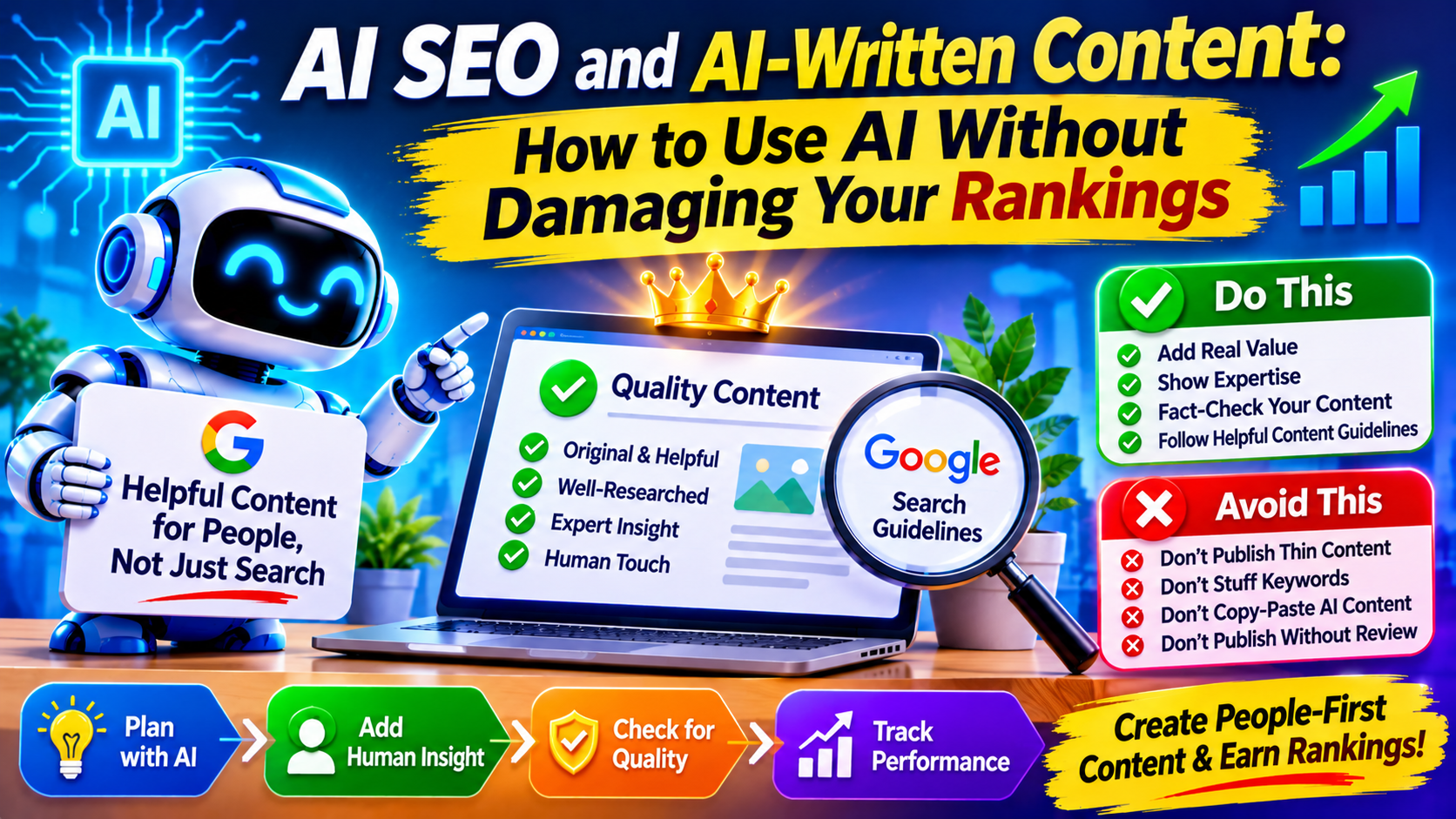
Almost every marketing team now uses AI to help produce content, and almost every team worries about the same thing: will it hurt our search performance? The answer depends less on whether you use AI SEO and more on how you use it. This guide explains where Google actually draws the line, what separates helpful AI-assisted work from the kind that gets demoted, and a workflow you can adopt. Sarkar SEO recommends treating AI as a fast assistant, never as the author of record.
What Google actually says
Google does not ban AI content. One compliance guide summarises the position as AI itself is fine, but AI used to game rankings is not. Google’s helpful content guidance judges whether pages are useful, original and created for people, not whether AI was involved in production. rankai
The risk sits in a specific policy. Google’s spam rules define scaled content abuse as producing many pages primarily to manipulate rankings rather than help users, no matter how the content was made. Human-written spam and machine-written spam face the same consequences. Google also states that using generative AI to create large numbers of pages without adding value can violate its rules on scaled content abuse.
The policy has a history. In March 2024, scaled content abuse became a named spam policy category alongside expired domain abuse and site reputation abuse. The focus moved from how content is made to what it does for the reader.
Why the distinction matters in practice
Some commentary claims dramatic damage. One agency says that sites publishing AI pages at scale saw 50% to 80% of their organic traffic disappear within two weeks after the March 2026 core update. That is a single vendor’s claim, without a clear methodology, so do not treat it as a benchmark. A more reliable lesson is this: one update does not mean all weak pages disappeared, and search quality is not solved in one release. Risk is real but uneven, and low-value pages tend to lose ground over time.
Quality raters, who help Google test its systems, also look for effort. One summary of the September 2025 rater guidelines says pages with AI-generated content showing little effort, originality or added value can receive the lowest quality rating. rankai
The test that separates good from bad
Google’s helpful content guidance suggests asking Who, How and Why. A guide to AI content applies this neatly: the framework separates the tool from editorial responsibility. You can use it as a pre-publication gate:
- Who created this, and is a real, accountable person or team behind it?
- How was it produced, and what human checking took place?
- Why does it exist: to help a reader, or to capture a keyword?
If you cannot answer the third question honestly in favour of the reader, do not publish.
A workable division of labour
Rather than banning AI or trusting it blindly, assign tasks by risk. This split is my own practical suggestion, not an official standard.
Where AI helps safely
- Brainstorming angles and outlines from your own notes
- Summarising long documents you supplied
- Suggesting headline variations and meta description drafts
- Cleaning grammar and improving clarity
- Turning raw interview transcripts into a first structure
Where a human must lead
- Choosing what the article should say and why it matters
- Supplying firsthand experience, examples and opinions
- Verifying every statistic, quote, date and source
- Making claims about health, money, law or safety
- Final voice, accuracy and approval
AI cannot supply experience it does not have. If the sentence begins “In our testing,” a real test must exist.
Seven checks before you publish
- Fact-check every claim. AI tools can state invented figures with confidence. Trace each statistic to its original source and remove anything you cannot confirm.
- Add something new. Ask what this page offers that top-ranking pages do not. An original example, dataset, screenshot or expert view meets that test. A smoother rewrite of existing pages does not.
- Remove filler. Delete generic openings, repeated points and vague summaries.
- Check duplication. Make sure your page is not near-identical to your own template pages. Mass-produced variants are the pattern Google targets.
- Name an accountable author. Include a real byline and credentials where relevant. Honest author information supports trust.
- Read it aloud. Awkward phrasing is a reliable sign that no one actually edited the draft.
- Decide on disclosure. There is no universal rule, but readers may reasonably expect a note when AI materially shaped the content. One source says the firm labelling rule sits in Merchant Center, where AI-generated product text must be marked. Verify the current requirements in Google’s own documentation if you sell through it.
The programmatic page trap
Template-based pages, such as one page per city or product with a few swapped words, deserve special care. They can be legitimate when each page contains genuinely distinct, useful information, such as real local data or specific inventory. They become a problem when the only difference is the place name. If you cannot justify why a user would want each page, publish fewer pages.
Why this also matters for AI search
Answer engines retrieve from the same web. A site stuffed with interchangeable articles gives them little reason to cite you over anyone else. Substance, evidence and a clear point of view help in both traditional search and AI-generated answers. Quality is also easier to defend when platforms change their rules.
Measuring whether your approach works
Review AI-assisted pages after publication. Look at impressions, clicks, time on page, conversions and whether the page earns links or mentions. Compare them with fully human-written pages in the same topic area. If AI-assisted pages consistently lag, tighten the editing process before producing more. Scale only what proves its worth.
