



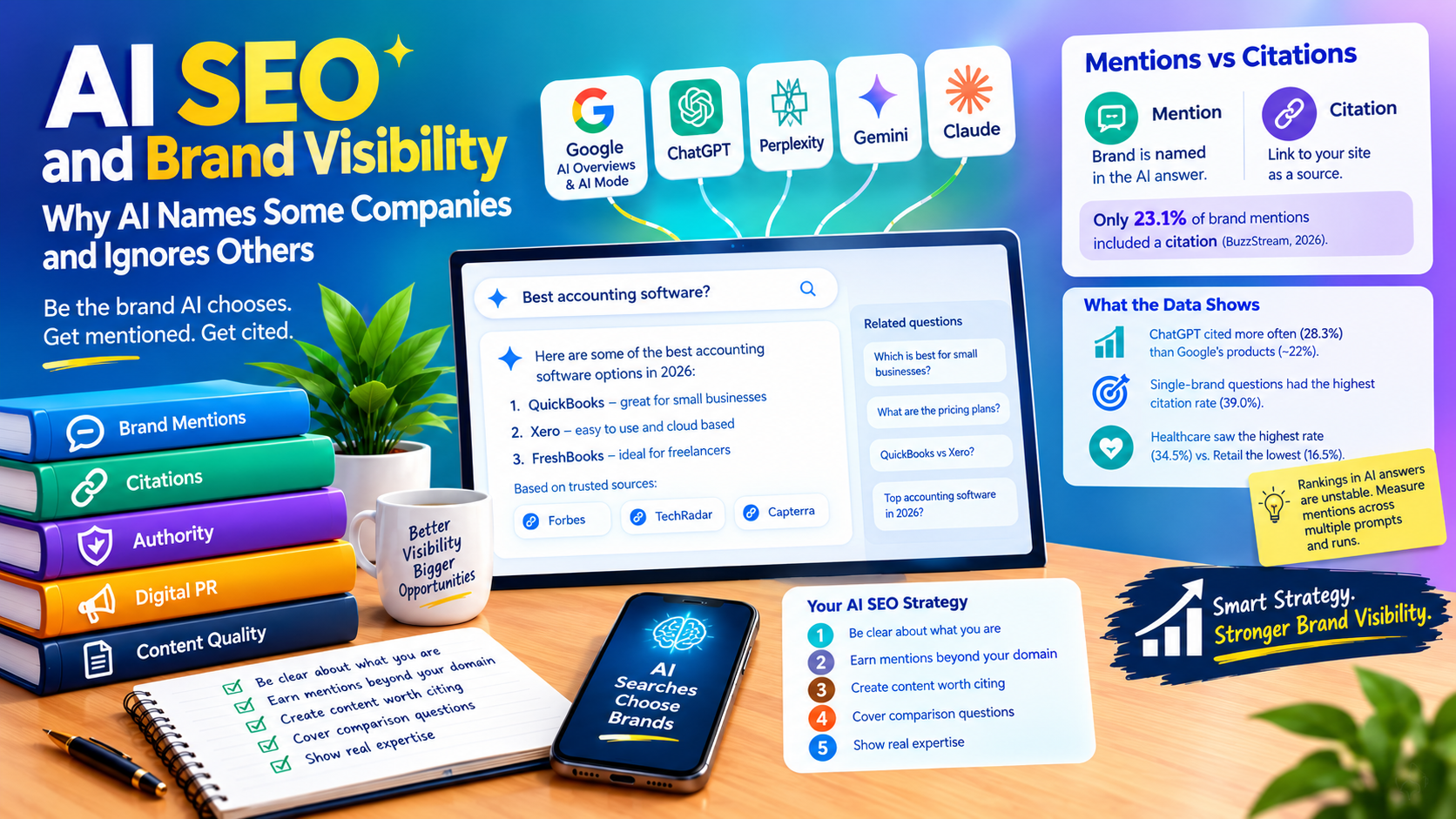
Ask an AI assistant for the best accounting software, a reliable web agency or a good running shoe, and it answers with names. No ten blue links, no scrolling. Either your brand is in that answer or it is not. This is the part of AI SEO that most guides skip: the goal is no longer only a high ranking, but being the brand a machine chooses to name. At Sarkar SEO, we see this as the biggest shift in how visibility is earned.
Mentions and Citations Are Not the Same Thing
A mention is when an AI answer names your brand. A citation is when it links to a page as a source. They often get confused, and the data shows they diverge sharply.
A June 2026 study by BuzzStream, run with the tracking firm Xofu, examined 12,000 AI responses across Google AI Mode, AI Overviews, Gemini and ChatGPT, covering about 200 brands in ten industries. Only 23.1% of brand mentions included a citation to that brand’s own domain. Read the full BuzzStream study. Note that BuzzStream sells related tools and the sample is limited, so treat the numbers as directional.
Other findings from that study are worth knowing:
- ChatGPT cited the brands it mentioned more often (28.3%) than Google’s products did (about 22%).
- Mentions were most likely to carry a citation when the question named a single brand (39.0%) and least likely for broad list or category questions (7.2%).
- Industry mattered: healthcare saw the highest mention-to-citation rate (34.5%) and retail among the lowest (16.5%).
The study’s author suggests that a mention with no citation may come from what a model absorbed during training, while a citation points to evidence retrieved live. That is an interpretation, not a proven mechanism, but it is a useful way to think about two separate visibility problems.
Why Category Questions Are the Hard Ones
The queries that matter most commercially are rarely “tell me about Brand X.” They are “what is the best tool for Y” or “who should I hire for Z.” These are exactly the list-style prompts where, in BuzzStream’s data, citations to brand sites were rarest. The study’s commentary indicates that most citations pointed to third-party sites rather than the brands’ own pages, though that figure comes from the author’s commentary rather than a headline metric.
The practical implication: for competitive category questions, what credible third parties say about you can matter as much as your own pages.
Rankings Inside AI Answers Are Unstable
Before building a strategy, understand how noisy these answers are. Rand Fishkin of SparkToro and Patrick O’Donnell of Gumshoe.ai had about 600 volunteers run 12 identical prompts through ChatGPT, Claude and Google’s AI close to 3,000 times. The odds of getting the same list of brands twice were under 1 in 100, and the odds of the same list in the same order were closer to 1 in 1,000.
Their recommendation: stop tracking your “position” in an AI answer, because it is effectively random. Measure how often your brand appears across many prompts and many runs. Some brands showed up in 60% to 90% of responses for a given intent, which is a meaningful signal. The study also leaves open questions, including how many runs produce reliable numbers.
What This Means for Your AI SEO Strategy
None of the research above proves a guaranteed formula. What it supports is a sensible order of priorities.
- Be clear about what you are. Sarkar SEO starts every engagement here. A model can only associate your brand with a topic if your site states plainly what you do and who you serve. Keep names and descriptions consistent across your website, social profiles and listings.
- Earn mentions beyond your own domain. If most citations come from third parties, then reviews, expert roundups, industry publications, podcasts, community discussions and partner pages all deserve attention. This is classic digital PR, now with a measurable payoff in AI answers. Sarkar SEO treats these off-site signals as part of an AI SEO plan, not an optional extra.
- Create pages worth citing. Original research, benchmarks, transparent pricing explanations, detailed comparisons and honest “who this is not for” sections give a retrieval system something specific to quote. Generic overviews give it nothing it cannot get elsewhere.
- Cover your category’s comparison questions. Build pages for “X vs Y,” “best X for Z” and alternatives to your own product. Be fair to competitors. Balanced pages tend to read as more trustworthy to both people and machines.
- Show real expertise. Name your authors, state their credentials truthfully, and include first-hand detail such as tested methods or client lessons you can document. Never invent experience.
How to Check Where You Stand
You do not need expensive software to start. Write 20 to 30 prompts that real customers would ask, covering single-brand, comparison and category questions. Run each several times across ChatGPT, Gemini, Perplexity and Claude, and record two things separately: whether your brand was mentioned, and whether your site was cited. Repeat monthly.
Given how unstable individual answers are, trust the pattern across runs rather than any single response. A rising mention rate on category prompts is a stronger sign of progress than one lucky first-place appearance.
Also look at who is cited instead of you. Those sites are your outreach and content roadmap.
