



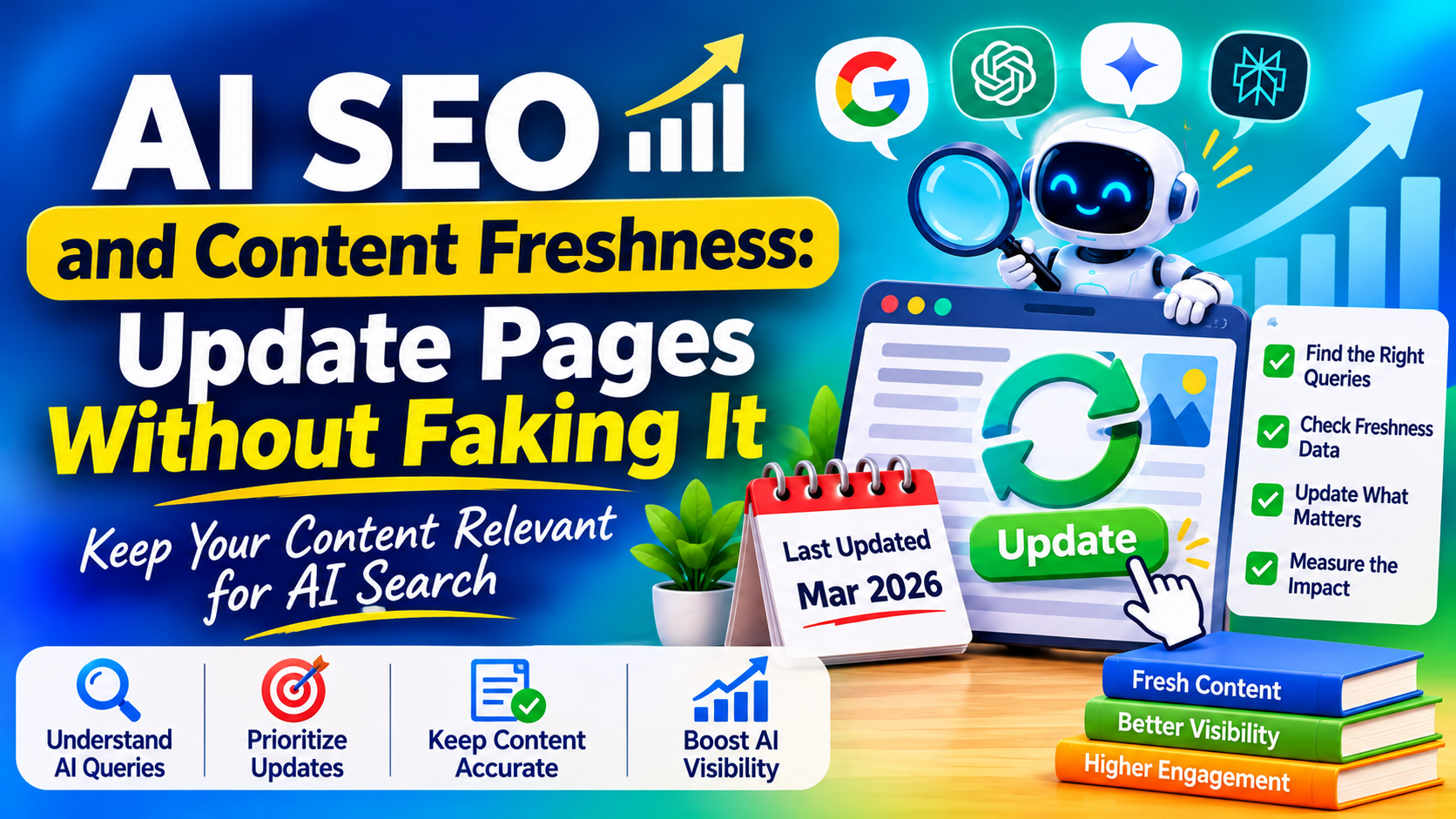
Most content teams know they should update old posts. Few know which ones, how much to change, and whether it matters for AI SEO answers. New research gives a more useful answer than “refresh everything every year.” The pattern is real but narrower than the marketing around it suggests, and it rewards honest maintenance over date tricks. Sarkar SEO treats freshness as a prioritization problem: spend effort where age actually costs you.
What the freshness data shows
Ahrefs analyzed about 17 million cited URLs from ChatGPT, Perplexity, Gemini, Copilot, AI Overviews and Google’s organic results. Its headline finding was that cited URLs are, on average, 25.7% “fresher” than URLs in organic search results. In days, organic results averaged 1,432 days since publication against 1,064 for AI-cited content, and 1,047 against 909 days since last update.
The platforms differ. ChatGPT showed the strongest bias toward recent content, with reference URLs about 393 days newer than organic results, rising to 458 days in citation lists. Google’s AI Overviews broke the pattern: they cite content about 16 days older than organic results on average. And Perplexity and ChatGPT both show newer content being cited first, which looks like intentional age-based ordering. ai loves fresh content how to keep your blog posts relevant and cited +2
Read the data with some restraint
Even Ahrefs’ own caveats are worth repeating. The average age of cited pages is still 2.9 years, and like traditional search, AI assistants still prefer long-lived content. A newsletter summary of the study drew the sensible conclusion: the researchers warn against knee-jerk reactions, and content quality trumps freshness.
Another write-up adds that freshness is a complement, not a replacement for quality. A thin page updated yesterday is still a thin page.
Platform behavior also moves. One analysis reports that Perplexity and Grok weight freshness most heavily, Google’s AI surfaces are the most conservative, and ChatGPT’s behavior has swung sharply across model releases, so it should not be treated as one stable number. Treat any “cited within 13 weeks” statistic you see circulating as a rough indicator, not a rule.
Not all content ages at the same speed
The useful question is not “how old is this page?” but “what would make this page wrong today?” A simple triage:
Fast-decay pages. Pricing, tool comparisons, “best of” lists, regulatory summaries, platform features, statistics and anything tied to a software version. A reader and a model both lose trust quickly when these are out of date.
Medium-decay pages. Process guides and how-tos that depend on interfaces, laws or standards that change a few times a year.
Slow-decay pages. Core concepts, definitions, principles and historical explanations. These can sit untouched for a long time without harm.
Spend your update budget on the first group, review the second on a schedule, and leave the third alone unless something actually changes.
What counts as a real update
Ahrefs published separate guidance titled how to update posts, not just change dates. That distinction matters. One industry write-up makes the same point: AI systems appear to check whether content reflects current reality, not just whether the timestamp says 2026. I cannot verify how any specific engine does this, but fake date bumps are a bad bet because they risk readers’ trust the moment they notice stale content under a fresh date. ahrefsmarketing
A substantive update includes at least some of these:
- Replace outdated statistics with current ones and name the source.
- Correct claims that are no longer true and remove obsolete advice.
- Add new examples, screenshots or tested steps.
- Cover developments that changed the answer.
- Rework sections that no longer match what people ask.
- Add a short visible note describing what changed and when.
Keep the same URL, make the visible date and any structured date match the real edit, and do not republish untouched pages as new.
A practical update workflow
- List your pages by decay speed. Use the three-tier triage above.
- Find the ones losing ground. In Search Console, look for pages with falling clicks or impressions over six to twelve months.
- Check the page against today’s facts. Open every source and statistic.
- Decide: update, merge or retire. If two weak pages cover the same topic, combine them.
- Edit with a changelog. Note what you changed so readers and editors can see it.
- Re-test. Run your core prompts in several AI tools before and after, and record whether the page appears.
Sarkar SEO recommends keeping this as a rolling process, with a few pages reviewed every week, instead of a once-a-year clean-up that creates a pile of work and a burst of change.
Common mistakes
Updating everything. The data does not suggest every page needs touching. Pages that already perform and do not depend on time-sensitive facts are best left alone.
Rewriting a page that ranks. Heavy rewrites can disrupt a working page. Change what is wrong or missing, and preserve what is performing.
Adding the current year everywhere. Years in titles help only when the content is actually current. Otherwise they age badly and look careless.
Treating correlation as proof. The studies show that cited pages tend to be fresher. They do not prove that updating causes citation, and a page may be cited because its team maintains it well in general.
How to measure the effect
Track each updated page against a short list of signals: impressions and clicks over the following eight to twelve weeks, whether it appears in your monthly AI prompt test, and any change in referral visits from AI tools. Compare with a similar page you did not update. Without a comparison group, you will credit updates with changes that came from elsewhere.
