



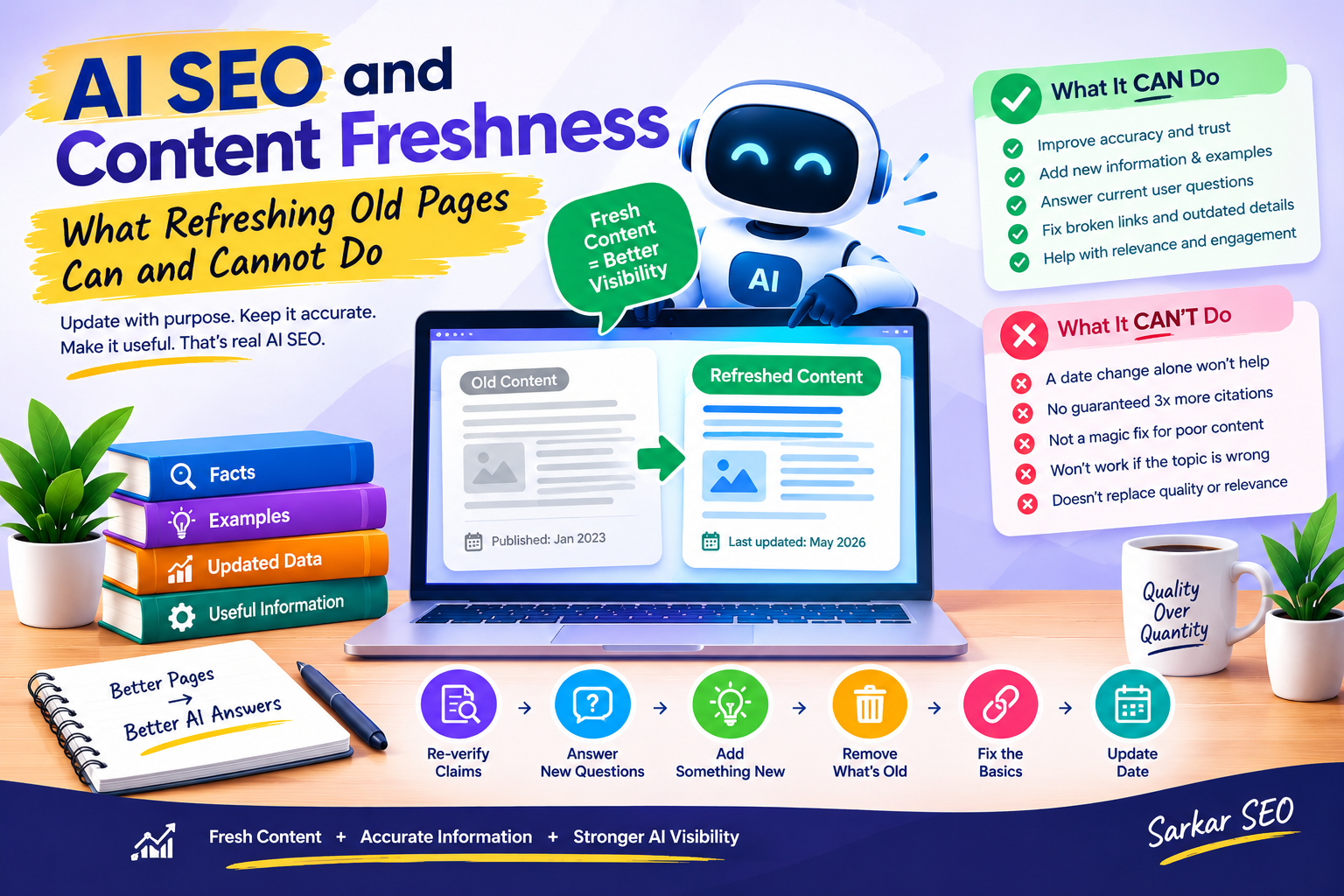
Refreshing old content is one of the cheapest AI SEO moves available, but the popular claim that updated pages win three times more AI citations rests on weak evidence. A real update, one that corrects facts and adds substance, is worth doing. Changing a date and hoping for a boost is not. This Sarkar SEO guide separates what is supported from what is marketing.
Where the “3x” Claim Comes From
Search for freshness and AI citations and you will meet a confident number. A May 2026 article from an API vendor reported that pages refreshed within 30 days earned roughly three times the ChatGPT citations of pages untouched for over a year. The only sample stated was one internal audit of 400 pages. The article did not explain how citations were counted, over what period, or how refreshes were verified, and the vendor sells citation-tracking tools.
Another compilation page cites an Ahrefs analysis of 17 million citations, saying cited content is 25.7% fresher. Yet the average ages it quotes, 909 and 1,047 days, imply a gap of roughly 13 to 15 percent. When a headline number does not match its own inputs, treat it with caution.
None of this proves freshness is irrelevant. It means the size of the effect is unknown, and the evidence we reviewed is mostly correlational. Fresher pages may simply be better maintained, better linked or about faster-moving topics.
What Google Says About Dates
Google’s documentation on publication dates is practical and modest. It recommends:
- Showing a visible date, labelled such as “Last updated”
- Using datePublished and dateModified structured data on an Article or BlogPosting
- Keeping the visible and structured dates consistent
- Using the date the page was published or updated, not a date tied to an event it describes
An older Google post adds a warning: do not give a story a new date without substantial changes or a compelling reason. The takeaway is simple. Dates are a statement of fact about your page, so update them only when the page genuinely changed.
What Counts as a Real Refresh
A refresh should change what the page tells the reader. Work through this list:
- Re-verify every claim. Replace outdated statistics with current ones and cite the original source.
- Fill gaps against current questions. Review what searchers now ask and answer what the page misses.
- Add something new. A worked example, a decision step, original data or an expert comment.
- Cut what no longer helps. Dead tools, expired offers and repeated explanations.
- Fix the basics. Titles, internal links, broken links and any metadata that no longer matches the page.
- Then update the date, in both visible text and structured data, because the page has now genuinely changed.
At Sarkar SEO, we apply a simple test: if the editor cannot list what changed in one sentence, it is not a refresh.
Keep the URL, Keep the History
Update the existing page rather than publishing a near-duplicate under a new address. A stable URL keeps its links, history and any citations already pointing to it. Google’s guidance also warns against making a minor edit, republishing it as new, then deleting the old version and redirecting to it. If you must change a URL, use a proper redirect and expect some disruption.
How to Judge Whether It Worked
Avoid reading results after a few days. A cleaner method:
- Record impressions, clicks and conversions for the page for several weeks before the update.
- Note the date and a one-line summary of changes.
- Compare against a similar page you did not touch, so seasonal shifts do not fool you.
- Re-run a fixed list of questions in the main AI tools and log whether you are mentioned or cited.
Because AI answers vary, do not read much into a single check. A few weeks of consistent movement is a better signal than one good result.
Common Mistakes
- Date-only updates. The sources we reviewed say these show no consistent benefit, and they risk misleading readers.
- Refreshing everything at once. You cannot review quality at that speed.
- Chasing the newest statistic regardless of source quality. A recent number from a weak source is worse than an older one from a strong source.
- Ignoring topic fit. A refresh will not rescue a page that targets the wrong search intent.
How often should I update content? There is no proven schedule. Review high-value pages at least yearly, and update sooner when facts, prices or tools change.
Do AI tools prefer new content? Some evidence suggests recency matters, but the studies we reviewed were vendor-run or poorly documented, so the size of any effect is uncertain. Relevance and accuracy come first.
