



Every few weeks someone announces that AI assistants only cite fresh content. Teams then scramble to change dates on hundreds of pages. The evidence is more interesting than that advice suggests. Freshness matters, but unevenly, and in ways that reward honest updates over cosmetic ones. This guide shows which pages deserve your time.
What the Largest Study Found
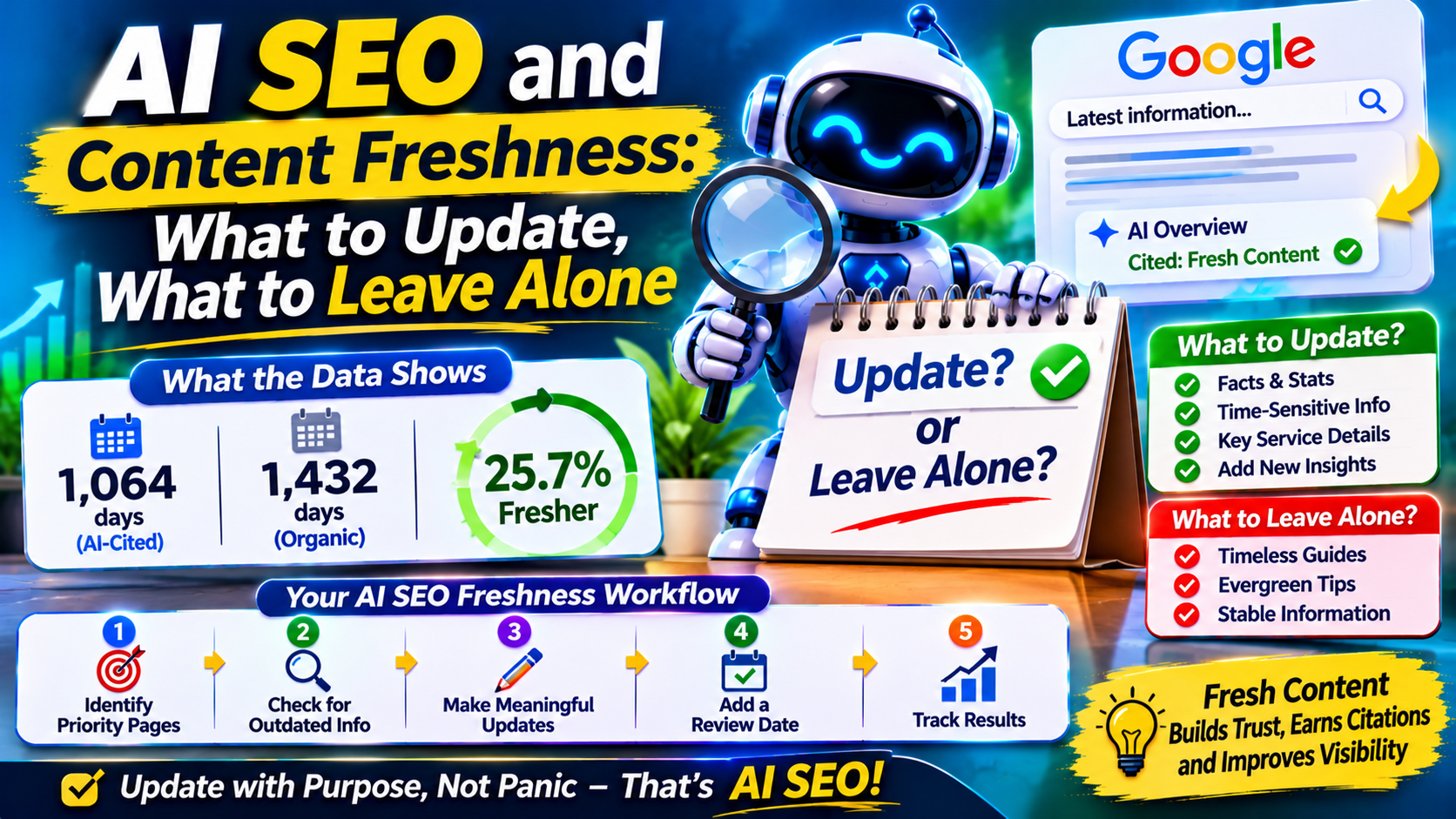
In July 2025, Ahrefs analyzed about 17 million citations. The average age of URLs cited by AI SEO assistants was 1,064 days, against 1,432 days for URLs in organic Google results, which makes AI-cited content 25.7% fresher.
The platforms differ a lot. Compared with the organic results, every AI assistant favored fresher content except Google’s AI Overviews, which cited pages about 16 days older on average. ChatGPT leaned most toward newer pages, and both ChatGPT and Perplexity ordered their in-text references from newest to oldest. ahrefsahrefs
The study also carries a caution that headlines usually drop. The average cited page was still 2.9 years old, and Google is the least influenced by freshness. The study is also more than a year old now, and platform behavior shifts.
Why It Is Not Proof That Updating Works
Several more recent datasets point the same way. One was Seer Interactive’s analysis of 7,683 pages and 47,097 citations across ChatGPT, Gemini and Perplexity. As summarized by another agency, 72% of cited pages looked fresh by last-update date, but only 42% by original publish date. In other words, a large share of cited pages are old pages that someone maintained.
Notice the weakness, though. All of these studies are correlational, and the pages that get maintained are likely the pages someone cares about. The same summary adds that Seer could date only about two-thirds of its pages. So the data says maintained pages get cited. It does not say that updating a page causes citations.
Which Pages Deserve a Refresh
Treat refreshing as triage, not a calendar chore. Sarkar SEO suggests sorting pages into three groups.
Pages with facts that expire. Prices, statistics, software versions, regulations, product lineups, “best of” lists. If a reader could be misled by last year’s number, the page is a candidate. Freshness expectations also differ by sector. In Seer’s earlier recency study, financial content showed extreme recency bias, with thousands of AI bot hits on 2024 and 2025 pages and almost none before 2020.
Pages close to winning. These rank reasonably but never seem to appear in AI answers. A genuine update is the cheapest experiment you can run on them.
Timeless pages. Leave these alone. Seer found that even 10 to 15-year-old content still sees AI bot activity, which shows timeless instructional content can hold value for a long time. Rewriting a sound page can damage it.
What a Real Update Looks Like
A real update changes what the reader gets. Work through this list:
- Replace outdated figures with current ones, and name the year beside each number.
- Add a section for something that has genuinely changed since you published.
- Delete advice that no longer holds, rather than burying it.
- Add something original, such as your own test, data or worked example. Never invent it.
- Show a “last reviewed” date that matches the work actually done.
That last point matters. Google’s John Mueller has warned against updating publish dates without corresponding changes to the page content. A new date on an unchanged page gives readers nothing and risks eroding trust.
Matching Your Rhythm to the Platform
Since Google’s AI Overviews show the weakest freshness pull in the Ahrefs data, a page aimed mainly at Google does not need constant tinkering. ChatGPT and Perplexity show a stronger lean toward recent material. Some agencies publish exact schedules, such as monthly updates for Perplexity targets, but I found no primary evidence behind specific intervals, so treat them as guesses.
A defensible default is to review priority pages quarterly and update immediately when a fact changes. Adjust it once your own results tell you more.
Keep a Simple Refresh Log
Without a record, you cannot learn anything. For every update, log the URL, the date, what changed and why. Then compare the page’s search impressions, AI citations (checked by hand on a handful of relevant questions) and referral traffic after eight to twelve weeks. Change one thing at a time where you can.
A log also guards against a common trap: low-quality or irrelevant content updated every day gets no magic benefit in AI search. Freshness is one factor among many. ahrefs
The Honest Limits
Nobody outside the AI companies knows how heavily recency is weighted, and it may differ by query. Studies sample different platforms, industries and time periods, and platforms change between model releases. Sarkar SEO’s position is simple: refresh pages when you have something true to add, and judge the results with your own data.
