



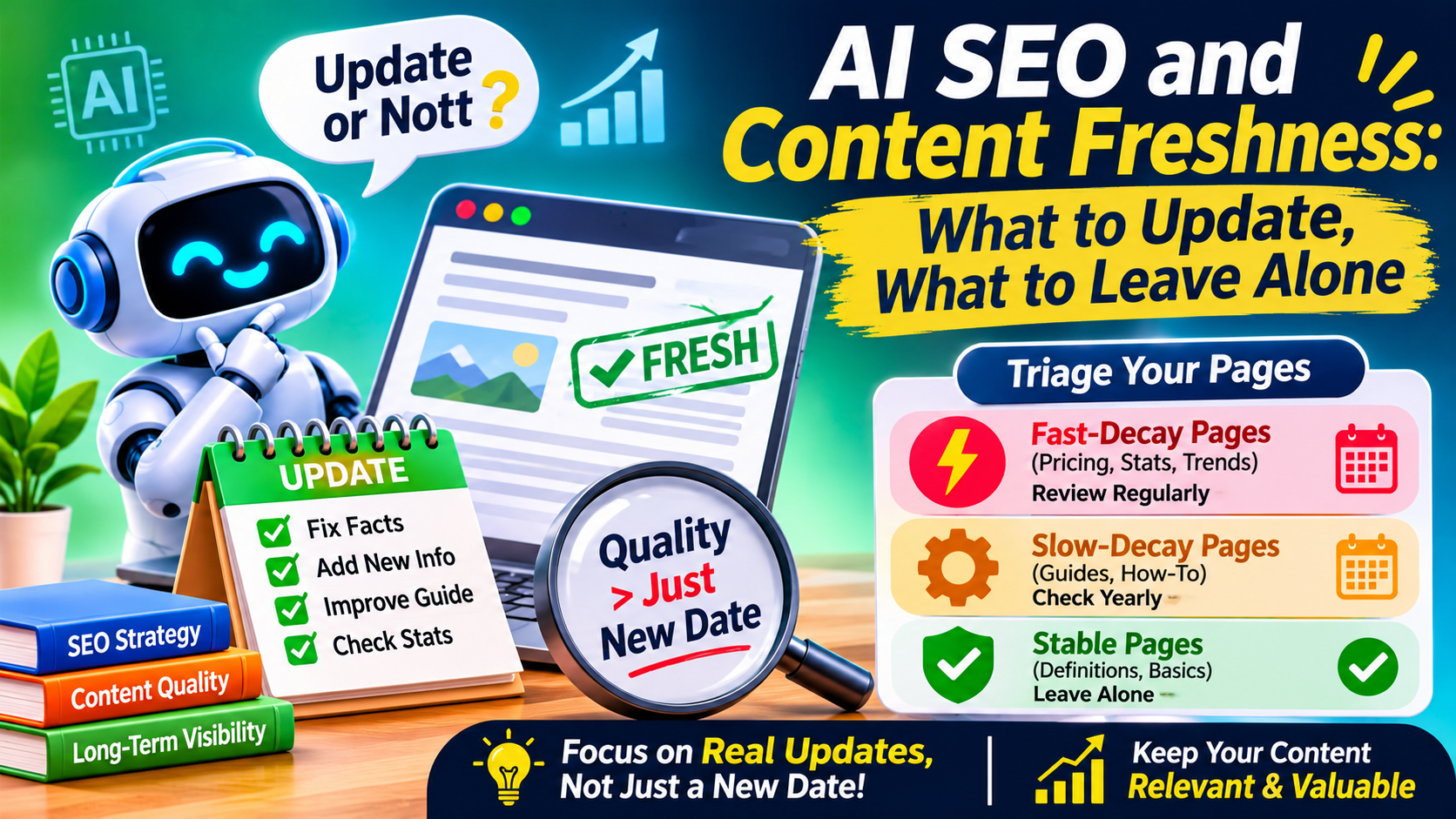
“Update your old content” is among the most repeated tips in AI SEO. It is also one of the easiest to misapply, because it tempts teams into rewriting hundreds of pages for a small, uneven benefit. The research gives a more useful answer: freshness matters in some places and barely at all in others.
What the Research Found
Ahrefs analyzed roughly 17 million citations across AI platforms and published the results in July 2025. AI-cited URLs averaged 1,064 days old, compared with 1,432 days for pages in traditional organic results, which Ahrefs described as 25.7% “fresher.” Using time since last update, the gap was smaller: 909 days against 1,047, or 13.1%.
The details matter more than the headline:
- The gap varies by platform. ChatGPT and Perplexity showed a clear lean toward newer pages, and both tended to list newer sources first in their references.
- Google AI Overviews went the other way. Cited pages were about 16 days older on average than organic results.
- Old pages still get cited. The typical cited page was still about 2.9 years old.
Ahrefs sells AI visibility tools and drew this data from its own dataset, and the study shows correlation, not cause. Ahrefs itself listed caveats alongside its conclusions. A fair reading is that freshness helps at the margin, especially for ChatGPT and Perplexity, and does not replace quality.
Why Dates Don’t Do the Work
A new date on an unchanged page is not freshness. Retrieval systems prefer current sources because outdated answers are more likely to be wrong. If the content is identical, the only thing you have refreshed is the label, and readers who spot stale advice beneath a new date lose trust fast.
Sarkar SEO treats a page as genuinely refreshed only when a reader would find something materially different: a corrected fact, a new example, a revised recommendation or an answered question that was previously missing.
Triage Before You Touch Anything
Here is a three-bucket system of my own, not an industry standard. Sort your pages by how quickly their information expires.
Fast-decay pages. Pricing guides, tool comparisons, “best of” lists, regulations, statistics, platform instructions and anything tied to a current year. These can become wrong within months. Review them on a fixed schedule, such as quarterly.
Slow-decay pages. Process guides, how-to articles and strategy explainers. The principles hold, but screenshots, tools and examples age. A yearly check is usually enough.
Stable pages. Definitions, historical explainers and foundational concepts. Leave these alone unless something has actually changed. Rewriting them for freshness alone is the likeliest waste of time.
Most sites find that a small share of pages sits in the fast-decay bucket and carries most of the risk. Start there.
What Counts as a Substantive Update
When you open a page, work through this list:
- Check every fact and figure. Replace outdated numbers and name the source and year in the text.
- Fix instructions that no longer work. Interface changes make step-by-step guides wrong quickly.
- Remove advice that has aged badly. Cutting a recommendation is a real update.
- Add the questions readers now ask. Look at Search Console queries and customer questions that the page does not answer.
- Replace weak examples. Swap vague illustrations for specific, current ones.
- Improve the opening. Make sure the first lines answer the main question.
- Record the change. Add a short “Updated” note describing what changed, not just when.
If you can’t find anything worth changing, don’t touch the page. Not every page needs a refresh.
Prioritize Using Evidence
Rank candidate pages by combining four signals:
- Business value. Does the page drive leads, sales or important visibility?
- Decline. Have clicks or impressions fallen over several months?
- Accuracy risk. Does it contain figures or instructions likely to be out of date?
- Opportunity. Do competitors or AI answers cover something your page lacks?
A page that scores high on three or four is worth an afternoon. One that scores high on none can wait. The aim is to find a dozen pages that matter, not to refresh four hundred.
Freshness Isn’t Durable Alone
Some vendor analyses report that AI citations are volatile, with cited sources changing frequently between observations. I could not verify those claims against original data, so treat them cautiously. The reasoning behind them is still sound: no single update guarantees a lasting citation. Pages that are accurate, specific and part of a coherent body of work on your topic are more likely to stay useful across many refreshes.
Freshness is also not equally valuable everywhere. Because Google’s AI Overviews showed the weakest recency lean in the Ahrefs data, a team focused only on Google may reasonably refresh less often than one chasing visibility in ChatGPT and Perplexity.
Build a Maintenance Routine
Treat freshness as upkeep, not as a campaign:
- Keep a simple register listing each important page, its decay bucket, its owner and its next review date.
- Set reminders in your calendar or project tool so reviews actually happen.
- Assign owners who know the subject, not just editors who know the style.
- Review the register quarterly and adjust the buckets as you learn which pages age fastest.
Measure the effect honestly. Compare refreshed pages with similar unrefreshed ones over a few months, and check clicks, conversions and your monthly AI prompt checks. Seasonal changes and ranking shifts can muddy the picture, so avoid crediting every gain to a refresh.
