



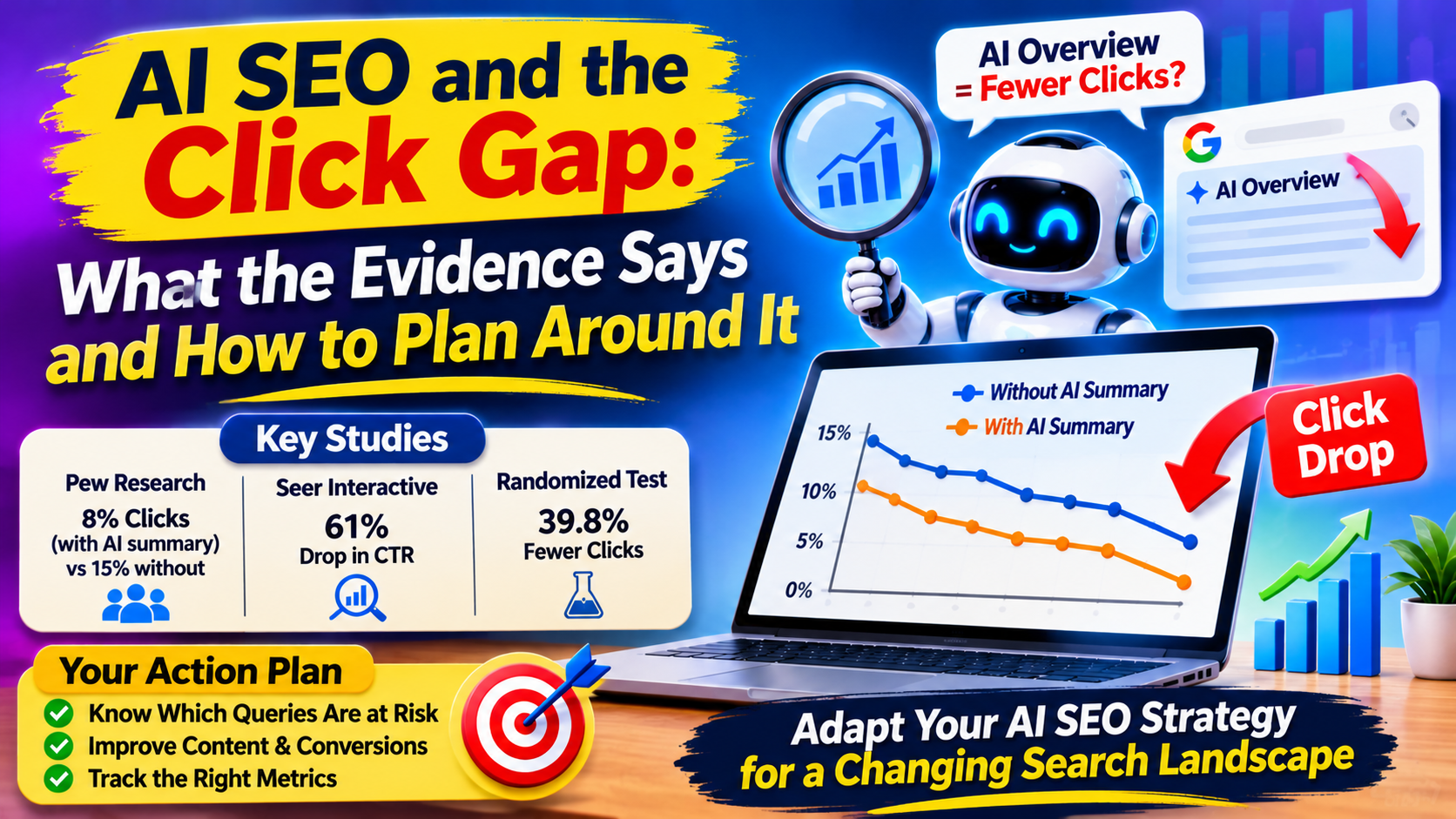
When Google shows an AI-written summary, fewer people click through to websites. Three independent studies point the same way, though they disagree on the size of the drop. For businesses, the practical question is not whether clicks fall, but which of your pages can afford it.
Sarkar SEO treats this as a portfolio problem. Some queries are now answered on the results page itself; others still need a website. Your AI SEO strategy should know the difference.
Three studies, one direction, different sizes
Pew Research Center tracked 900 US adults in March 2025, covering 68,879 Google searches. About 18% produced an AI summary. Users clicked a regular result in 8% of visits with a summary versus 15% without one. Only 1% of visits involved clicking a link inside the summary, and sessions ended more often (26% versus 16%). It is observational, US-only, and based on a tracked panel.
Seer Interactive, an agency, analyzed 3,119 informational queries across 42 organizations from June 2024 to September 2025. For queries showing AI Overviews, organic click-through fell from 1.76% to 0.61%, a 61% decline. Seer cautions that its sample is a retrospective comparison drawn from its own clients.
A randomized field experiment by Saharsh Agarwal and Ananya Sen, posted on SSRN in April 2026, randomly hid AI Overviews for some of 1,065 desktop Chrome users. Where a summary appeared, outbound organic clicks fell 39.8%, and clicks per search rose from 0.37 to 0.62 when it was hidden. Random assignment makes this the strongest causal evidence of the three, but it is a working draft not yet peer reviewed, and it measures clicks, not revenue.
The sizes differ because the methods, users, queries and dates differ. Do not average them or quote one as a forecast for your site. Take the shared conclusion: AI summaries reduce clicks on the queries where they appear.
Does being cited help?
Seer found that brands cited in AI Overviews earned higher click-through than uncited brands on the same queries: 0.70% versus 0.52% for organic. Seer states it cannot prove citation causes the difference, since strong brands may win both. Citation is worth pursuing, but it is not a replacement for lost clicks.
Triage your queries by click risk
This framework is our own reasoning, not a finding from the studies, but it follows from them. Sort the queries behind your key pages by how completely a short answer can satisfy the searcher.
Rebuild your reporting around outcomes
If you report rankings and sessions alone, a click decline can look like failure when leads are stable. Consider tracking:
- Conversions and qualified leads from organic, not total sessions.
- Branded search demand over time, since awareness from AI answers may show up as people searching for your name.
- Impressions versus clicks by query group, to see where the gap is widening.
- Assisted conversions, where organic search appears earlier in the journey.
Google’s AI feature reporting has been limited. One May 2026 report said there was still no dedicated view of AI-search clicks in Search Console, so check what your own account currently shows before relying on any single dashboard.
Make the click worth more
If fewer visitors arrive, each one matters more. Review pages that still get traffic and ask three questions:
- Does the page answer the next question a visitor will have, not just the first?
- Is the action clear, whether that is a call, quote request or download?
- Does it contain something a summary cannot compress, such as a calculator, original dataset, example or checklist?
A modest improvement in conversion can offset part of a decline in traffic.
Three mistakes to avoid when clicks fall
Blaming the last update. Not every traffic dip is an AI effect. Before concluding that summaries are responsible, compare affected pages with similar pages whose queries show no AI answer.
Cutting informational content wholesale. Seer also found paid click-through on AI Overview queries dropped from 19.7% to 6.34%, so the effect is not confined to organic results. Informational pages still build the awareness that feeds later searches. Sarkar SEO suggests keeping them, but expecting less direct traffic and judging them on assisted outcomes.
Chasing one metric. A page can lose clicks and still contribute leads. Judge each page on the job it was built to do.
A realistic stance
Do not panic and abandon search, and do not assume the old playbook still works. Search still sends visitors, but for some query types the page no longer gets the first look. Content built only to answer a simple question is most exposed.
If you want a query-by-query click-risk review and a reporting setup that reflects what actually drives leads, Sarkar SEO can help you build one.
