



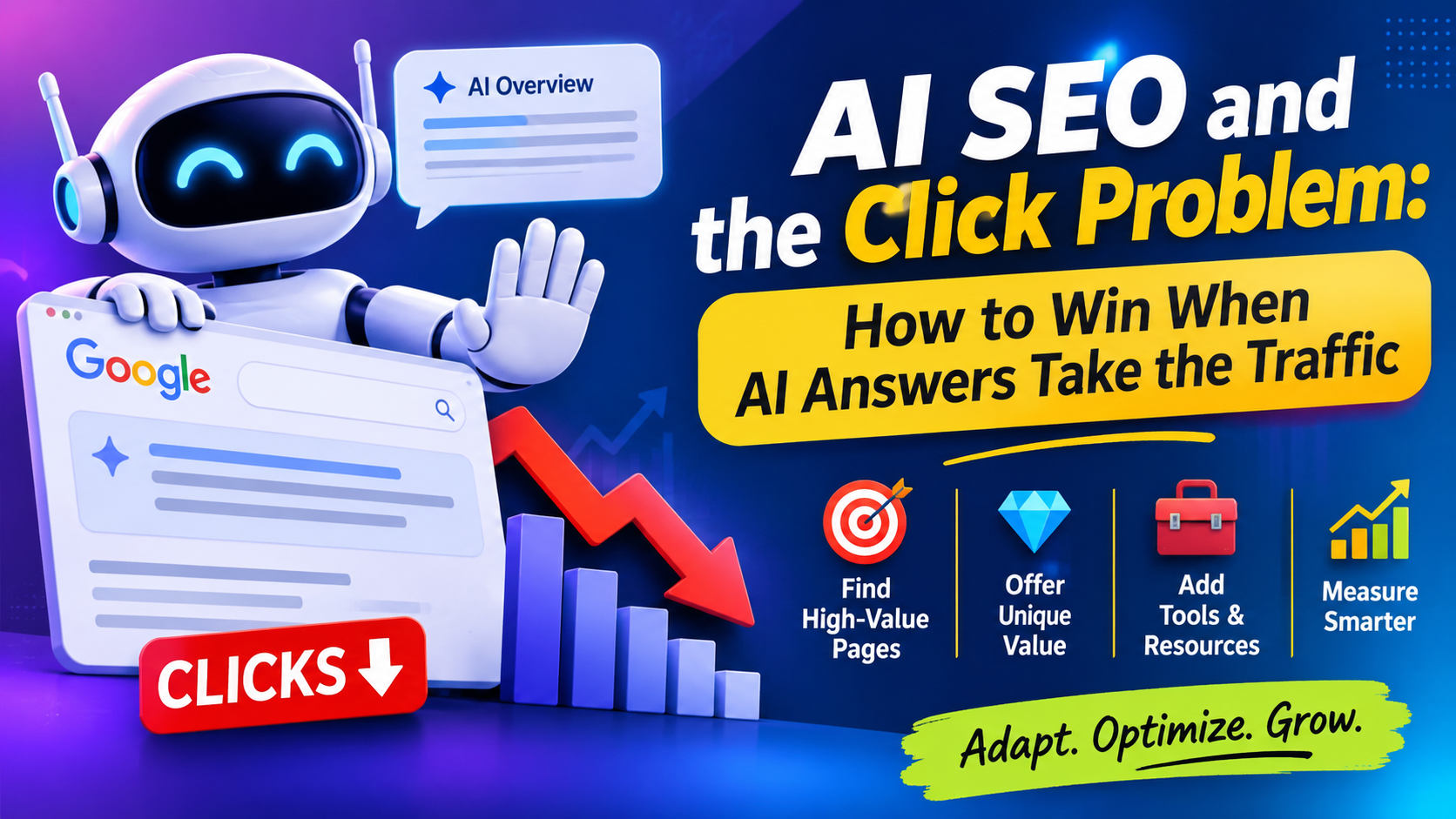
Many site owners now see the same pattern in Search Console: impressions hold steady, clicks fall. AI answers satisfy part of the demand before anyone reaches your page. A realistic AI SEO strategy starts by accepting this, then deciding which pages are worth fighting for.
What the Evidence Shows
The research is not perfectly consistent, but the direction is clear.
Pew Research Center tracked 900 U.S. adults across 68,879 Google searches in March 2025. Users clicked a traditional result on 8% of visits when an AI summary appeared, against 15% when none did. Only 1% of visits included a click on a link inside the AI summary itself.
Ahrefs analyzed Search Console data and reported a 34.5% drop in click-through rate for top-ranking pages when AI Overviews appeared. A later Ahrefs study of 300,000 keywords, published in February 2026, put the drop for the first result at 58%.
A randomized field experiment gives stronger causal evidence. Researchers Saharsh Agarwal and Ananya Sen, working with 1,065 U.S. desktop Chrome users between January and February 2026, hid AI Overviews for some participants. Search Engine Journal’s report says AI Overviews appeared on 42% of queries and cut outbound clicks by 38% on those queries. Zero-click searches rose from 54% to 72%. Satisfaction scores barely changed whether the summaries were shown or not.
Treat all of this with care. The Agarwal and Sen paper is a non-peer-reviewed draft with a narrow sample. Pew and Ahrefs measured different things, and Google has disputed Pew’s findings. Still, three different methods point the same way.
Not Every Query Is Equally Exposed
Pew’s data, as reported by Search Engine World, shows that AI summaries cluster around certain query types. Searches of ten or more words included one 53% of the time, while one- or two-word searches did so only 8% of the time. Questions beginning with who, what or why showed them 60% of the time.
This suggests a useful pattern. Long, informational, question-style searches are the most exposed. Short, navigational and commercial searches are less so. That is an inference from one dataset, so check it against your own Search Console data before acting on it.
A Click-Value Triage
Instead of treating all content the same, sort pages by how much a click is worth. This is a planning framework of my own, not an industry standard.
Answer pages. These exist to state a fact or definition. An AI summary can satisfy the reader in one line, so expect fewer clicks. Keep them accurate and concise because they still build awareness and may earn citations, but don’t build your growth plan on them. Sarkar SEO advises clients’ teams to stop adding new pages of this type unless they feed something bigger.
Decision pages. These help someone choose: comparisons, pricing explanations, buying guides, implementation checklists. A reader weighing a purchase still needs detail, nuance and proof. These pages deserve the most investment.
Asset pages. These offer something that cannot be summarized away, such as a calculator, template, dataset, tool or downloadable guide. A summary can describe an asset, but the reader must visit to use it.
Audit your existing library with these three labels. You will likely find many answer pages and few asset pages, which tells you where the gap is.
Give People a Reason to Click
If an AI summary can answer the basic question, your page must offer what the summary cannot. Practical ways to do that:
- Add a tool or template. A budget calculator or checklist invites use, not just reading.
- Publish original numbers. Even a small survey of your customers gives readers something new, as long as you state the sample honestly.
- Show the process. Annotated examples, screenshots and step-by-step decisions are harder to compress.
- Offer a next step. An email series, a downloadable version or a comparison tool gives interested readers somewhere to go.
- Build return visits. Brand searches and direct visits are less exposed to AI answers because the person already knows where to go.
Place the most useful material below a clear summary. Readers who want only the answer get it, and readers who want depth continue.
Change the Scorecard
If you judge success by clicks alone, you will see only losses. Add measures that reflect the new reality:
- Impressions alongside clicks. Rising impressions with flat clicks may signal visibility without visits.
- Conversions per visit. Google has said clicks from pages with AI features tend to be higher quality. That is Google’s claim, so check it against your own conversion data.
- Branded search growth. More people searching your name is a sign the brand is being remembered.
- Leads and revenue by page type. Compare answer, decision and asset pages separately.
Segment Search Console by query length and by question words. If your biggest click losses concentrate in long informational queries, the triage above applies directly. If losses are spread evenly across all queries, look at other causes such as rankings, seasonality or algorithm changes before blaming AI.
