



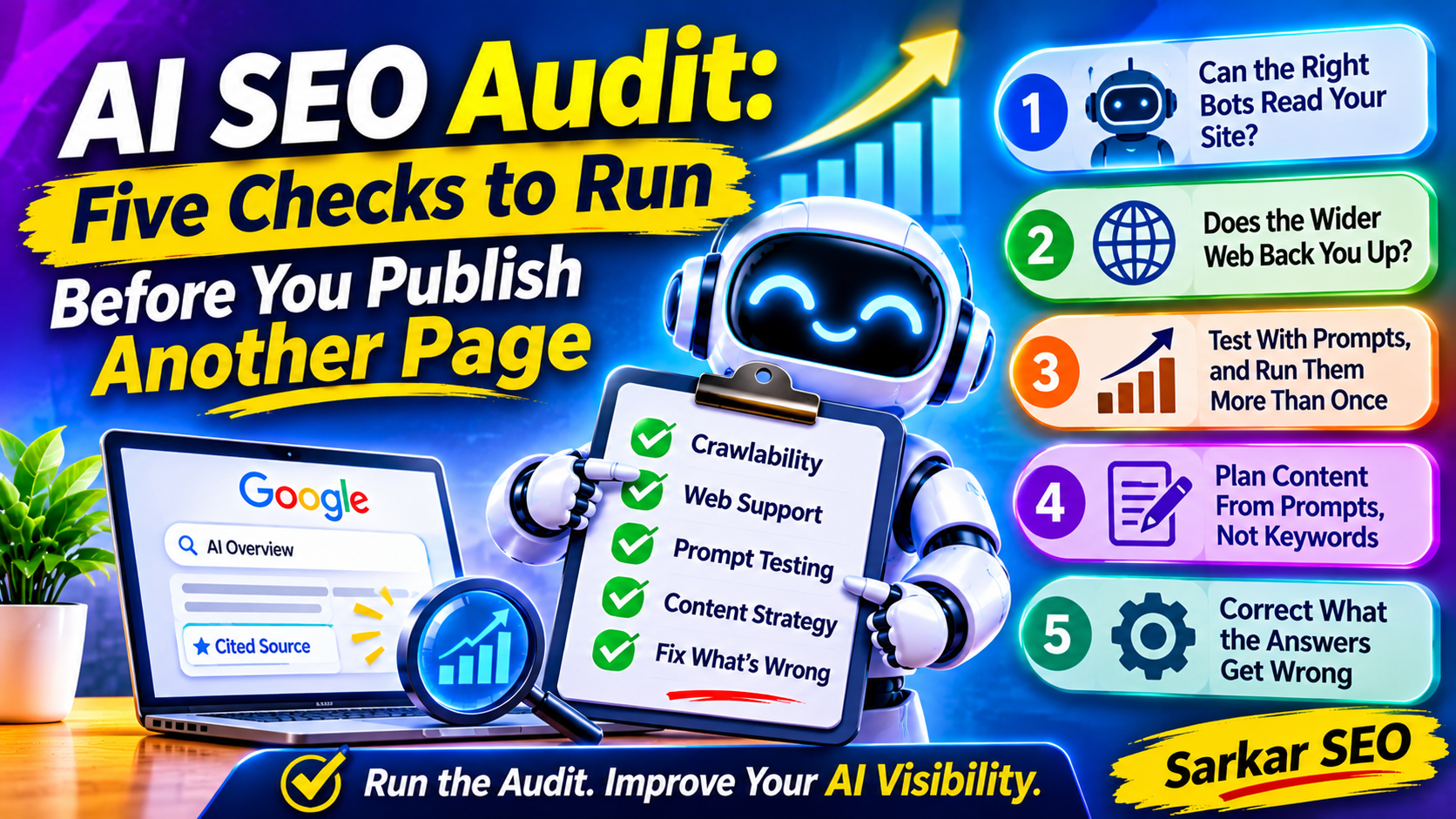
Most AI SEO advice starts with writing: add an FAQ, tighten the summary, sprinkle in statistics. But content can only be cited if a machine can read it, and only recommended if the web agrees with it. An audit should start where problems hide, outside the article itself.
This five-step audit works for any site, in any market. Sarkar SEO recommends running it in this order, because each check makes the next more meaningful.
Check 1: Can the Right Bots Actually Read Your Site?
AI companies do not use a single crawler. They use several, and each one does a different job.
OpenAI documents three. GPTBot gathers content that may be used to train its models. OAI-SearchBot surfaces sites in ChatGPT’s search features. ChatGPT-User fetches pages when a person asks ChatGPT something, and because those requests are user-initiated, robots.txt rules may not apply to it. Anthropic describes a similar split: ClaudeBot for training data, Claude-SearchBot for search indexing, and Claude-User for retrieval during a person’s question.
The common mistake is a blanket block. OpenAI says sites opted out of OAI-SearchBot will not be shown in ChatGPT search answers, and that robots.txt changes can take about 24 hours to apply. Training and visibility are separate decisions: a publisher may block training crawlers while allowing search and retrieval ones. Choose deliberately, per bot, and write down why.
Google is similar. Its Google-Extended token governs Gemini training and grounding, but Google states it does not affect inclusion in Google Search or act as a ranking signal, so blocking it will not remove you from AI Overviews.
Audit action: Open your robots.txt, list every AI user agent, and label each as training, search or user retrieval. Confirm important pages are not hidden behind logins, heavy scripts or firewalls that challenge legitimate crawlers. Anthropic warns that blocking its IP addresses can stop its bots from reading your robots.txt at all, so use user-agent rules instead.
Check 2: Does the Wider Web Back You Up?
AI systems do not only quote your website. They draw on forums, encyclopedias, video platforms and review sites, and the mix differs by product.
Profound analyzed roughly 30 million citations between August 2024 and June 2025. It found that Wikipedia made up 47.9% of ChatGPT’s top citations, while Reddit led Google AI Overviews at 21%, with YouTube close behind. Search Engine Roundtable reported that Ahrefs later published a similar study with notably different results.
Treat the exact percentages with care, since patterns shift by period, method and sector. The durable lesson: your own domain is only one input, and an answer about which provider to choose may lean on what strangers say about you.
Audit action: Search your brand and core service plus “reviews” or “alternatives.” Note which third-party pages appear and whether they describe you accurately. Then fix gaps honestly: complete business profiles, answer real questions in communities where you add value, and earn mentions through useful work. Never manufacture reviews or astroturf discussions.
Check 3: Test With Prompts, and Run Them More Than Once
Checking one ChatGPT answer and declaring victory is a trap. In a study by SparkToro and Gumshoe.ai, covering 2,961 prompts across ChatGPT, Claude and Google’s AI features, the same brand list appeared in fewer than 1% of repeated runs, and the same list in the same order less than 0.1% of the time. The authors found that how often a brand appears across many runs was steadier than its position in any one answer. Caveats: it was partly funded by an AI-tracking company and is not peer-reviewed.
So build a test you can trust:
- Write 15 to 25 prompts a real customer would type, mixing broad (“best way to…”) and specific (“X vs Y for a small team”) questions.
- Run each prompt several times on each platform you care about, in fresh sessions.
- Record the percentage of runs in which your brand appears, is cited, or is described correctly.
- Repeat monthly and watch the trend.
Sarkar SEO favors this routine because it replaces anecdotes with a baseline. Ignore any tool promising a precise “AI ranking position.”
Check 4: Plan Content From Prompts, Not Keywords
Keywords show what people type into a search box. Prompts reveal how they describe a situation in full sentences, with constraints attached: budget, team size, country, deadline.
Collect those sentences from sales call notes, support tickets and the questions prospects ask before buying. Early prompts ask what something is; late ones ask which option fits and what could go wrong.
Audit action: For each prompt cluster, ask whether a page on your site answers it completely. Pages that merely define a term rarely beat the encyclopedia. Pages that resolve a decision, covering who a solution suits, who it does not and what it costs in time and effort, give an AI system something worth citing.
Check 5: Correct What the Answers Get Wrong
Testing will sometimes show your brand described incorrectly: an old price, a discontinued service, a wrong location. That is a map of where your information is stale or inconsistent.
Trace each error to its source: an outdated page on your site, a directory listing you never updated, or an old article that still ranks. Fix the source, and give your main service pages one plain statement of what you offer, where and for whom.
What to Do Next
AI SEO rewards teams that verify visibility rather than assume it. Run these checks, fix the cheapest problems first, and measure again in a month. If you want a partner to build the baseline and roadmap, Sarkar SEO can help turn this audit into a practical plan.
