



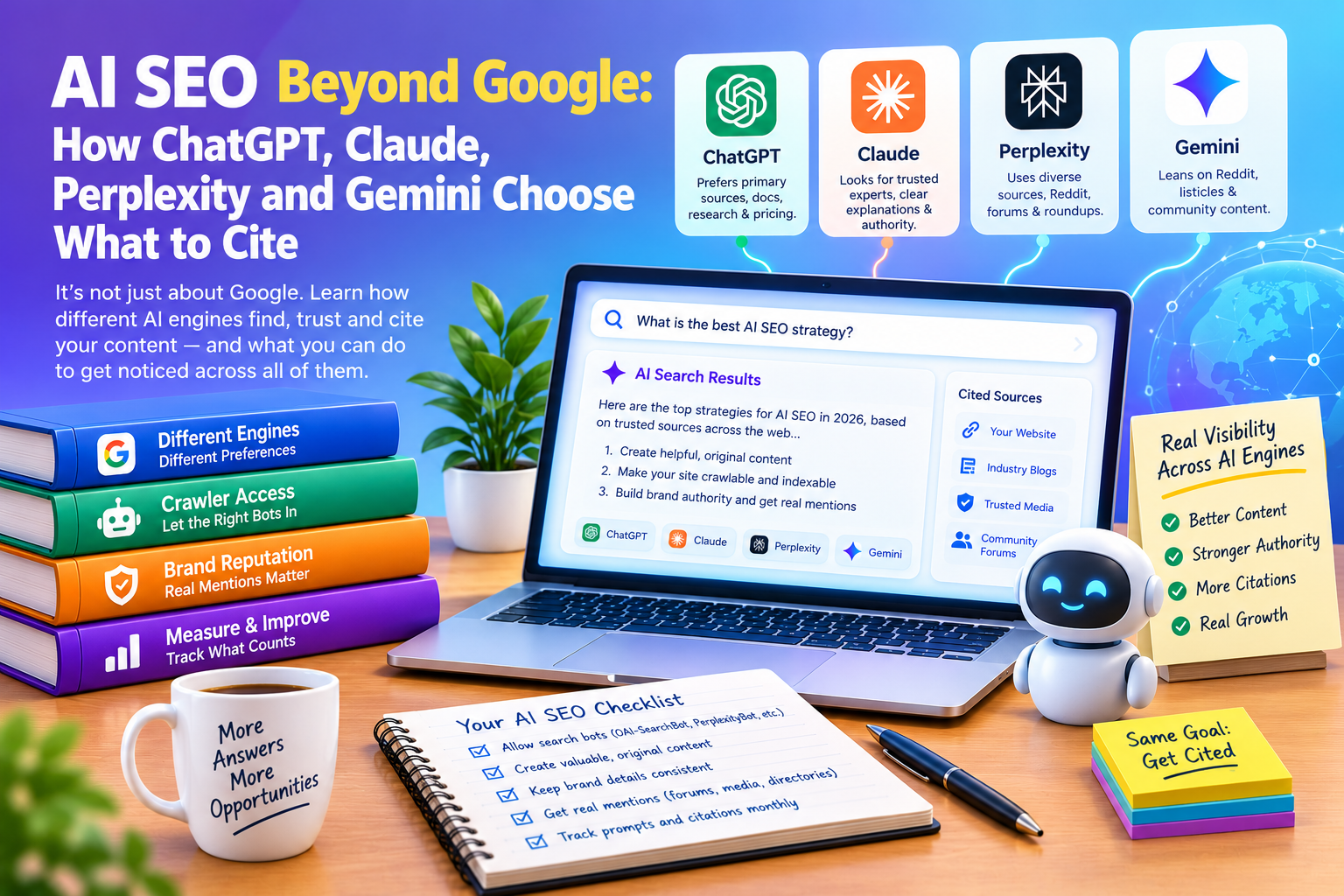
Most AI SEO advice starts and ends with Google. But your customers also ask ChatGPT for vendor shortlists, run Perplexity research sessions, and query Claude and Gemini for comparisons. Each of these tools picks its sources differently, and a page that wins in one can be invisible in another.
This guide covers the part of AI SEO that gets the least attention: how non-Google answer engines find, trust, and cite your site, and what to do about it.
Why One Strategy Doesn’t Fit Every Answer Engine
If you assume every AI tool cites the same pages, the data says otherwise. A practitioner tracked more than 13,000 citations across ChatGPT, Claude, Gemini, and Perplexity for client prompts and found that ChatGPT and Perplexity shared only 7.6% of their cited domains on one brand’s question set. The same tracking showed Perplexity averaging 19.2 sources per answer, Gemini 8.1, and ChatGPT 4.5. orbitmediaorbitmedia
This is one practitioner’s dataset across a limited set of clients, not a universal benchmark. Still, the direction is consistent with what many teams observe: the tools behave differently, so you should test each one separately rather than assuming a single score covers them all.
The same write-up reported that ranking on page one of Google was neither necessary nor sufficient for getting cited by AI. Strong Google rankings help, but they do not guarantee visibility elsewhere.
Step One: Let the Right Bots In
Before content quality matters, the crawler has to reach the page. This is the most common silent failure in AI SEO.
Each major vendor runs separate bots for separate jobs. OpenAI treats GPTBot as its training control and OAI-SearchBot as the control for ChatGPT search, while Anthropic names ClaudeBot for training, Claude-SearchBot for search indexing, and Claude-User for user-triggered retrieval. The consequence is practical. Blocking the search-and-citation crawlers, such as OAI-SearchBot, PerplexityBot, and Claude-SearchBot, excludes your site from those AI search answers entirely. therankmastersgrowthmk
That gives you a real strategic choice. Training bots are a business decision, since some publishers do not want their content used to train models. Search bots are different. If you want to be recommended, they should usually be allowed. As one guide puts it, you can stay in ChatGPT search while staying out of training by allowing OAI-SearchBot and blocking GPTBot.
Two cautions apply. First, default firewall rules at providers such as Cloudflare, Akamai, and AWS often rate-limit unfamiliar bot traffic before robots.txt is even consulted, so a permissive robots.txt file alone does not prove access. Check your server logs for these user agents and confirm they receive normal responses. Second, OpenAI notes that robots.txt changes take about 24 hours to be reflected in search appearance, so do not judge a change after an hour.
Bot names and policies shift often, so confirm current details in each vendor’s own crawler documentation before editing your file.
The Myth of the Magic File
Many site owners have rushed to publish an llms.txt file, a Markdown list of key pages placed at the site root. The evidence so far is unimpressive. A large SE Ranking analysis of ChatGPT citations found that including llms.txt had a negligible effect on citation likelihood. Another write-up describes that company’s work as the largest public study to date, covering roughly 300,000 domains.
Publishing the file is harmless and cheap, so do it if you like. Just do not expect it to replace content depth, crawl access, or reputation. Treat it as optional housekeeping rather than a strategy.
Reputation Travels Off Your Own Site
Here is where AI SEO departs most from traditional SEO. These systems appear to lean on what the wider web says about you, not just what you say about yourself. The SE Ranking study analyzed 129,000 unique domains and found that domains with heavy brand presence on Quora and Reddit were roughly four times more likely to be cited.
Correlation is not causation, and large, well-known brands naturally attract more discussion. But the pattern supports a sensible conclusion: corroboration matters. When independent communities, publications, and directories describe your business consistently, a model has more reason to trust it.
In practice, that means:
- Keep your business description, service names, and location details identical across your site, profiles, and listings.
- Contribute genuinely useful answers in forums where your audience asks questions, without promotional spam.
- Earn mentions in industry roundups and expert quotes, which also build classic authority.
Match the Source Type Each Engine Prefers
The tracking data hints that engines favor different source types. ChatGPT skewed toward primary sources such as official documentation, research papers, and vendor pricing and help pages, while Gemini leaned on Reddit and listicle roundups. If that holds for your niche, it suggests concrete content moves. Publish clear pricing, plain-language help pages, and original research to serve engines that favor primary sources. Pursue inclusion in credible comparison articles to serve those that prefer roundups.
How to Measure Without Fooling Yourself
AI answers vary between runs, so one screenshot proves nothing. Build a small, repeatable test instead:
- Write 20 to 40 prompts your buyers would really use, mixing branded and unbranded questions.
- Run them monthly in each engine you care about.
- Record whether you were mentioned, whether you were linked, and who else appeared.
The distinction between mentions and links matters. In the tracking above, Gemini mentioned brands in 72% of runs but cited them in 41%, while ChatGPT mentioned 56% and cited 47%. A mention without a link still shapes perception, but it will not show up in your analytics as a visit.
At Sarkar SEO, this kind of prompt tracking is treated as a baseline, not a finish line, because the goal is qualified enquiries rather than a screenshot of your name in an answer. Pair the prompt log with brand search trends and lead source questions on your forms.
A Practical Starting Checklist
- Audit robots.txt and firewall rules for search bots from OpenAI, Anthropic, and Perplexity.
- Decide deliberately on training bots, and document the reason.
- Standardize your brand details across every profile you control.
- Publish pages that give direct, verifiable answers, such as pricing, process, and comparisons.
- Start a monthly prompt log and review it quarterly.
Teams that lack the time to run this in-house often bring in Sarkar SEO to set up the audit and tracking, though the checklist above is workable on your own. The key is consistency: Sarkar SEO’s view is that AI visibility compounds slowly, much like traditional authority.
