



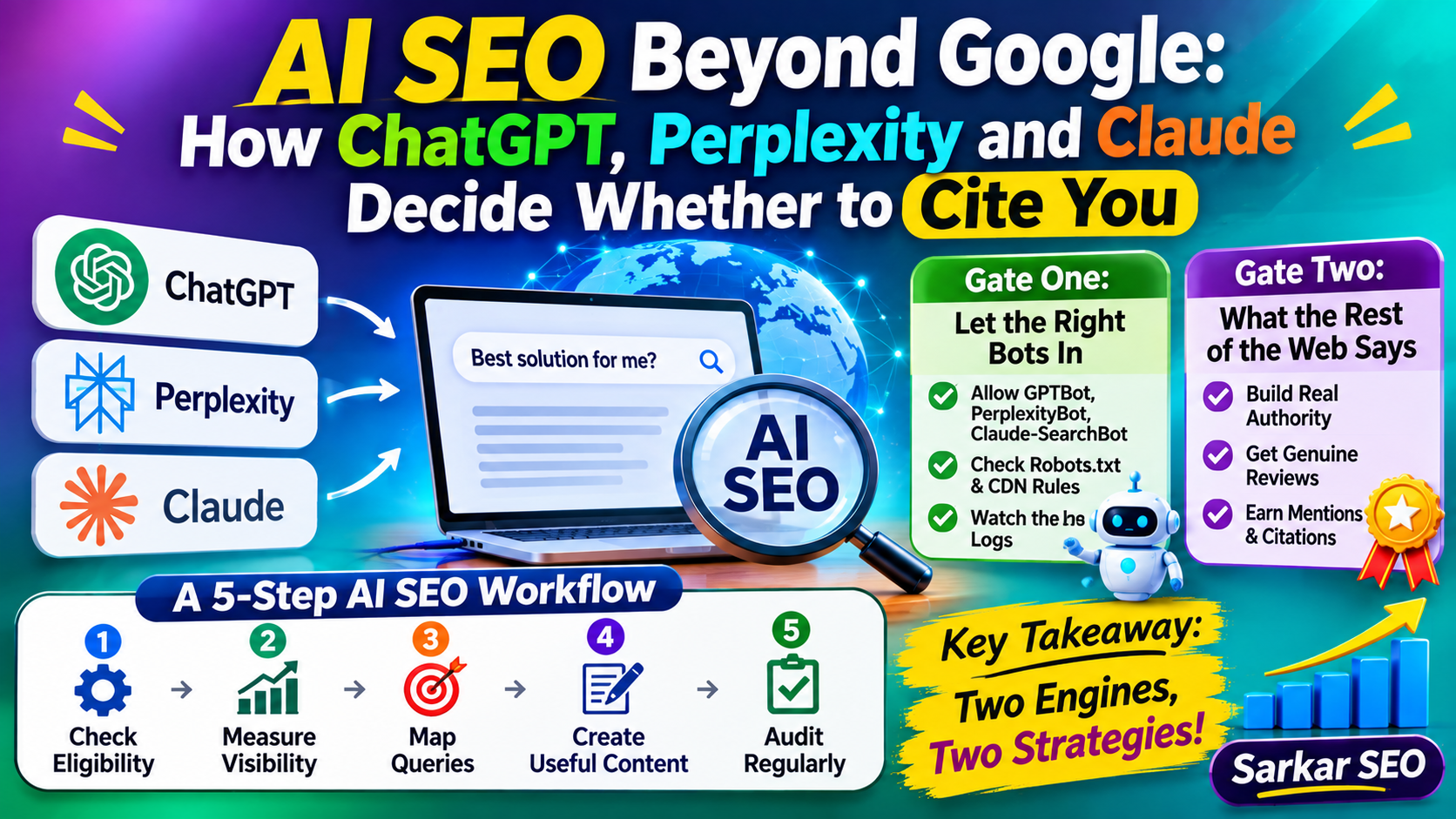
AI SEO is not only about Google. When a buyer asks ChatGPT, Perplexity or Claude for a recommendation, two things decide whether your brand appears: whether the assistant’s bots can reach your pages, and what the rest of the web says about you. Most site owners check the first by accident and ignore the second. This article covers both, plus a test you can run this week.
Gate one: let the right bots in
Each major AI SEO company runs separate bots for separate jobs. Confusing them is the most common and costly robots.txt mistake.
OpenAI states that sites opted out of OAI-SearchBot will not appear in ChatGPT search answers. That means blocking GPTBot to keep content out of training does not remove you from ChatGPT search, but blocking the search bot does. Perplexity recommends allowing PerplexityBot so your site can appear in its results. Anthropic says that disabling Claude-SearchBot may reduce your visibility and accuracy in search results, and disabling Claude-User may reduce visibility for user-directed search. OAI-SearchBot: The Crawler That Decides Whether ChatGPT Search Can Find You (2026) +3
Three practical points follow.
- Timing. Perplexity says robots.txt changes can take up to 24 hours to take effect, and OpenAI gives a similar window.
- User-triggered fetchers behave differently. Perplexity documents that Perplexity-User generally ignores robots.txt because a person initiated the request. For ChatGPT-User, robots.txt rules may not apply either.
- Your firewall may block what robots.txt allows. If a bot is missing from your logs, check your CDN’s bot rules, not just robots.txt.
One report notes that the old tokens anthropic-ai and Claude-Web are retired, so rules naming them have no effect on current traffic. If your robots.txt was copied from an old block list, review it.
Gate two: what the rest of the web says about you
Once a bot can read your site, the assistant still decides which sources to trust. Here the studies disagree, and that disagreement is itself the finding.
- Agenzy analyzed 2,283,923 citations for European businesses. It found ChatGPT, Google AI Overviews and Perplexity share only two of their top ten sources, and that brands’ own websites earned 3.7% of citations against 16.9% for named competitors.
- Averi’s analysis of 680 million citations found only 11% of domains were cited by both ChatGPT and Perplexity.
- A September 2026 sample of “who should I hire” questions found 48.1% of ChatGPT’s citations went to company websites, with directories and review sites taking 22.2%.
The samples, queries and methods all differ, and these are vendor studies, not universal laws. What holds across them is narrower. Engines differ from each other, and on buying questions third-party pages matter. Yext found that 48.7% of ChatGPT citations in its study came from third-party listings such as Yelp and TripAdvisor.
Any single “AI visibility score” hides these differences. Measure per engine and per type of question.
The evidence map: a test you can run
This is a working method, not a platform rule.
- Write ten buyer questions from your category: “best [service] for [need],” “[option A] vs [option B],” “is [service] worth it.”
- Run each one in ChatGPT, Perplexity and Claude with web search on.
- Record every cited domain, not only whether you appear.
- Mark the domains that recur. Those are your evidence map, typically directories, review platforms, publications and community threads.
- Audit your presence there. Do your description, services, location and pricing match your own site? Stale or wrong facts get repeated by assistants.
- Fill gaps honestly. Complete your profiles, ask real customers for reviews and contribute where you have genuine standing. Fake reviews and astroturfing violate platform rules and erode the trust you are trying to build.
Answers vary from run to run, so repeat this monthly and watch the trend, not a single result. Sarkar SEO starts with this map because it shows where a brand’s reputation is actually being assembled, which is often not the brand’s own website.
Pages worth writing on your own site
When assistants do cite company websites, they need a page that answers the question plainly. Write comparison pages and “who this is for” pages. State who your service is not right for. Date your claims and keep them current.
Your server logs can also help. Hits from Claude-User, ChatGPT-User and Perplexity-User mean a person, mid-task, asked an assistant about that specific page, so they are worth separating from scheduled crawler traffic. Pages that attract those hits show which of your content is being used to answer real questions. Sarkar SEO treats that log view as a free source of audience research. anglera
Two audits, not one
Beyond Google, AI SEO comes down to access and evidence. Access means the right bots can read you. Evidence means the pages assistants lean on describe you accurately. Neither requires special markup or tricks, and neither guarantees a citation.
If you would like a second pair of eyes on your robots.txt, bot rules and evidence map, Sarkar SEO can review them and tell you which fixes matter first, for any market.
