



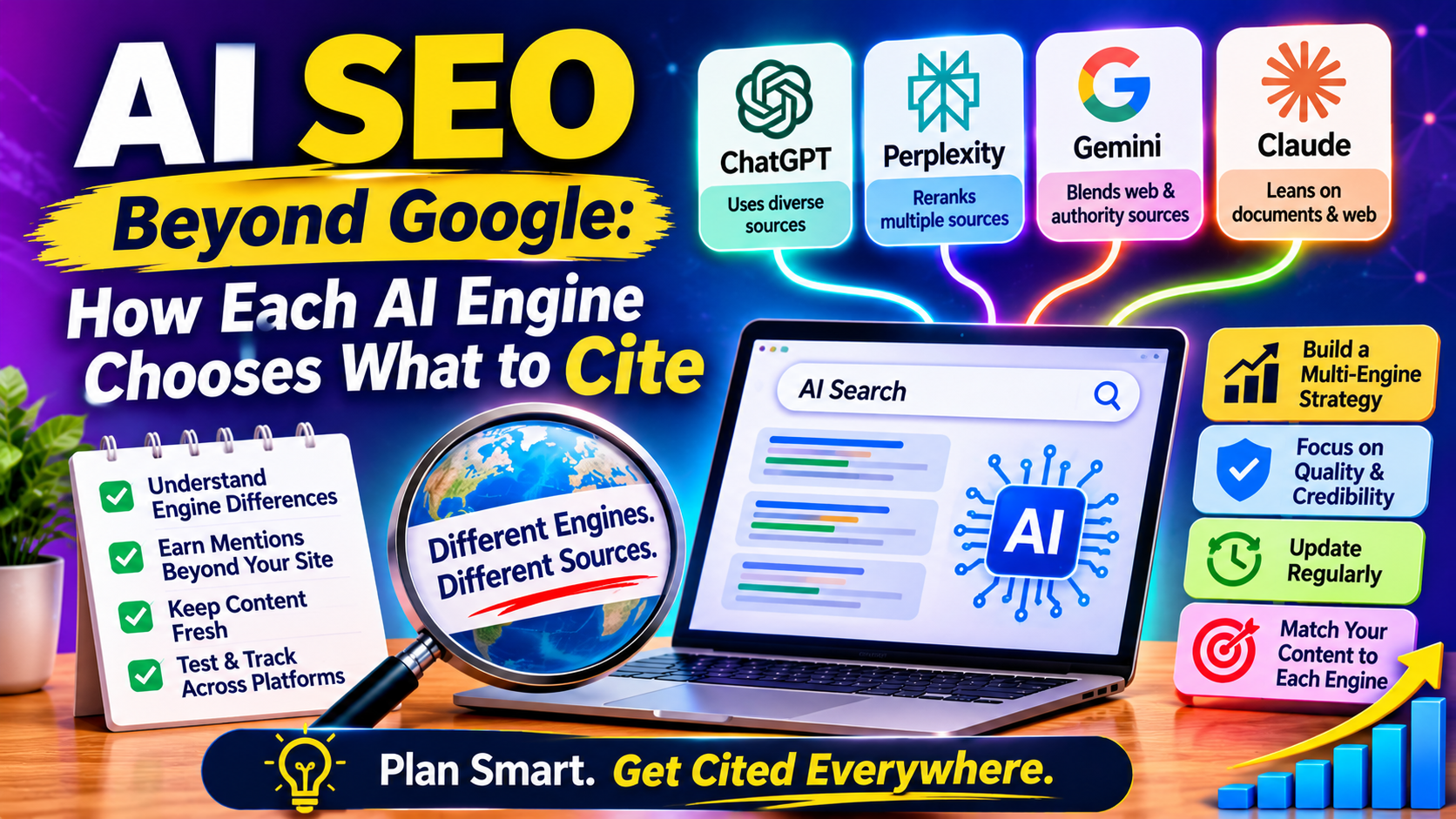
Ask ChatGPT, Perplexity, Gemini and Claude the same question and you will often get four different sets of sources. For anyone doing AI SEO, that is the awkward truth: there is no single ranking to climb. Sarkar SEO wrote this guide to show what recent research suggests about how these engines pick sources, where the evidence is thin, and which actions pay off whichever engine your buyers use.
Why One Playbook Fails
The engines retrieve information in different ways. One secondary analysis from Gracker describes ChatGPT as relying on a third-party search provider plus licensed publisher content, Google AI Overviews as reusing Google’s own ranking systems, and Perplexity as retrieving several sources, reranking them and citing a few. Claude, it says, leans on documents supplied to it or on web search. These are outside observations, not official statements from the companies, so treat them as working models.
The practical consequence is overlap, or the lack of it. A study by Whitehat and Qwairy, reported by DEV Community, found that only 11% of cited domains appeared across multiple engines. Visibility in one place does not transfer automatically to another.
What the Numbers Say, and What They Don’t
A 2026 study of 602 prompts and 21,143 citations, summarized by AuthorityTech, found Perplexity citing the most sources per answer (about 16), Google AI Overviews about 12, and ChatGPT about 7. The twist is depth: ChatGPT absorbed roughly 4.2 times more language from each source it cited. A different analysis, Qwairy’s review of 118,000 responses, reported higher averages for every engine, so exact figures shift with prompts, timing and method.
A caution on sources: most large citation studies come from vendors and agencies with products to sell. Yext, for example, analyzed 17.2 million citations and found verified, structured business data made up over half of them. That is useful, and it is also the type of data Yext sells. Read each figure as a signal, not a law.
Structure Helps. Q&A Formatting Alone Does Not
Research summarized by AuthorityTech suggests citation behavior follows how information is organized more than which words appear. It also reports that question-and-answer formatting by itself produced no measurable lift without real evidence behind the answers.
So write sentences that survive being lifted out of the page. Compare these two (the product is invented for illustration):
- Weak: “As mentioned above, this is great for small teams.”
- Stronger: “Acme Planner costs $12 per user monthly and suits teams under 20 people.”
The second carries its subject, its fact and its limit in one line. An AI system can quote it cleanly; the first depends on context it will not have.
Earn Mentions Off Your Own Site
One agency-published analysis, citing Superlines, reports that 85% of brand mentions in AI answers originate from third-party pages rather than the brand’s own domain. The same source claims ChatGPT and Claude draw over 93% of citations from earned media. Treat those exact numbers cautiously, but the logic is sound: engines look for independent confirmation.
Sarkar SEO therefore treats AI SEO as partly a reputation job. Useful off-site work includes:
- Accurate, consistent listings and business profiles
- Expert quotes and contributed articles in industry publications
- Genuine customer reviews on the platforms your buyers trust
- Participation in communities where your topic is discussed
Note the word genuine. Manufactured mentions are a risk, not a shortcut.
Freshness Is a Maintenance Job
AuthorityTech reports that pages under 30 days old earn roughly 3.2 times more AI citations, and that about half of AI-cited content is under 13 weeks old. Otterly.AI data, also quoted there, found only 30% of brands stayed visible between consecutive answers. Similarweb makes a related point: ask a similar question an hour later and the cited sources can change.
You cannot hold a citation like a ranking position. You renew it. Schedule quarterly reviews of your most important pages, and change the substance (new data, corrected details, added examples), not just the date.
A Four-Step Test to Run This Week
Sarkar SEO suggests replacing guesswork with a small experiment:
- List 15 questions your customers actually ask before buying.
- Run each in ChatGPT, Perplexity, Gemini, Claude and Google AI Mode, twice, on different days.
- Record which sources are cited, which of your pages appear, and whether your brand is described correctly.
- Look for patterns: do reviews, publishers, forums or directories dominate? Build your plan around the source types that win in your niche.
This is a sample, not a statistic, but it is evidence about your market that no generic study can give you.
Which engine should I prioritize? The one your buyers use. Check your own analytics and ask customers before spreading effort thin.
Does ranking in Google help in other engines? Sometimes, since some engines draw on web search results, but the overlap in cited domains appears limited.
Is Q&A formatting enough? No. Evidence, clarity and credibility do the work.
