



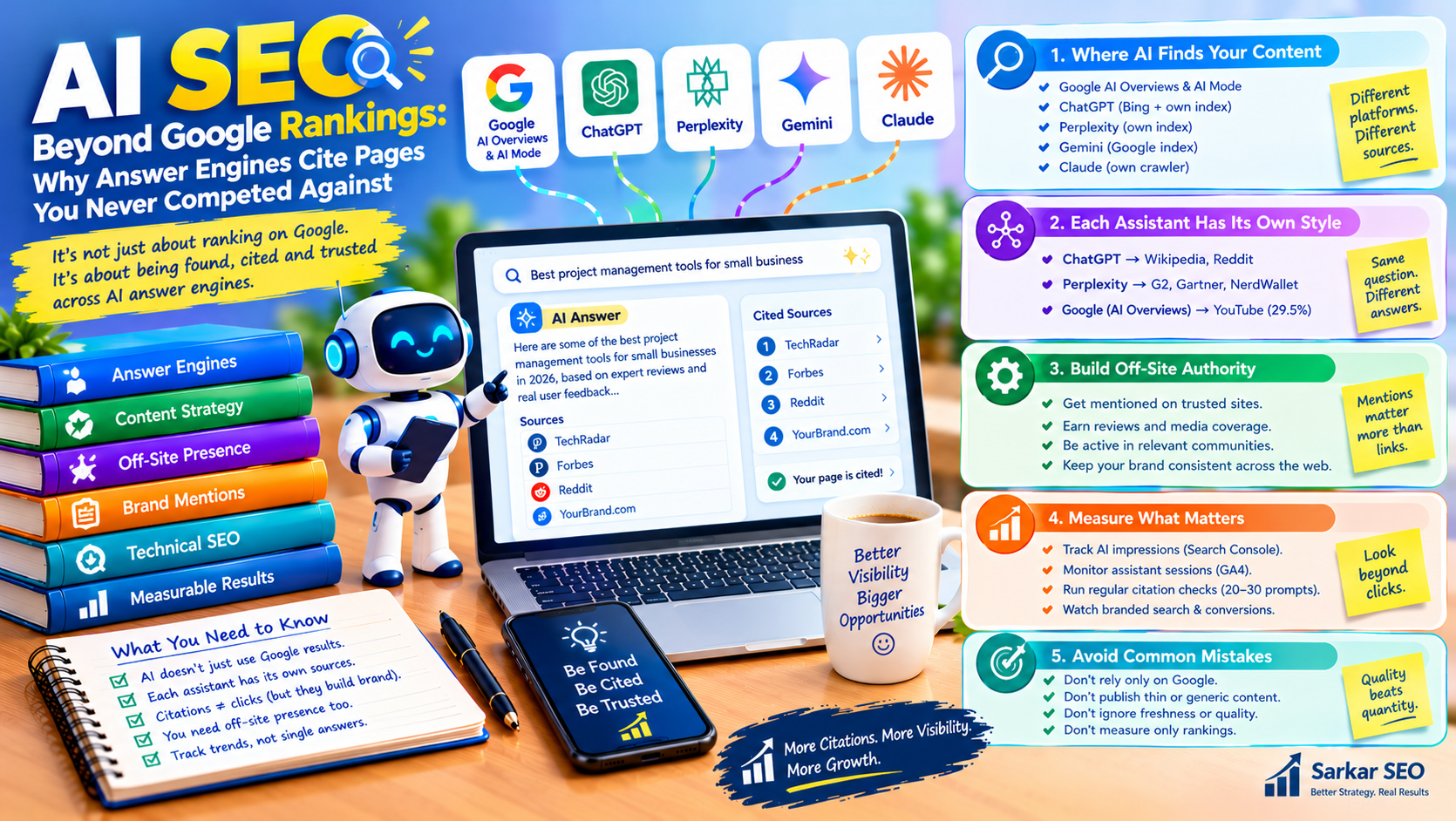
Most AI SEO advice rests on one comfortable assumption: if you rank well on Google, AI tools will cite you. Recent research suggests that assumption is weaker than it sounds. Answer engines run their own searches, build their own rankings and carry their own memories of which brands matter. Optimizing for them means understanding that process first.
The assumption that quietly breaks
Imagine you rank third on Google for a valuable question. A user asks ChatGPT the same thing. You expect a decent chance of a citation. The evidence says the connection is thin.
A University of Toronto study, available as a preprint on arXiv, tracked daily answers from ChatGPT, Gemini and Perplexity to commercial questions over 90 days. Its dataset covered 158,099 answers with 468,037 citations. Then the researchers replayed the questions through the engines’ APIs to see the retrieval step itself.
What the researchers found
Three findings matter most for anyone doing AI SEO.
First, every page ChatGPT cites is one its own search retrieved. A page cannot be cited unless it is found first.
Second, that search does not look like Google’s. The model rewrites the question into new sub-queries on every answer, and in the replay 97% of ChatGPT’s retrieved pages were absent from Google’s top 50 for the answer’s queries. Yet the websites of half of those pages did appear in Google’s top 50. Same domains, different pages. What Drives AI Citations? Content, Retrieval and Model Knowledge in Generative Engine Optimization (GEO) +2
Third, retrieval beat page quality as an explanation. Which pages the engine retrieved explained 32% of the variation in citations, against 2.8% for all page features.
Some honest caveats apply. This is a preprint, so it has not been through peer review. Its authors describe the results as associations, not proof of cause. The questions were English, US-focused and commercial, and the replay used API versions of the engines, which may not behave identically to the consumer apps. Treat the numbers as strong evidence about direction, not fixed laws.
Write for the sub-question, not the keyword
If the engine rewrites each question into several searches, your page needs to match those rewrites in meaning. The study’s one consistent content signal supports this. Comparing pages within the same website, those whose titles and paragraphs matched real questions were cited more: +15.5% per standard deviation for best-paragraph match and +14.1% for title match.
In practice, that means a page should contain at least one paragraph that answers a specific question completely, in plain terms, without needing the surrounding article for context. Titles should name the question or problem, not just the topic. A page titled “Email Deliverability Guide” is vaguer than one that says what makes emails land in spam and how to fix it.
The checklist problem
Here the research gets uncomfortable for conventional GEO advice. FAQ blocks, schema markup, summary boxes and author boxes all looked effective when comparing across websites. That was because popular sites use them more. Compare pages inside the same site and none of those markers showed a significant effect.
This does not mean structured data or clear authorship is worthless. They may help in ways this study could not measure, and they serve human readers and other search systems. It means they are not a shortcut. A page that is never retrieved gains nothing from a tidy FAQ.
Retrieved pages get cited, remembered brands get named
The study separates two routes to visibility. Pages are cited when searched, but brands can be named from the model’s memory. It found that 46% of ChatGPT’s mentions of a brand the question did not name were backed by no cited page that named it.
For well-known brands, that memory is an advantage that takes years to build. For smaller companies, the study points to a different lever: the model names a niche vendor mainly when a cited third-party page names it. In the small B2B market the researchers examined, a cited third-party page naming a vendor raised the odds of the answer naming it by about 40 times for ChatGPT.
This is why Sarkar SEO treats off-site presence as part of AI SEO, not an afterthought. Reviews, industry roundups, expert interviews and credible mentions give the engine evidence to find when your own pages are not enough.
Why a single snapshot misleads
Citations are not stable. The researchers found the set of cited pages drifts as engines regenerate searches and results shift. Two weeks later, only 40% of ChatGPT’s repeatable citation variation was still shared, and ten weeks later 14%. A screenshot showing you cited today says little about next month.
That changes how you should judge progress. Look at trends over weeks across a set of questions, not at one lucky answer.
A different kind of audit
Instead of asking whether a page is optimized, ask whether it deserves to be retrieved. A practical audit looks like this:
- List the real questions your customers ask, in their own words, including follow-ups.
- Find the single best paragraph on your site for each question. If none stands alone, rewrite it.
- Check the title against the question it should answer.
- Look outside your site. Where do credible third parties currently mention you for these topics? Where are the gaps?
- Compare results over time, not once.
Sarkar SEO builds audits around this sequence because it forces content decisions, not cosmetic ones. If a question has no strong answer on your site, no markup will fix that.
