



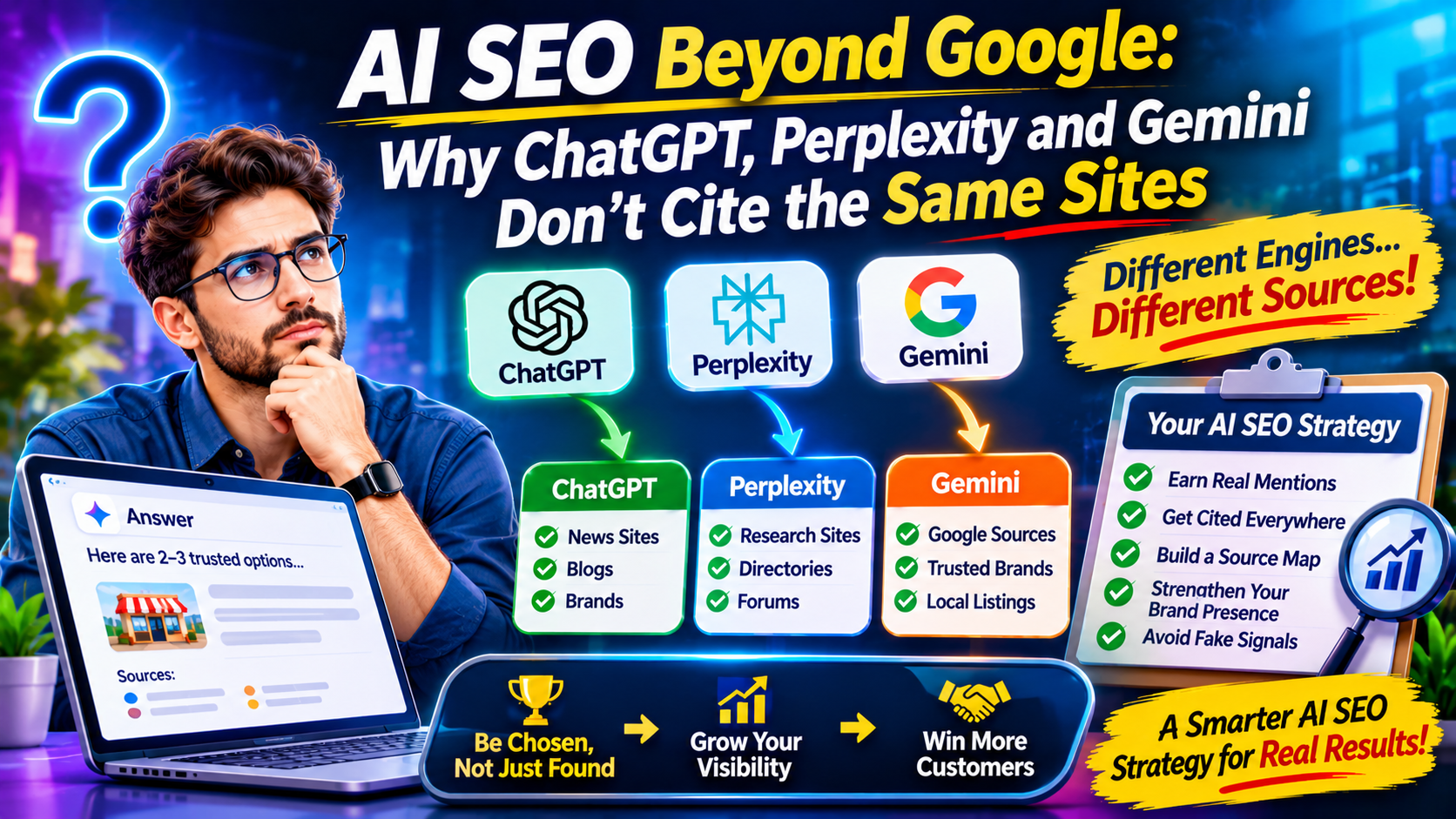
Many AI SEO guides talk about “AI search” as one thing. It is not. ChatGPT, Perplexity, Gemini and Google’s own AI features retrieve information in different ways and lean on different sources. A brand that shows up everywhere on one can be missing from another. This guide explains what the research says about those differences, how to read it critically, and how to build visibility that does not depend on any single engine’s quirks.
There Is No Single “AI Search”
Citation studies keep finding the same uncomfortable pattern: little overlap between platforms. Averi’s analysis of 680 million citations reported that only 11% of domains were cited by both ChatGPT and Perplexity, and an independent study of 118,000 responses found the same figure. Another analysis of 15,000 queries found that only 12% of cited sources matched across ChatGPT, Perplexity and Google AI. 73% of B2B Buyers Use AI Tools in Purchase Research, Multi-Source Analysis Finds +2
Behavior differs too. Studies disagree on exact counts, but they agree on direction: Perplexity cites sources far more densely than ChatGPT, which tends to mention brands often while linking sparingly. Treat any single number with caution, since these datasets use different prompts, industries and methods, and most come from companies that sell visibility-tracking products.
Mentions and Citations Are Different Prizes
A mention means an assistant names your brand in its answer. A citation means it links to or draws on your page. One practitioner summary puts it simply: mentions are about narrative authority, while citations are about being a URL the system chose to link or quote. You can win one without the other.
This matters for goals. If you sell services people research and then search for by name, being mentioned positively may be worth more than a link. If you publish reference material, citations bring visits. Decide which you are chasing before you measure anything.
Why Other People’s Pages Matter So Much
One tracking company’s analysis found that third-party sources made up about 83% of citations, with brands’ own websites cited far less often. That is a single vendor’s dataset in one set of industries, so do not read it as a universal law. But it fits a broader pattern: assistants lean on what the wider web says about you, not only on what you say about yourself.
Correlation research points the same way. Ahrefs’ study of 75,000 brands reported branded web mentions correlating with AI visibility at 0.664, versus 0.218 for backlinks, while warning that correlation is not causation. Brands that are talked about may simply be bigger brands. Still, the practical implication holds: reputation outside your site counts.
Sarkar SEO’s reading of this evidence is cautious. It supports investing in being genuinely worth talking about. It does not support buying mentions.
Earn Mentions Honestly
Google is direct on this point. Its guide says seeking inauthentic mentions across the web is less helpful than it might seem, because core ranking systems focus on high-quality content while other systems block spam. Authentic routes are slower but sturdier:
- Publish something others want to reference. Original data, a clear definition, a free calculator or a documented method gives writers a reason to name you.
- Share expertise where your audience already reads. Industry publications, podcasts and conference talks create mentions in context, from people who can verify you.
- Describe yourself consistently. Use the same name, one-sentence description and service list across your website, profiles and directories, so a system summarizing you meets no contradictions.
- Take part in communities honestly. Some analyses find community sites feature heavily in Perplexity answers; one index reports Reddit capturing roughly 20% to 24% of its answers. Answer questions helpfully, disclose any affiliation, and never astroturf. Fake accounts violate platform rules and can backfire. everything-pr
- Earn real reviews. Ask customers for honest feedback and respond professionally to criticism.
Build a Source Map
Rather than guessing which platform matters, observe it. Here is a simple method, offered as a practical suggestion rather than a tested formula.
- Write 15 to 20 prompts a buyer in your market would ask, covering comparisons, “best for” questions and problem descriptions.
- Run them in three or four assistants and record, for each, the brands named and the domains cited.
- Tally the domains. Which publications, directories, forums and review sites appear repeatedly for your category?
- Mark your gaps. Where do competitors appear and you do not? Which of those sources could you legitimately contribute to?
- Repeat monthly with the same prompts, and note changes in both sources and wording.
Expect volatility. One analysis found Claude and Copilot show the highest citation volatility, and answers shift with model updates. A trend across several months tells you far more than one run.
What Not to Do
Do not optimize for one engine’s current habits. A tactic tuned to a quirk can vanish with the next model update. Build assets that remain useful to any system: accurate, specific and corroborated.
Do not ignore Google. Google’s guide says its AI features are built on core Search systems, so classic SEO fundamentals still carry the largest audience.
Do not trust precision you cannot verify. Many statistics in this field come from vendors, use different definitions, and contradict each other. Use them to form hypotheses, then test against your own prompts.
Do not fabricate presence. Fake reviews, planted forum posts and purchased “mentions” create legal and reputational risk, and the systems are designed to discount them.
