



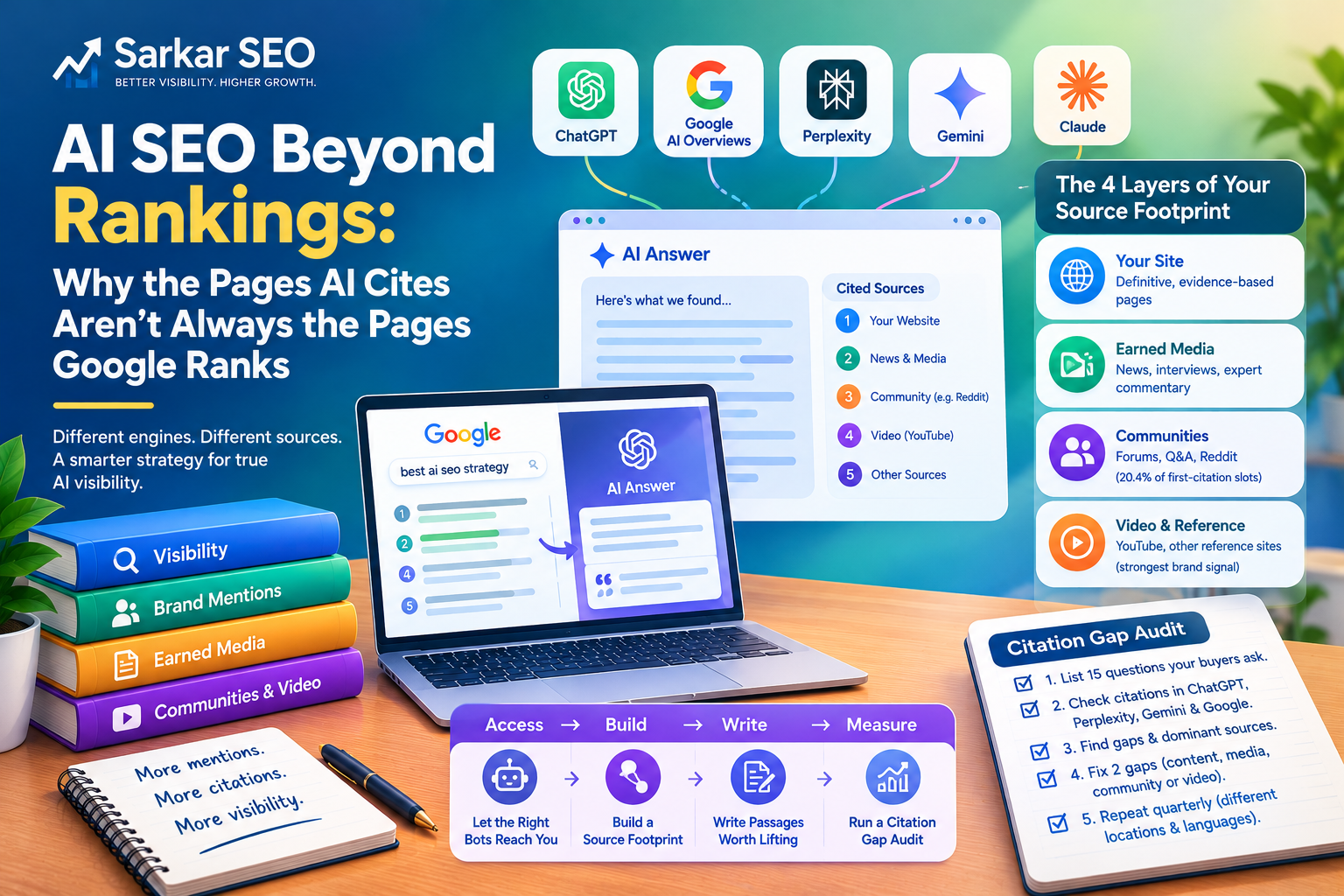
AI SEO was once sold as a simple extension of ranking: climb Google’s results and the AI answers will follow. The evidence now says it is messier. AI SEO is the practice of making your brand and content discoverable, understandable and quotable across several answer systems at once, each with its own way of choosing sources. This article tackles a question most guides skip. If the pages AI cites are not always the pages Google ranks, where should your effort go?
Rankings Still Help, but They No Longer Explain Most Citations
Ahrefs reported that the share of AI Overview citations coming from the organic top 10 fell from 76% in July 2025 to 37.9% by March 2026, based on 863,000 SERPs. Conductor’s analysis of roughly 168 million citations found that 57% of AI Overview citations went to pages outside the top 10. Both are vendor studies with different methods, so treat the exact figures as directional. threesevenmarketingconductor
The gap widens beyond Google. Ahrefs found that only 12% of links cited across 15,000 prompts in ChatGPT, Gemini, Copilot and Perplexity also appeared in Google’s top 10. A smaller benchmark of 320 buyer queries, reported through an agency’s press commentary, found Google’s AI Mode and Perplexity drawing most citations from the top 10 while ChatGPT drew far fewer. Hold that one loosely. The broader point holds, though: a rank tracker alone cannot show you your AI visibility.
Each Answer Engine Reads the Web Differently
Most engines split a question into sub-queries, retrieve candidate pages and then pick passages to cite. Selection is narrow. In an AirOps study, ChatGPT cited only 15% of the 548,534 pages it retrieved. Perplexity tends to cite more sources per answer, while ChatGPT cites fewer but leans on them more heavily. One 2026 analysis found only about 11% domain overlap between ChatGPT and Perplexity citations.
Source type matters too. Muck Rack’s May 2026 study of more than 25 million links cited by ChatGPT, Claude and Gemini found 84% were earned media, meaning coverage that brands neither own nor pay for. Your own blog is one channel among several, not the whole strategy.
Step One: Let the Right Bots Reach You
Visibility starts with access, and “AI crawler” is not one thing. Vendors run separate bots for training, retrieval and user-triggered fetches. OpenAI runs three: blocking GPTBot stops training use, while blocking OAI-SearchBot removes you from ChatGPT Search. A blanket “block AI” rule written years ago often catches the wrong bot. Whether to allow training access is a business decision. Retrieval access is what produces citations you can measure today.
Two further checks. A CDN or firewall setting that blocks AI bots can stop requests before robots.txt is ever consulted. And robots.txt is a policy signal rather than access control, so well-behaved crawlers honor it and others may not. Bot names change, so confirm each vendor’s current documentation before editing rules. Sarkar SEO begins AI SEO audits here, because no content upgrade matters if retrieval bots are turned away.
Step Two: Build a Source Footprint
Think of a source footprint as the set of places where an AI system can encounter credible information about you. Map four layers:
- Your site: definitive pages that state what you do, for whom and with what evidence.
- Earned media: industry publications, interviews and expert commentary that mention you by name.
- Communities: forums and Q&A spaces. A Seer Interactive study found Reddit captured 20.4% of first-citation slots in Google AI Overviews. threesevenmarketing
- Video and reference: In Ahrefs’ 75,000-brand study, YouTube mentions were the strongest correlating factor with AI Overview brand visibility.
The same Ahrefs study found brand mentions across the web correlated with AI Overview visibility at 0.664, roughly three times stronger than backlinks. That is correlation, not proof. Strong brands may simply attract both mentions and citations. It also does not license astroturfing. Contribute real expertise where your audience already asks questions, and let the mentions follow.
Sarkar SEO treats this layer as reputation work as much as page optimization, because a thin footprint limits what even excellent on-site content can achieve.
Step Three: Write Passages Worth Lifting
Engines cite passages, not pages, so each one should stand on its own. A secondary summary of Semrush and Indig research reports that sentences with clear definitions were cited nearly twice as often as vague framing, with citations clustering in the first 30% of content. These are second-hand findings, so treat them as hypotheses. They cost almost nothing to test: define the concept plainly, answer the question early and keep one idea per passage.
A Citation Gap Audit You Can Run This Week
- List 15 questions your buyers genuinely ask.
- Run each in ChatGPT, Perplexity, Gemini and Google. Record every cited source and classify it as own site, earned media, community, video or reference.
- Mark where you are absent and which source types dominate.
- Pick two gaps and fix them by source type. For example, publish an original data page, pitch an expert comment to a trade publication, or record a short explainer video.
- Repeat quarterly, in your target countries and languages, because answers vary by location, wording and time.
Single runs are noisy, so look for patterns across questions rather than reacting to one answer.
