



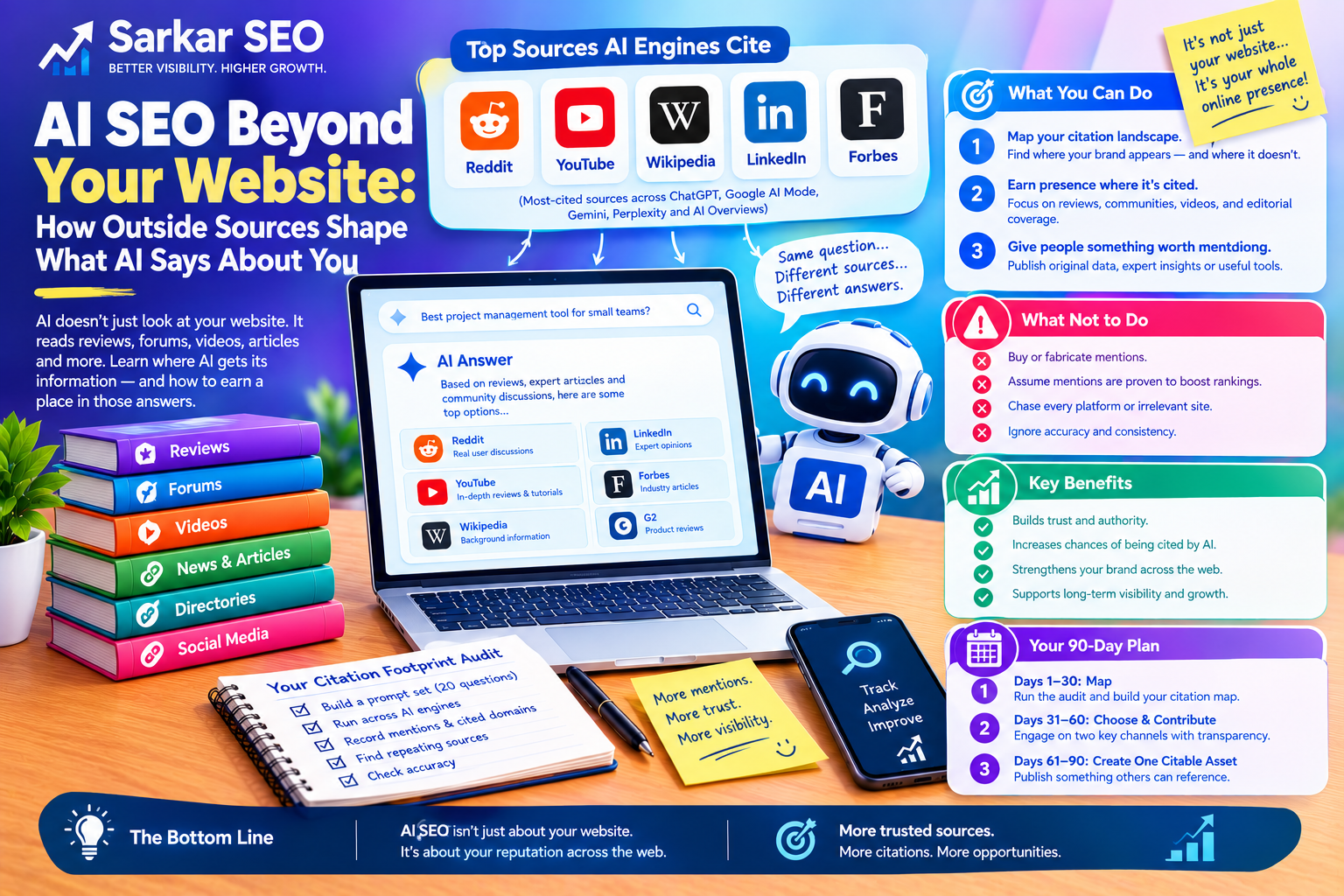
Most AI SEO advice stays inside your own domain: fix your pages, tidy your markup, publish better content. That matters, but it describes only half the picture. When ChatGPT, Perplexity, or Google’s AI features answer a question about your category, they often lean on places you don’t own. If you want to be named in those answers, you need to understand where the answers come from.
AI engines often cite the middlemen
A large citation analysis published by 5W concluded that AI engines cite intermediary sources, not brand websites, for the vast majority of queries. The same analysis points to Reddit, Wikipedia, YouTube, LinkedIn, and major publishers as gatekeepers. When a software brand is recommended, the engine may be drawing on G2 reviews, Reddit threads, and Capterra listings that mention it.
The mix differs by platform. In a Profound study of 30 million citations, Wikipedia was ChatGPT’s top source at 47.9%, Reddit led Google AI Overviews at 21%, and Reddit led Perplexity at 46.7%. Those figures cover August 2024 to June 2025, so treat them as a snapshot rather than a rule. seroundtable
Why you should distrust headline numbers
Citation research is useful but noisy, and three cautions matter before you build a strategy on it.
The data moves. ChatGPT’s Reddit citation share reportedly fell from roughly 60% to 10% in mid-September 2025 before stabilizing. One platform tweak can reroute enormous numbers of citations.
Studies disagree. Another index puts Reddit at 20 to 24% of Perplexity answers, well below the Profound figure. Methods, time frames, and prompt sets differ.
Averages hide your market. A Tinuiti analysis cautioned that citation patterns vary widely by platform, industry, and intent, and that Reddit’s growth in citations didn’t apply to every brand. Note that Tinuiti’s author disclosed a commercial role in AI SEO, as do several other sources here.
There is also no single dashboard to settle it. There is no Search Console equivalent for AI citations, and the same prompt can produce different citations across sessions. That makes your own sampling more valuable than anyone’s average.
What the signals suggest about brand strength
Several studies point toward a common theme: being known matters. 5W’s synthesis reports that brand search volume is the strongest known predictor of AI citation likelihood, with a 0.334 correlation that is stronger than backlinks. A separate roundup cites an Ahrefs study that found a 0.664 correlation between branded web mentions and AI Overview visibility. Another reports that domains with heavy brand mentions on Reddit averaged 7 ChatGPT citations versus 1.8 for domains with little Reddit presence. The State of AI Citations 2026 — 5W Research +2
These are correlations, not proof. Popular brands may simply attract more mentions and more citations for the same underlying reason: people already trust them. Still, the direction is sensible. A brand that is widely and accurately discussed gives an engine more to work with.
Also note that being cited and being mentioned are different. ChatGPT reportedly mentions brands about 3.2 times more often than it links to them. A mention without a link won’t show up in your analytics, which is why manual checking matters.
The Citation Footprint Audit: a five-step method
This is a simple routine you can run in an afternoon. At Sarkar SEO, we think of it as checking your reputation the way an answer engine would.
- Build a prompt set. Write 20 realistic questions a buyer would ask in your category, including comparisons (“X vs Y”) and recommendations (“best option for…”).
- Run them across engines. Test ChatGPT, Perplexity, Google AI Mode, and any others your audience uses. Log fresh sessions to reduce personalization.
- Record two things. First, whether your brand is named, linked, or absent. Second, which outside URLs the engine cites.
- Find the repeating sources. If the same three articles, directories, or forum threads appear again and again, those are your targets. Note which competitors appear there and you don’t.
- Check accuracy. Read how the engine describes you. Wrong pricing, outdated services, or a mixed-up identity are fixable problems, and usually trace back to inconsistent source material.
Repeat monthly and compare. Trends across several runs tell you far more than any single answer.
How to earn presence honestly
Once you know the gaps, the work is reputation building, not tricks.
- Publish something citable. A single original data study can earn mentions across ten or twenty independent publications. Even a small, well-run survey of your customers can qualify.
- Show up where buyers research. That means review platforms relevant to your industry, credible directories, and communities. Participate as a person who adds value, disclose your affiliation, and don’t astroturf. Communities punish promotion, and engines inherit that judgment.
- Pursue earned coverage. Contribute expert commentary to publications your audience reads, particularly the ones your audit shows being cited.
- Handle Wikipedia carefully. If your brand has an entry, its wording heavily shapes how ChatGPT describes you. Don’t edit it yourself. Wikipedia’s conflict-of-interest norms discourage that, so make sure independent, reliable coverage exists for editors to draw on.
- Back it with video where it fits. YouTube appears among top sources for Google’s AI features and Gemini. A clear explainer on your core topic can serve both viewers and engines.
Keep your own site as the source of truth
Outside sources shape the story, but your site anchors it. State your name, services, locations, pricing model, and credentials plainly on pages that are easy to find, and keep them identical everywhere else. Gemini and Google AI Overviews show citation patterns most correlated with traditional SEO, drawing heavily from sites that already rank well, so your fundamentals still pay off.
What to measure
Track share of mentions across your prompt set, the accuracy of descriptions, the number of high-value third-party pages that name you, and branded search trends. Treat traffic from AI platforms as a bonus, not the only scoreboard.
